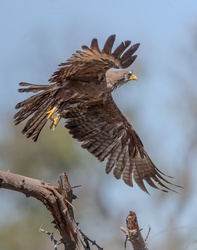
Yellow-billed Kite Identification Guide
A common African raptor with a bright yellow bill and a shallowly forked tail that it twists constantly for steering in flight.
Read the full Yellow-billed Kite encyclopedia entry →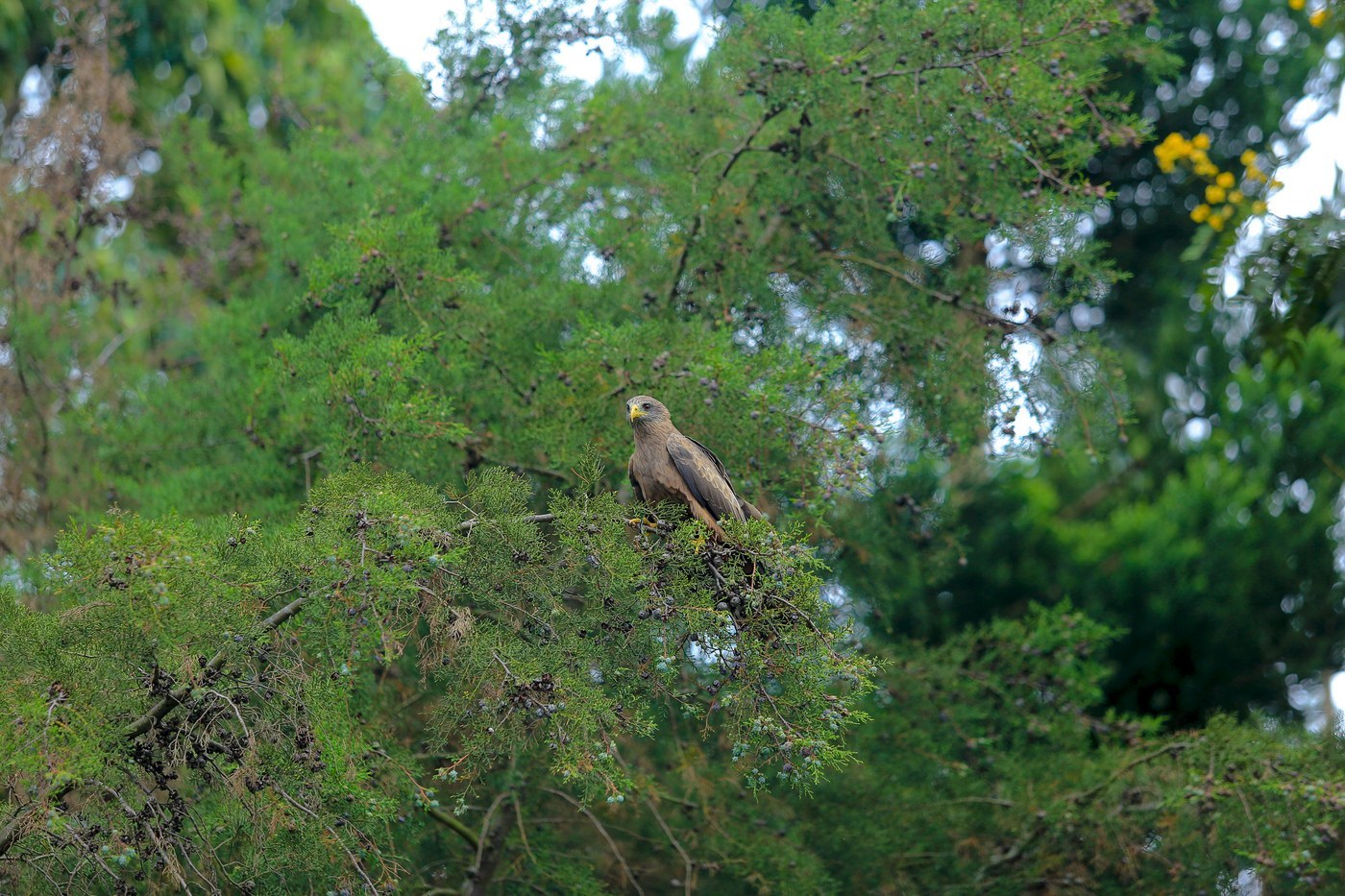
Key Field Marks
- Size & shape: A medium-large raptor with long, angled wings and a distinctly forked tail that is frequently twisted from side to side to steer in flight — one of the most useful silhouette clues for any kite.
- Plumage: Overall dark brown body with slightly paler, more mottled underwing coverts and dark flight feathers; no bold contrasting patches.
- Bill: Adults show a bright yellow bill (with a black tip in some views), which gives the species its name and is the key mark separating it from Black Kite.
- Legs: Yellow legs and feet.
- Behavior: An opportunistic scavenger and hunter, often seen soaring over towns, markets, rubbish dumps, and grass fires, and readily follows farm machinery or livestock to catch flushed prey.
Separating It From Similar Species
- Black Kite: Closely related (and formerly considered the same species); has a dark, blackish bill rather than yellow, and a grayer head. Note that juvenile and immature Yellow-billed Kites also have dark bills, so bill color alone is only reliable on adults; overall structure and forked, twisting tail apply to both forms.
- Steppe Buzzard and other buzzards: Broader wings, a shorter, more fanned (not forked) tail, and a more direct soaring flight without the constant tail-twisting of a kite.
Habitat, Range & Season
- Widespread and common across sub-Saharan Africa, from savanna and woodland to farmland, wetlands, and urban areas, often very tolerant of humans.
- Largely resident in tropical Africa, though some populations make seasonal movements tracking rainfall and prey availability; not present in temperate Eurasia, where the closely related Black Kite occurs instead.
- Can be seen year-round throughout its African range, often in loose groups at food sources such as swarming insects, fires, or refuse sites.
Voice
- Gives a shrill, whinnying, descending whistle, similar in quality to the call of Black Kite.
- Often fairly vocal when soaring in groups or squabbling over food.
Frequently asked questions
How do I tell Yellow-billed Kite from Black Kite?
Adult Yellow-billed Kite has a bright yellow bill, while Black Kite's bill is dark; note that young Yellow-billed Kites also have dark bills, so use range and overall structure as backup clues.
Why does the kite's tail look like it's twisting in flight?
Kites use their shallowly forked tail as a rudder, constantly twisting it to make fine adjustments while soaring and hunting — a helpful behavioral clue for identifying any kite species.
What does the Yellow-billed Kite eat?
It is an opportunistic feeder, taking insects, small mammals, reptiles, carrion, and scraps, and is a frequent scavenger around human settlements and grass fires.
Where does the Yellow-billed Kite live?
It is widespread across sub-Saharan Africa in a wide range of open and semi-open habitats, including towns and farmland.
Yellow-billed Kite identified by the community
Recent Yellow-billed Kite sightings identified with Bird Identifier.