
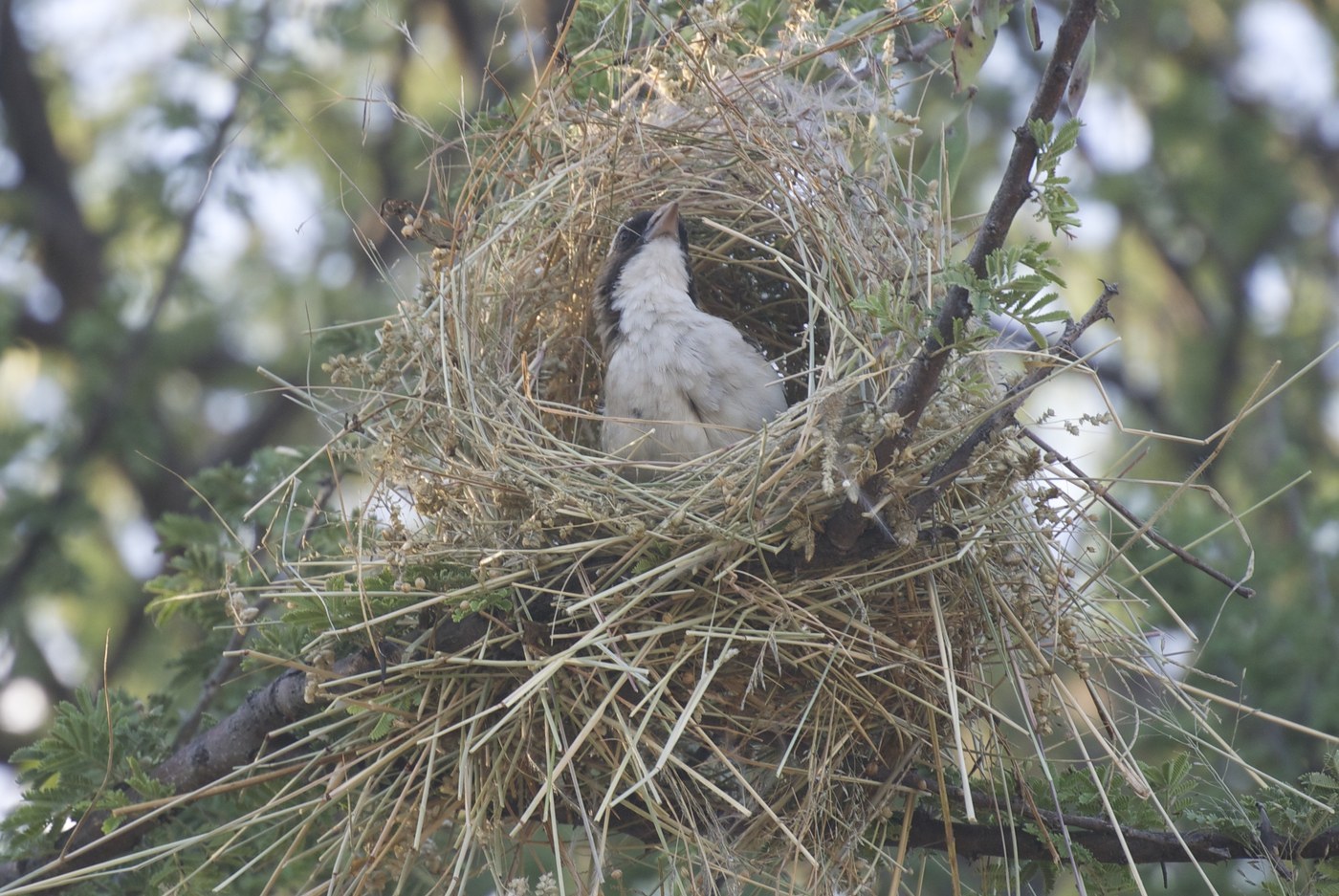
White-browed Sparrow-Weaver
Plocepasser mahali
A cooperatively breeding savanna bird known for its conspicuous white eyebrow and untidy grass nests built in acacia trees.
- Size
- About 17-18 cm long
- Habitat
- Dry savanna and thornveld with scattered trees
- Type
- songbird
Spotted a bird like this?
Identify any bird from a photo, free.
Overview
The White-browed Sparrow-Weaver is a common, gregarious bird of dry savanna in southern and eastern Africa. Unlike true weavers, it does not build tightly woven nests but instead constructs loose, untidy nests of grass stems, often in noticeable clusters in a single tree.
It has brown upperparts, a dark brown crown, and a broad white stripe over the eye that gives the species its name. The underparts are whitish, and the rump is white, showing clearly in flight. The bill is stout and pale to dark depending on season and subspecies.
These birds live in small, cooperative family groups that defend a territory centered on their cluster of nests year-round.
How to identify it
Key field marks
- Broad white supercilium (eyebrow stripe) contrasting with dark brown crown and eye-stripe
- Brown, streaked upperparts and whitish underparts
- White rump, conspicuous in flight
- Stout, conical bill
- Often seen in small groups near clustered nests
Similar species
- Other sparrow-weavers (Plocepasser species) look similar but have limited range overlap; check local range.
- True sparrows (Passer) lack the bold white eyebrow and white rump.
- Weaver species (Ploceus) usually show more yellow or olive tones and build enclosed, neatly woven nests rather than loose grass masses.
Habitat & range
Range
Widespread across southern and East Africa, including Namibia, Botswana, South Africa, Zimbabwe, Mozambique, Zambia, Tanzania, and Kenya.
Habitat
Inhabits dry savanna, thornveld, and acacia woodland with scattered large trees, which it needs for nest sites. Common in game reserves and rural farmland with suitable trees.
Movements
Sedentary and strongly territorial; family groups remain on the same territory throughout the year.
Behavior & voice
Behavior
Lives in cooperative groups of a few to a dozen or more birds that jointly defend a territory around a tree containing multiple nests. Groups include a dominant breeding pair plus helpers, often previous offspring, that assist with nest building and territory defense.
Voice
Noisy and vocal, giving a variety of chattering, chirping, and harsh alarm calls, often in duet or chorus among group members at dawn.
Feeding
Forages mostly on the ground, hopping in search of seeds and insects, and will also glean insects from foliage and bark.
Nesting and breeding
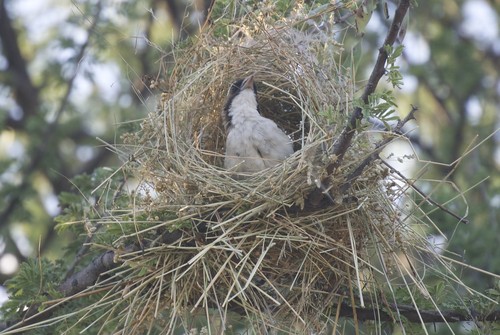
Builds several loosely woven, untidy nests of grass with entrances at each end, clustered together in one tree; only some nests are used for actual breeding while others serve as roosts. Cooperative breeding is common, with helpers assisting the dominant pair in raising young.
Frequently asked questions
How do you identify a White-browed Sparrow-Weaver?
Look for a sparrow-sized bird with a bold white eyebrow stripe, brown streaked upperparts, whitish underparts, and a white rump visible in flight.
Where do White-browed Sparrow-Weavers live?
They live in dry savanna and thornveld across southern and East Africa, wherever scattered large trees provide nest sites.
Why do they build so many nests in one tree?
Groups build several nests in a single tree for roosting and breeding; not every nest is used for raising young, and the cluster helps the group defend its territory.
Do White-browed Sparrow-Weavers breed cooperatively?
Yes, they live in family groups with a dominant pair and helpers, often offspring from previous broods, that assist with nest building and defense.
What do White-browed Sparrow-Weavers eat?
They feed mainly on seeds and insects, foraging primarily on the ground.
White-browed Sparrow-Weaver guides
In-depth guides for identifying, finding, and understanding White-browed Sparrow-Weaver.
Other birds you may enjoy

Black Redstart
13-14.5 cm (5.1-5.7 in) long, 23-26 cm wingspan

Black-throated Sparrow
12-14 cm (4.7-5.5 in) long, about 19-20 cm (7.5-8 in) wingspan

Greater Bird-of-paradise
Body about 43 cm; males with additional flank plumes up to 50 cm and long tail wires

Blue Tit
11-12 cm (4.3-4.7 in) long, 17-20 cm wingspan

Red-billed Quelea
11.5–13 cm long, wingspan about 20–22 cm
White-plumed Antbird
13-14 cm (5-5.5 in) long

Pyrrhuloxia
19-22 cm (7.5-8.7 in) long, 30 cm wingspan

Blue-gray Tanager
16-18 cm (6-7 in) long

Blackburnian Warbler
11-13 cm (4.3-5.1 in) long, 20-22 cm wingspan

Bluethroat
13-14 cm (5.1-5.5 in) long, 20-22 cm wingspan

Eurasian Nuthatch
12-14.5 cm (4.7-5.7 in) long, 22.5-27 cm wingspan

Wood Thrush
19-21 cm (7.5-8.3 in) long, about 33 cm (13 in) wingspan