
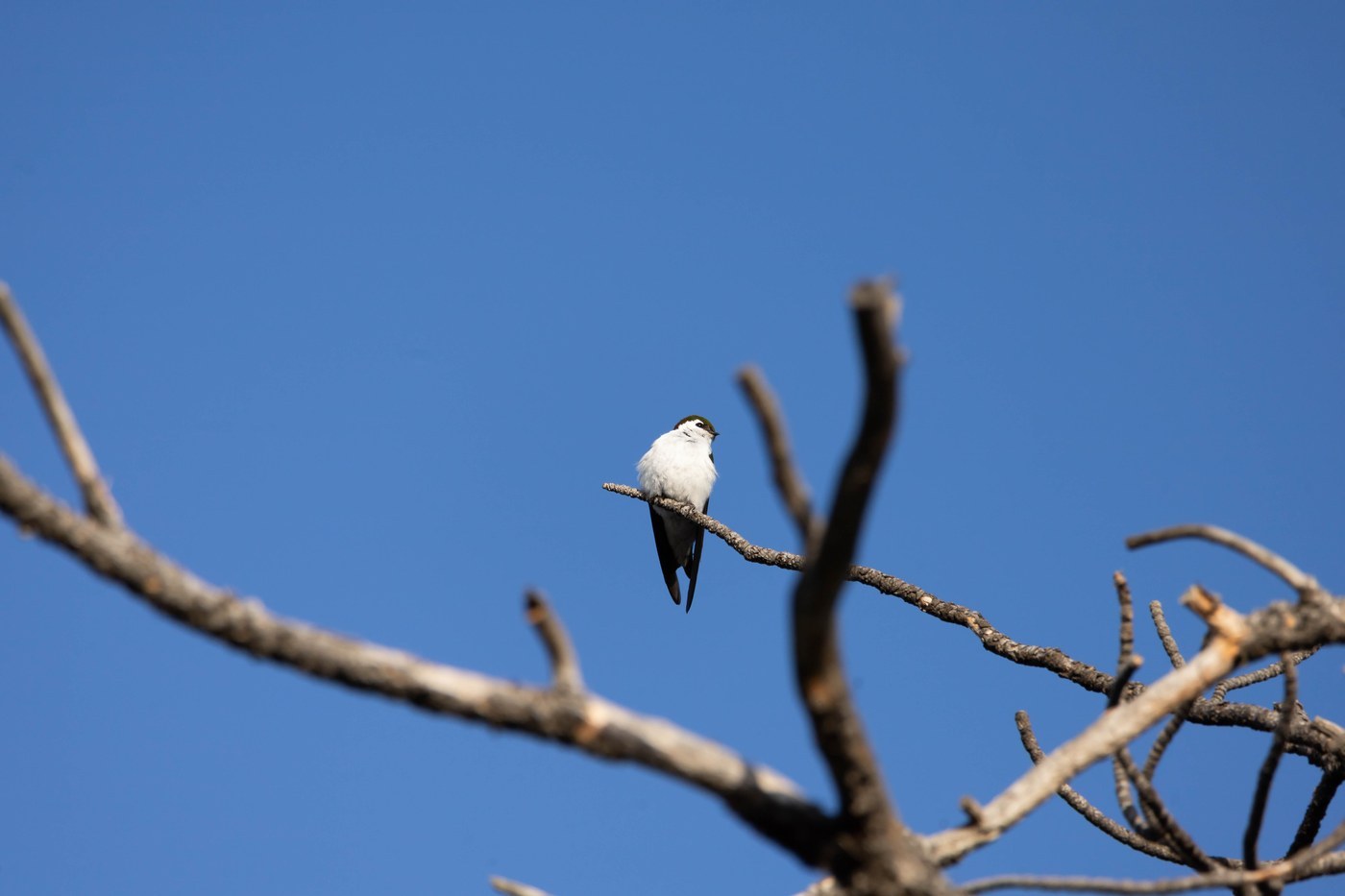
Violet-green Swallow
Tachycineta thalassina
A shimmering western swallow with an iridescent green back, violet rump, and white patches that nearly wrap around the face and flanks.
- Size
- 12-14 cm (5 in) long, 27-31 cm wingspan
- Habitat
- open woodlands, canyons, and cliffs of western North America
- Type
- songbird
Spotted a bird like this?
Identify any bird from a photo, free.
Overview
The Violet-green Swallow is a dazzling aerial insectivore of the American West, glinting emerald-green and violet-purple in good light. The crown and back shine iridescent green, while the rump and uppertail coverts show a rich violet-purple sheen. White extends from the underparts up onto the face (forming a white patch above and around the eye) and onto the sides of the rump, nearly meeting over the back in flight—a key difference from the similar Tree Swallow.
This fast, agile flier is a cavity nester, using tree holes, cliff crevices, and nest boxes across open woodlands, canyons, and mountain habitats.
How to identify it
Key field marks
- Iridescent green crown/back, violet-purple rump
- White face patch extending above and around the eye
- White flank patches that nearly wrap around the rump, visible in flight
Similar species
- Tree Swallow: solid dark (blue-green to blue-black) above with no white on the face or rump, white underparts stop cleanly at the throat.
- White-throated Swift: unrelated but superficially similar in flight; has a forked tail and black-and-white pattern rather than iridescent colors.
Habitat & range
Range and habitat
Violet-green Swallow breeds across western North America, from Alaska south through the western US into the Mexican highlands, in open woodlands, canyons, cliffs, and increasingly in towns and suburbs where nest boxes are provided.
Migration
Migratory; winters from Mexico south to Central America, arriving on breeding grounds relatively early in spring.
Behavior & voice
Behavior
Highly aerial, foraging in fast, agile flight often at considerable heights, sometimes in mixed flocks with other swallow and swift species.
Voice
Soft, high twittering chips given both in flight and around the nest site.
Feeding
Exclusively flying insects, caught on the wing during sustained aerial foraging bouts, often high above the ground.
Nesting and breeding
A cavity nester, using natural tree holes, old woodpecker cavities, cliff crevices, and nest boxes; often nests in loose colonies. The female incubates 4-6 eggs for roughly 2 weeks.
Frequently asked questions
How do you tell a Violet-green Swallow from a Tree Swallow?
Violet-green Swallow shows white on the face (above and around the eye) and white flank patches that nearly wrap around the rump, while Tree Swallow is solid dark above with no white on the face or rump.
Where does the Violet-green Swallow live?
Across western North America, in open woodlands, canyons, cliffs, and towns, from Alaska south into the Mexican highlands.
What does a Violet-green Swallow eat?
Exclusively flying insects caught in mid-air.
Where does the Violet-green Swallow nest?
In cavities—natural tree holes, old woodpecker holes, cliff crevices, and nest boxes—often in loose colonies.
Violet-green Swallow guides
In-depth guides for identifying, finding, and understanding Violet-green Swallow.
Other birds you may enjoy

Black Redstart
13-14.5 cm (5.1-5.7 in) long, 23-26 cm wingspan

Black-throated Sparrow
12-14 cm (4.7-5.5 in) long, about 19-20 cm (7.5-8 in) wingspan

Greater Bird-of-paradise
Body about 43 cm; males with additional flank plumes up to 50 cm and long tail wires

Blue Tit
11-12 cm (4.3-4.7 in) long, 17-20 cm wingspan

Red-billed Quelea
11.5–13 cm long, wingspan about 20–22 cm
White-plumed Antbird
13-14 cm (5-5.5 in) long

Pyrrhuloxia
19-22 cm (7.5-8.7 in) long, 30 cm wingspan

Blue-gray Tanager
16-18 cm (6-7 in) long

Blackburnian Warbler
11-13 cm (4.3-5.1 in) long, 20-22 cm wingspan

Bluethroat
13-14 cm (5.1-5.5 in) long, 20-22 cm wingspan

Eurasian Nuthatch
12-14.5 cm (4.7-5.7 in) long, 22.5-27 cm wingspan

Wood Thrush
19-21 cm (7.5-8.3 in) long, about 33 cm (13 in) wingspan