
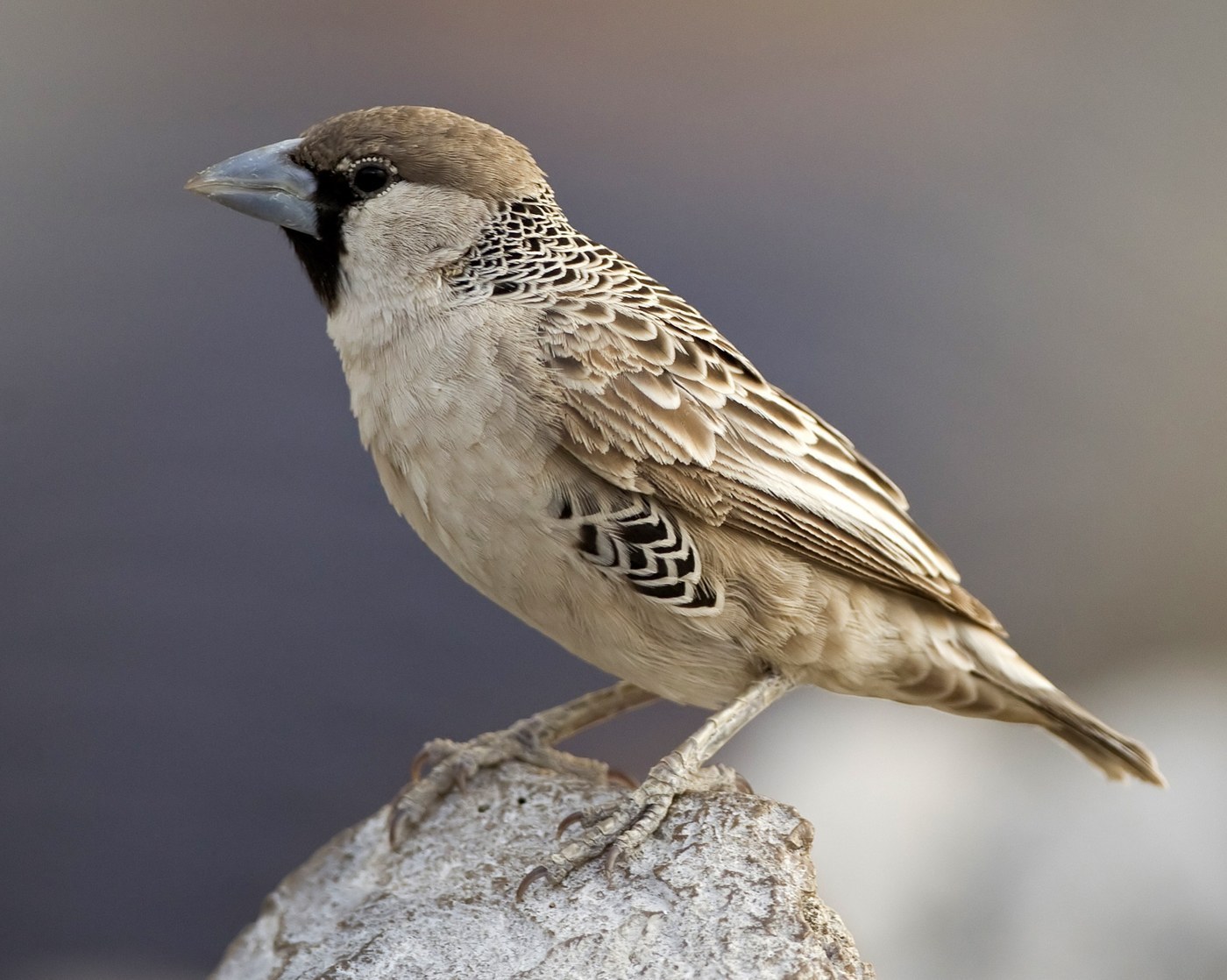
Sociable Weaver
Philetairus socius
A small Kalahari finch-weaver famous for building the largest communal stick nests of any bird, sometimes housing hundreds of pairs.
- Size
- About 14 cm long
- Habitat
- Arid savanna and semi-desert of the Kalahari region
- Type
- songbird
Spotted a bird like this?
Identify any bird from a photo, free.
Overview
The Sociable Weaver is a small, plainly colored bird of the arid Kalahari region of southern Africa, renowned not for its appearance but for its extraordinary nesting behavior. Colonies construct enormous, permanent communal nest structures out of dry grass and twigs, built around a tree branch or utility pole, that can weigh over a tonne and house up to several hundred individual nest chambers.
The bird itself is modest: pale grey-brown above with a black chin and throat patch, a scaly black-and-buff pattern on the back, and buffy-white underparts. Both sexes look alike.
These nest structures are among the largest built by any bird species and can persist and grow for many decades, being used by generations of Sociable Weavers as well as by other bird species and even small mammals.
How to identify it
Key field marks
- Small, sparrow-like bird with a black bib on the chin and upper throat
- Scaly black-and-buff pattern on the back and wing coverts
- Pale grey-brown crown and buffy-white underparts
- Short, dark, conical bill
- Almost always found near or associated with the giant communal nest structure
Similar species
- The huge communal nest itself is essentially diagnostic and not built by any other African bird.
- Sparrow-weavers and true sparrows lack the neat scaly back pattern and are not found nesting in such massive shared structures.
- Female and male Sociable Weavers look alike, unlike many other weaver species with strong breeding plumage differences.
Habitat & range
Range
Endemic to the arid interior of southern Africa, chiefly Namibia, Botswana, and the Northern Cape and North West provinces of South Africa, centered on the Kalahari Basin.
Habitat
Occupies dry savanna, semi-desert scrubland, and thornveld, generally requiring a large tree (such as a camel thorn acacia) or artificial structure like a utility pole to support its massive communal nest.
Movements
Non-migratory and highly sedentary; colonies remain attached to the same nest structure, sometimes for decades, with birds rarely moving far from it.
Behavior & voice
Behavior
Extremely social, living year-round in colonies that can range from a handful to several hundred pairs sharing one giant nest mass. Colony members cooperate in nest construction and maintenance, and the thick thatched roof of the structure provides insulation against the extreme desert temperatures.
Voice
Gives soft chirping and chattering calls, typically less loud than other weaver species, often heard as a constant low chatter around the colony.
Feeding
Forages mainly on the ground in flocks, taking seeds and insects; also feeds on flying insects when available.
Nesting and breeding
Builds a shared, permanent haystack-like structure of dry grass stems, with each pair or individual maintaining its own separate nest chamber and entrance tunnel within the mass. The structure is continuously repaired and expanded over generations, growing larger each year and providing stable, temperature-buffered breeding chambers used across multiple breeding seasons.
Frequently asked questions
How do you identify a Sociable Weaver?
Look for a small grey-brown bird with a black chin patch and a neatly scaled black-and-buff back, almost always seen around its distinctive giant communal grass nest.
Where do Sociable Weavers live?
They are found only in the arid Kalahari region of southern Africa, in Namibia, Botswana, and parts of South Africa.
Why are Sociable Weaver nests so famous?
Colonies build the largest communal nest structures of any bird, a haystack-like mass of grass and twigs that can house hundreds of nest chambers and weigh over a tonne.
How long do Sociable Weaver nests last?
The communal structures are permanent and can be used and expanded by successive generations of birds for many decades.
Do other animals use Sociable Weaver nests?
Yes, the large structures are also used by other bird species, such as pygmy falcons and lovebirds, as well as by small mammals and reptiles seeking shelter.
Sociable Weaver guides
In-depth guides for identifying, finding, and understanding Sociable Weaver.
Other birds you may enjoy

Black Redstart
13-14.5 cm (5.1-5.7 in) long, 23-26 cm wingspan

Black-throated Sparrow
12-14 cm (4.7-5.5 in) long, about 19-20 cm (7.5-8 in) wingspan

Greater Bird-of-paradise
Body about 43 cm; males with additional flank plumes up to 50 cm and long tail wires

Blue Tit
11-12 cm (4.3-4.7 in) long, 17-20 cm wingspan

Red-billed Quelea
11.5–13 cm long, wingspan about 20–22 cm
White-plumed Antbird
13-14 cm (5-5.5 in) long

Pyrrhuloxia
19-22 cm (7.5-8.7 in) long, 30 cm wingspan

Blue-gray Tanager
16-18 cm (6-7 in) long

Blackburnian Warbler
11-13 cm (4.3-5.1 in) long, 20-22 cm wingspan

Bluethroat
13-14 cm (5.1-5.5 in) long, 20-22 cm wingspan

Eurasian Nuthatch
12-14.5 cm (4.7-5.7 in) long, 22.5-27 cm wingspan

Wood Thrush
19-21 cm (7.5-8.3 in) long, about 33 cm (13 in) wingspan