
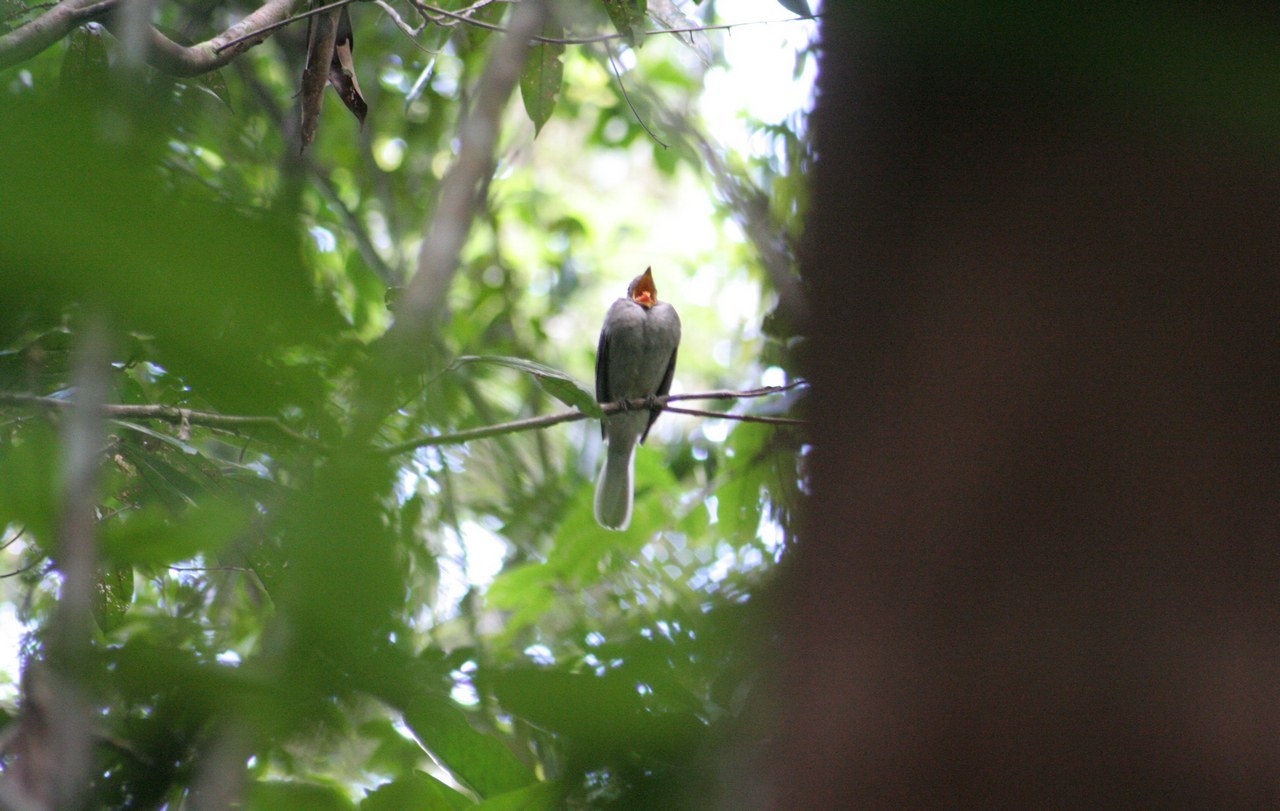
Screaming Piha
Lipaugus vociferans
A plain gray Amazonian cotinga famous for one of the loudest, most far-carrying calls in the rainforest despite its unremarkable appearance.
- Size
- 24-25 cm (9.5-10 in) long
- Habitat
- understory and mid-story of humid Amazonian lowland forest
- Type
- songbird
Spotted a bird like this?
Identify any bird from a photo, free.
Overview
The Screaming Piha is, visually, an entirely unremarkable bird: a medium-sized, uniformly gray cotinga with no bold markings, patterns, or bright colors to distinguish it. What it lacks in appearance, however, it makes up for dramatically in voice, producing one of the loudest and most iconic sounds of the Amazon rainforest, a piercing, far-carrying call so frequently used as ambient jungle sound in films and television that it has become one of the most recognizable bird sounds in the world, even to people who have never set foot in South America.
Despite the volume of its call, the bird itself is notoriously difficult to spot, typically remaining still and well hidden in the mid-story or understory foliage while calling, so that observers often hear it dozens of times before ever laying eyes on the caller.
How to identify it
Key field marks
- Plain, uniform gray plumage overall, slightly paler below
- No bold facial pattern, wing bars, or other distinguishing marks
- Fairly large, stocky cotinga shape with a shortish tail
- Best identified by its extremely loud, distinctive call rather than by sight
Similar species
- Several other pihas exist in South America (e.g., Rufous Piha, Gray-tailed Piha) but the Screaming Piha's call is highly distinctive and diagnostic; visually similar gray cotingas and flycatchers can be told apart mainly by voice and range.
Habitat & range
Habitat
Inhabits the understory and mid-story of humid lowland forest, generally staying within the shaded interior rather than at open edges.
Range
Widespread across the Amazon basin, including Brazil, Peru, Ecuador, Colombia, Venezuela, and the Guianas.
Migration
Resident and non-migratory throughout its range.
Behavior & voice
Behavior
Typically solitary and inconspicuous visually, remaining still on a mid-story perch while delivering its loud call repeatedly, often for extended periods; can be extremely difficult to locate visually despite the volume of sound.
Voice
An extremely loud, sharp, far-carrying call often rendered as "WEE-o" or "pee-YOO," among the most recognizable and frequently used ambient sounds of the Amazon rainforest in film and audio recordings.
Feeding
Feeds on fruit and insects, foraging by making short sallies from a perch in the understory or mid-story.
Nesting
Builds a simple, flimsy platform nest of twigs; the female alone incubates and raises the single chick, as in other cotingas with polygynous or lek-like mating systems.
Frequently asked questions
Why is the Screaming Piha so famous?
Its extremely loud, piercing call is one of the most recognizable sounds of the Amazon rainforest and has been used extensively as background jungle sound in films, television, and other media.
What does a Screaming Piha look like?
It is a plain, uniformly gray bird with no bold markings, making it visually unremarkable compared to its dramatic voice.
Is the Screaming Piha hard to see?
Yes, despite calling loudly and frequently, it typically perches motionless in dense mid-story foliage, making it notoriously difficult to spot even when calling nearby.
What does a Screaming Piha eat?
Mainly fruit and insects, foraged with short sallies from a perch in the forest understory or mid-story.
Screaming Piha guides
In-depth guides for identifying, finding, and understanding Screaming Piha.
Other birds you may enjoy

Black Redstart
13-14.5 cm (5.1-5.7 in) long, 23-26 cm wingspan

Black-throated Sparrow
12-14 cm (4.7-5.5 in) long, about 19-20 cm (7.5-8 in) wingspan

Greater Bird-of-paradise
Body about 43 cm; males with additional flank plumes up to 50 cm and long tail wires

Blue Tit
11-12 cm (4.3-4.7 in) long, 17-20 cm wingspan

Red-billed Quelea
11.5–13 cm long, wingspan about 20–22 cm
White-plumed Antbird
13-14 cm (5-5.5 in) long

Pyrrhuloxia
19-22 cm (7.5-8.7 in) long, 30 cm wingspan

Blue-gray Tanager
16-18 cm (6-7 in) long

Blackburnian Warbler
11-13 cm (4.3-5.1 in) long, 20-22 cm wingspan

Bluethroat
13-14 cm (5.1-5.5 in) long, 20-22 cm wingspan

Eurasian Nuthatch
12-14.5 cm (4.7-5.7 in) long, 22.5-27 cm wingspan

Wood Thrush
19-21 cm (7.5-8.3 in) long, about 33 cm (13 in) wingspan