
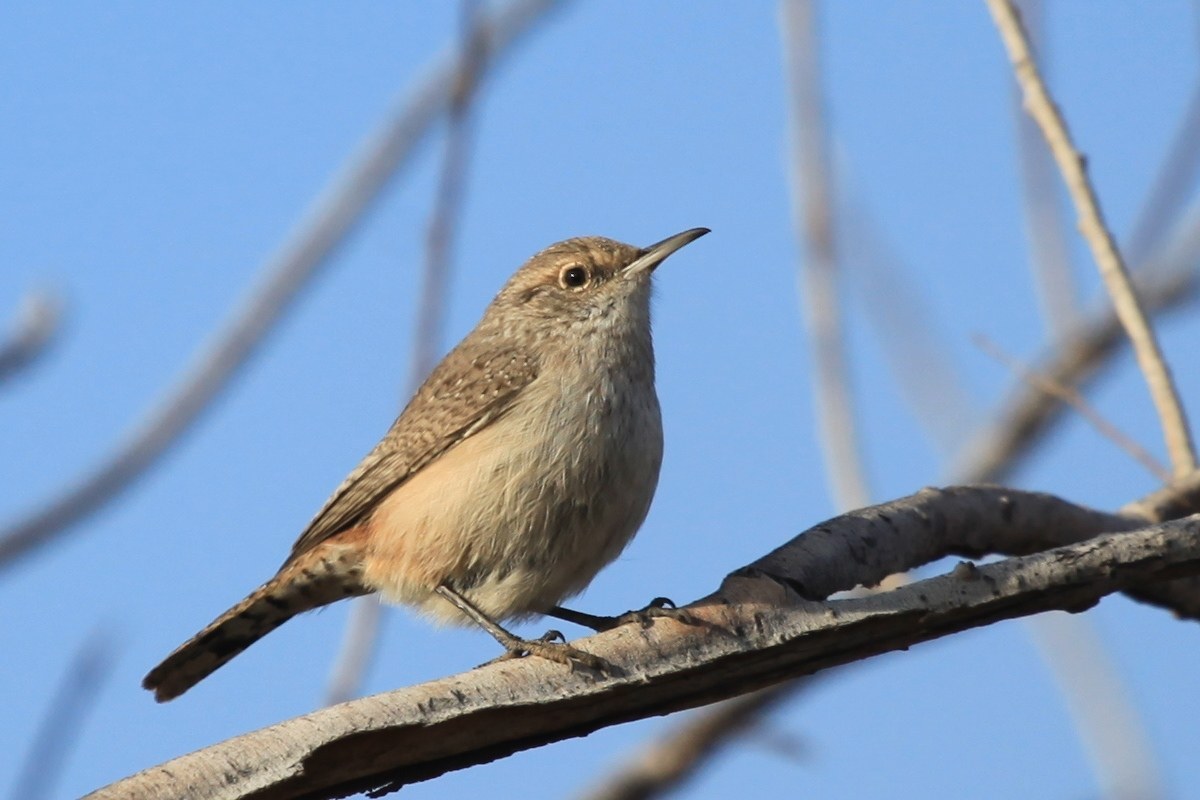
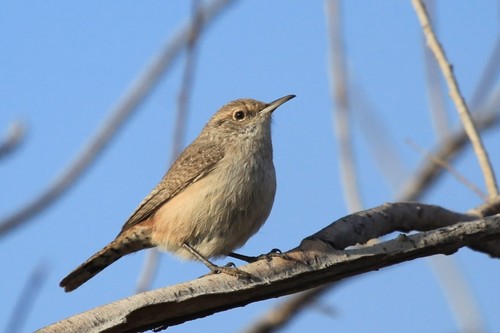
Rock Wren
Salpinctes obsoletus
A pale, grayish-brown wren of arid rocky landscapes, known for bobbing on boulders and building pebble-paved nest paths.
- Size
- 13-15 cm (5-6 in) long, 21-24 cm wingspan
- Habitat
- arid rocky slopes, canyons, talus fields, and boulder-strewn terrain in open country
- Type
- songbird
Spotted a bird like this?
Identify any bird from a photo, free.
Overview
The Rock Wren is a plain, pale grayish-brown bird perfectly suited to the barren, rocky terrain it calls home. Its upperparts are finely speckled gray-brown, its underparts buffy white with faint streaking on the breast, and it shows a buffy wash on the flanks and a cinnamon-tinged rump and tail tip visible in flight.
Rather than blending into vegetation, this wren blends into stone, spending its life clambering over boulders, cliffs, and talus slopes in some of the driest, most rugged habitats in North America. It is well known among naturalists for a peculiar nesting habit: it often paves a walkway of small stones leading to its nest entrance.
How to identify it
Key Field Marks
- Pale grayish-brown upperparts with fine speckling
- Buffy-white underparts with light streaking on the breast
- Cinnamon-buff rump and tail corners, visible in flight and when the tail is spread
- Long, thin, slightly downcurved bill
- Habit of bobbing its body up and down while perched on rocks
Similar Species
Canyon Wren shares similar rocky habitat but has a bright white throat and breast contrasting sharply with rich rufous underparts, plus a longer, more strongly curved bill and a very different cascading, whistled song. Bewick's Wren is browner overall with a bold white eyebrow stripe and longer tail, and typically favors brushy habitat rather than bare rock.
Habitat & range
Habitat
Rock Wrens inhabit arid and semi-arid rocky environments: canyon walls, talus slopes, rockslides, cliffs, and boulder fields in deserts, badlands, and mountain foothills, generally with sparse vegetation.
Range
This species breeds across the western United States, from the Great Basin and Rocky Mountains south through the desert Southwest and into Mexico, with some populations extending onto the Great Plains where suitable rocky outcrops occur.
Migration
Rock Wrens in the northern and higher-elevation parts of the range migrate south or downslope for winter, while populations in the milder southwestern deserts are largely resident year-round.
Behavior & voice
Behavior
Rock Wrens are active and conspicuous for a wren, hopping and darting between boulders and frequently bobbing their whole body up and down, a habit that helps identify them at a distance.
Voice
The song is a loud, varied series of trills and buzzy phrases, often with each phrase repeated several times before switching to the next, echoing distinctively off canyon walls. The call is a sharp, buzzy 'tick-ear.'
Feeding
It forages by probing crevices between rocks and under stones for insects and spiders, hopping rapidly over uneven, rocky terrain.
Nesting & Breeding
Rock Wrens nest in rock crevices, cavities, or burrows, and are famous for constructing a paved pathway of small flat stones or pebbles leading to the nest entrance. The female lays 4-6 eggs in a cup nest of grass and fibers tucked into the rocky cavity.
Frequently asked questions
Why does the Rock Wren build a path of stones to its nest?
It paves the entrance to its rock-crevice nest with small pebbles and flat stones, a unique behavior among North American birds whose exact purpose is not fully understood but may help mark or protect the entrance.
How do you identify a Rock Wren?
Look for a pale, finely speckled grayish-brown bird bobbing on rocks in arid, rugged terrain, with buffy underparts and a cinnamon-tinged tail visible in flight.
What is the difference between a Rock Wren and a Canyon Wren?
Canyon Wren has a bright white throat and rich rufous belly with a longer curved bill, while Rock Wren is more uniformly pale gray-brown with light streaking and a shorter bill.
What habitat does the Rock Wren prefer?
It lives on arid rocky slopes, canyons, cliffs, and talus fields with little vegetation, across the dry western United States.
What does a Rock Wren eat?
It eats insects and spiders found by probing crevices in rocks and talus.
Rock Wren guides
In-depth guides for identifying, finding, and understanding Rock Wren.
Other birds you may enjoy
Black Redstart
13-14.5 cm (5.1-5.7 in) long, 23-26 cm wingspan
Black-throated Sparrow
12-14 cm (4.7-5.5 in) long, about 19-20 cm (7.5-8 in) wingspan
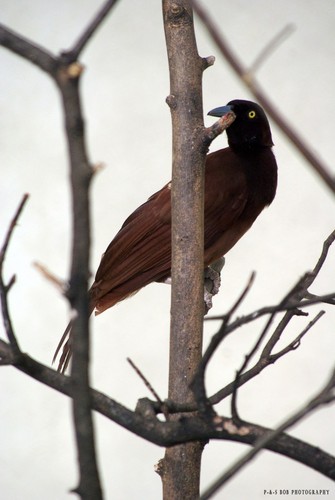
Greater Bird-of-paradise
Body about 43 cm; males with additional flank plumes up to 50 cm and long tail wires
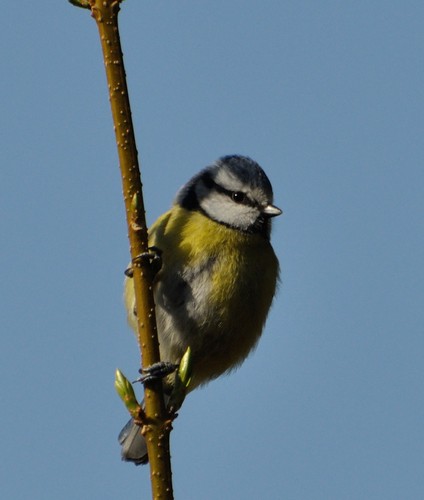
Blue Tit
11-12 cm (4.3-4.7 in) long, 17-20 cm wingspan
Red-billed Quelea
11.5–13 cm long, wingspan about 20–22 cm
White-plumed Antbird
13-14 cm (5-5.5 in) long
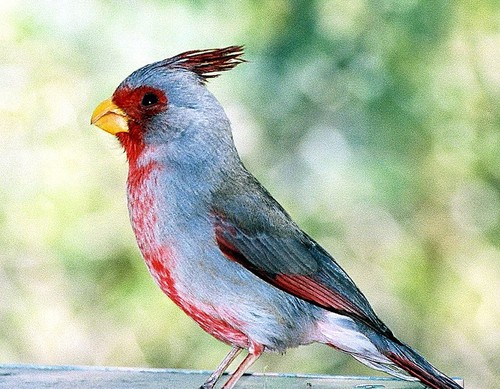
Pyrrhuloxia
19-22 cm (7.5-8.7 in) long, 30 cm wingspan
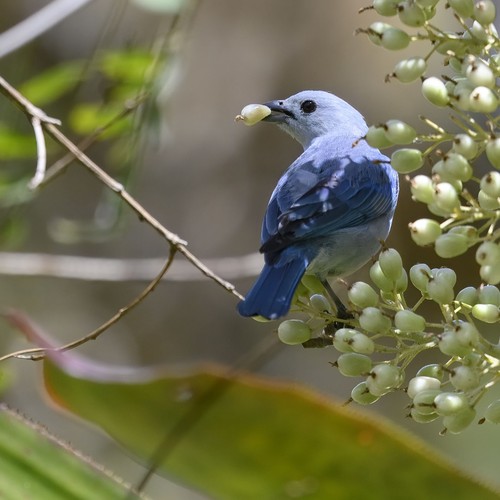
Blue-gray Tanager
16-18 cm (6-7 in) long

Blackburnian Warbler
11-13 cm (4.3-5.1 in) long, 20-22 cm wingspan
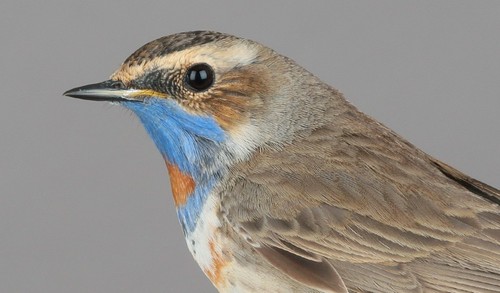
Bluethroat
13-14 cm (5.1-5.5 in) long, 20-22 cm wingspan
Eurasian Nuthatch
12-14.5 cm (4.7-5.7 in) long, 22.5-27 cm wingspan

Wood Thrush
19-21 cm (7.5-8.3 in) long, about 33 cm (13 in) wingspan