
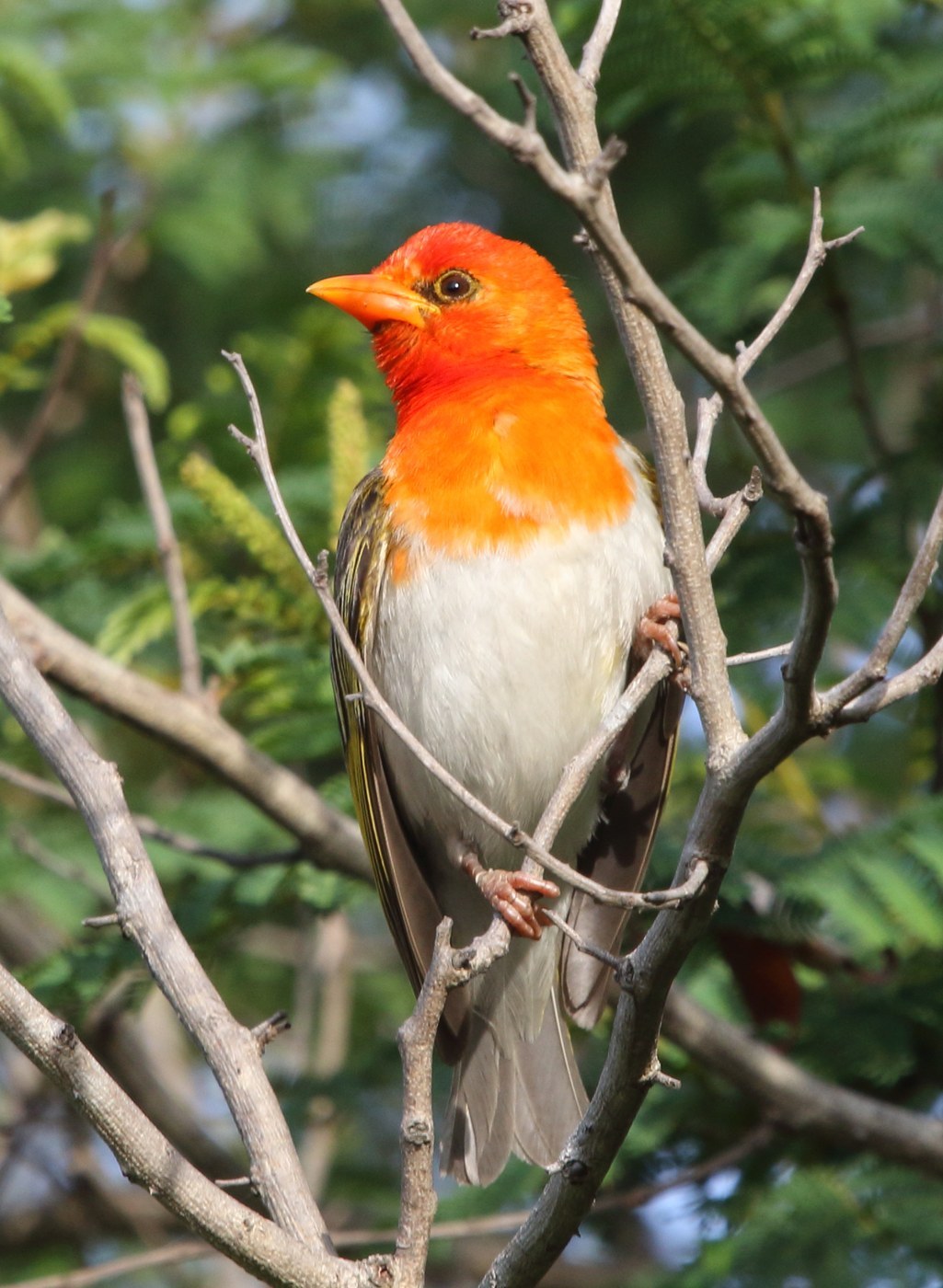
Red-headed Weaver
Anaplectes rubriceps
A distinctive African weaver with a bright red head, throat, and bill on breeding males, set off against pale grey underparts and a mixed red-and-black back.
- Size
- 14–15 cm long, wingspan about 22–24 cm
- Habitat
- Savanna woodland and thornveld across sub-Saharan Africa
- Type
- songbird
Spotted a bird like this?
Identify any bird from a photo, free.
Overview
The Red-headed Weaver is an unusually plumaged weaverbird, easily told apart from other weavers by its striking red head and coral-red bill.
Appearance
- Breeding male: crimson-red head, throat, and upper breast, with a red bill; back mottled with red, black, and olive-yellow; pale grey-white underparts
- Female and non-breeding male: much duller, with a yellowish-olive head and less red overall, though the reddish bill is often retained
- Slim build compared with some other weavers, with a fairly long, slightly downcurved bill
The species is sometimes placed in its own genus, Anaplectes, distinguishing it structurally from typical Ploceus weavers.
How to identify it
Key field marks
- Bright red head, throat, and bill on breeding males
- Pale grey underparts contrasting with the red head
- Back showing a mix of red, black, and yellowish tones
Similar species
- Red-headed weavers are unlikely to be confused with other weavers since no other common Ploceus species combines a fully red head with a red bill and grey underparts.
- Some bishops and red-plumaged finches show red coloring but lack the weaver's bill shape, grey belly, and behavior.
- Females and non-breeding birds are duller and can be told by the reddish bill and overall slim weaver shape.
Habitat & range
Range
Occurs in scattered populations across sub-Saharan Africa, including parts of West Africa, East Africa (Kenya, Tanzania), and southern Africa (Zimbabwe, Mozambique, South Africa).
Habitat
Prefers savanna woodland, thornveld, and broadleaved woodland, often in drier habitats than many other weaver species.
Movements
Generally resident, though it can be locally uncommon or patchily distributed across its range.
Behavior & voice
Behavior
Less strongly colonial than many other weavers, often nesting solitarily or in small, loose groups rather than large colonies.
Voice
Gives sharp chirps and a soft, warbling song, generally quieter and less raucous than the calls of colonial weavers like the Village Weaver.
Feeding
Forages actively in trees and shrubs for insects, supplementing its diet with seeds, gleaning from foliage rather than feeding mainly on the ground.
Nesting
Builds a distinctive, tightly woven nest with a long entrance tunnel, suspended from a thin branch, often at the tip of an outer twig to reduce predation risk; typically nests alone or in small, scattered groups rather than dense colonies.
Frequently asked questions
What is the easiest way to identify a Red-headed Weaver?
Look for a breeding male with a bright red head, throat, and bill contrasting with pale grey underparts — a pattern unlike any other common African weaver.
Does the Red-headed Weaver nest in large colonies like other weavers?
No, it is less colonial than species like the Village Weaver, typically nesting alone or in small, loose groups.
Where is the Red-headed Weaver found?
It occurs in scattered populations across sub-Saharan Africa, favoring savanna woodland and thornveld habitats.
What does a female Red-headed Weaver look like?
Females are much duller than males, with a yellowish-olive head instead of red, though they often retain the reddish bill.
Red-headed Weaver guides
In-depth guides for identifying, finding, and understanding Red-headed Weaver.
Other birds you may enjoy

Black Redstart
13-14.5 cm (5.1-5.7 in) long, 23-26 cm wingspan

Black-throated Sparrow
12-14 cm (4.7-5.5 in) long, about 19-20 cm (7.5-8 in) wingspan

Greater Bird-of-paradise
Body about 43 cm; males with additional flank plumes up to 50 cm and long tail wires

Blue Tit
11-12 cm (4.3-4.7 in) long, 17-20 cm wingspan

Red-billed Quelea
11.5–13 cm long, wingspan about 20–22 cm
White-plumed Antbird
13-14 cm (5-5.5 in) long

Pyrrhuloxia
19-22 cm (7.5-8.7 in) long, 30 cm wingspan

Blue-gray Tanager
16-18 cm (6-7 in) long

Blackburnian Warbler
11-13 cm (4.3-5.1 in) long, 20-22 cm wingspan

Bluethroat
13-14 cm (5.1-5.5 in) long, 20-22 cm wingspan

Eurasian Nuthatch
12-14.5 cm (4.7-5.7 in) long, 22.5-27 cm wingspan

Wood Thrush
19-21 cm (7.5-8.3 in) long, about 33 cm (13 in) wingspan