
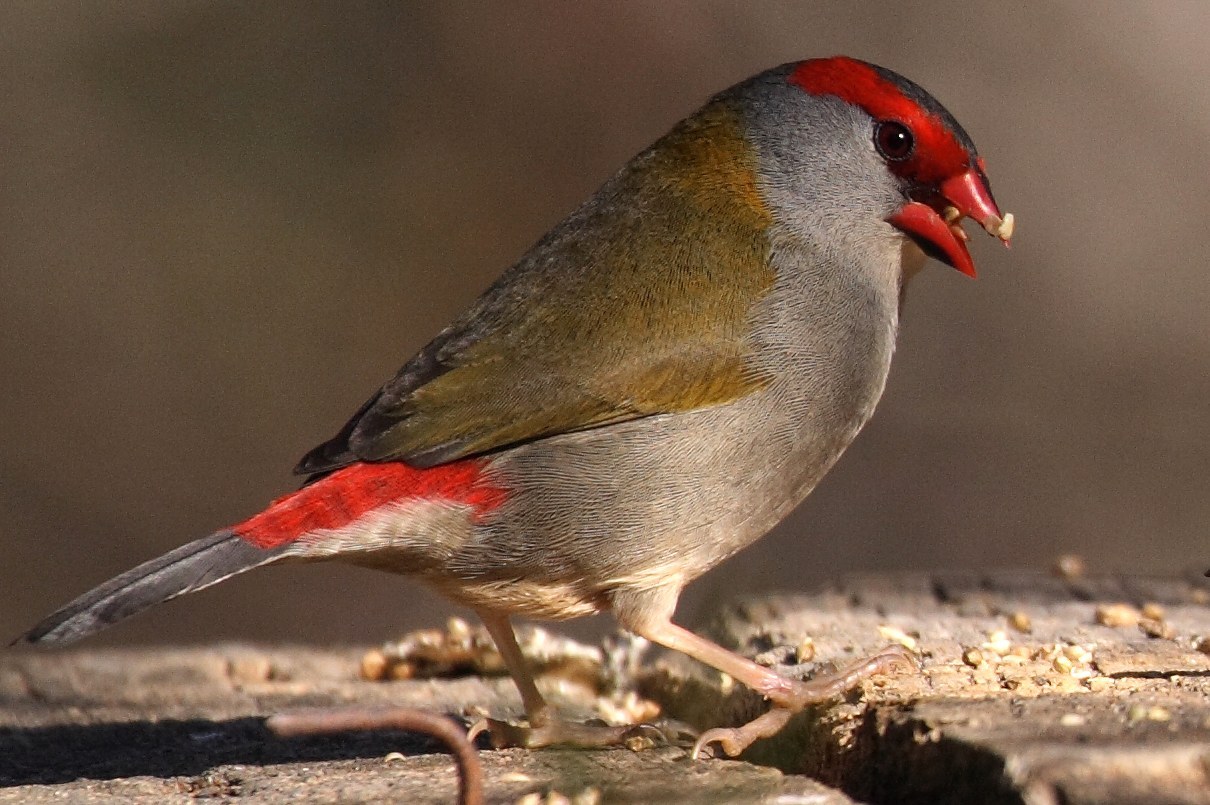
Red-browed Finch
Neochmia temporalis
An olive-grey finch with a bright red rump, bill, and eyebrow stripe, often seen in small flocks along forest edges.
- Size
- 11-12 cm (4-4.5 in) long
- Habitat
- forest edges, woodlands, and gardens near water, mainly eastern Australia
- Type
- songbird
Spotted a bird like this?
Identify any bird from a photo, free.
Overview
The Red-browed Finch is a small, neatly marked estrildid finch with olive-grey upperparts, a pale grey head and underparts, and a striking bright red eyebrow stripe, rump, and bill that provide vivid accents against its otherwise muted plumage. Sexes look similar, and juveniles are duller with a blackish rather than red bill.
This finch is typically encountered in small, active flocks that move together through low vegetation, grassy clearings, and forest edges, often giving soft contact calls as they forage on the ground and in low shrubs. It is one of the most commonly seen native finches in gardens and parks along the eastern Australian seaboard.
Well adapted to modified and semi-urban landscapes, the Red-browed Finch has thrived alongside human settlement in many areas, frequently visiting gardens, parks, and farmland with suitable grassy or shrubby cover near water.
How to identify it
Key field marks
- Small finch with olive-grey upperparts and pale grey underparts
- Bright red eyebrow stripe, rump, and bill
- Short, stubby, conical finch bill
- Typically seen in small, active flocks close to cover
Similar species
The Diamond Firetail is larger with bold black-and-white spotted flanks and a black band across the breast, quite different from the plainer Red-browed Finch. No other common eastern Australian finch shares the combination of red eyebrow, red rump, and red bill on an otherwise olive-grey body.
Habitat & range
Habitat
Red-browed Finches favour forest and woodland edges, grassy clearings, riparian vegetation, and gardens and parks with dense shrubby cover, generally near water.
Range
The species occurs along the eastern Australian coast and ranges from Cape York Peninsula in far north Queensland south through New South Wales and Victoria to southeastern South Australia, and has been introduced to parts of Western Australia.
Migration
Most populations are sedentary or locally nomadic, moving short distances in response to food and water availability rather than undertaking long migrations.
Behavior & voice
Behavior
This finch is highly social, usually encountered in small flocks that forage together on the ground and in low vegetation, keeping close to cover and flying up into shrubs or trees when disturbed.
Voice
Its call is a thin, high-pitched 'seee' contact note, often given repeatedly as flock members keep in touch while foraging.
Feeding
It feeds mainly on the seeds of grasses and other plants, gathered from the ground or directly from seed heads, supplemented with small insects, particularly when breeding.
Nesting and breeding
The nest is a bulky, domed structure of grass with a side entrance, built in dense shrubs, grass tussocks, or vine tangles; both parents share incubation and feeding duties, and pairs may raise several broods across a breeding season.
Frequently asked questions
How can I identify a Red-browed Finch?
Look for its olive-grey body combined with a bright red eyebrow stripe, red rump, and red bill.
Where do Red-browed Finches live?
They inhabit forest edges, grassy clearings, and gardens near water along the eastern Australian coast from far north Queensland to South Australia.
What do Red-browed Finches eat?
Mainly grass seeds, along with some insects, especially during breeding.
Are Red-browed Finches social?
Yes, they are usually seen in small, active flocks that forage and move together.
How is the Red-browed Finch different from the Diamond Firetail?
The Red-browed Finch is smaller and plainer overall, while the Diamond Firetail is larger with bold black-and-white spotted flanks and a black breast band.
Red-browed Finch guides
In-depth guides for identifying, finding, and understanding Red-browed Finch.
Other birds you may enjoy

Black Redstart
13-14.5 cm (5.1-5.7 in) long, 23-26 cm wingspan

Black-throated Sparrow
12-14 cm (4.7-5.5 in) long, about 19-20 cm (7.5-8 in) wingspan

Greater Bird-of-paradise
Body about 43 cm; males with additional flank plumes up to 50 cm and long tail wires

Blue Tit
11-12 cm (4.3-4.7 in) long, 17-20 cm wingspan

Red-billed Quelea
11.5–13 cm long, wingspan about 20–22 cm
White-plumed Antbird
13-14 cm (5-5.5 in) long

Pyrrhuloxia
19-22 cm (7.5-8.7 in) long, 30 cm wingspan

Blue-gray Tanager
16-18 cm (6-7 in) long

Blackburnian Warbler
11-13 cm (4.3-5.1 in) long, 20-22 cm wingspan

Bluethroat
13-14 cm (5.1-5.5 in) long, 20-22 cm wingspan

Eurasian Nuthatch
12-14.5 cm (4.7-5.7 in) long, 22.5-27 cm wingspan

Wood Thrush
19-21 cm (7.5-8.3 in) long, about 33 cm (13 in) wingspan