
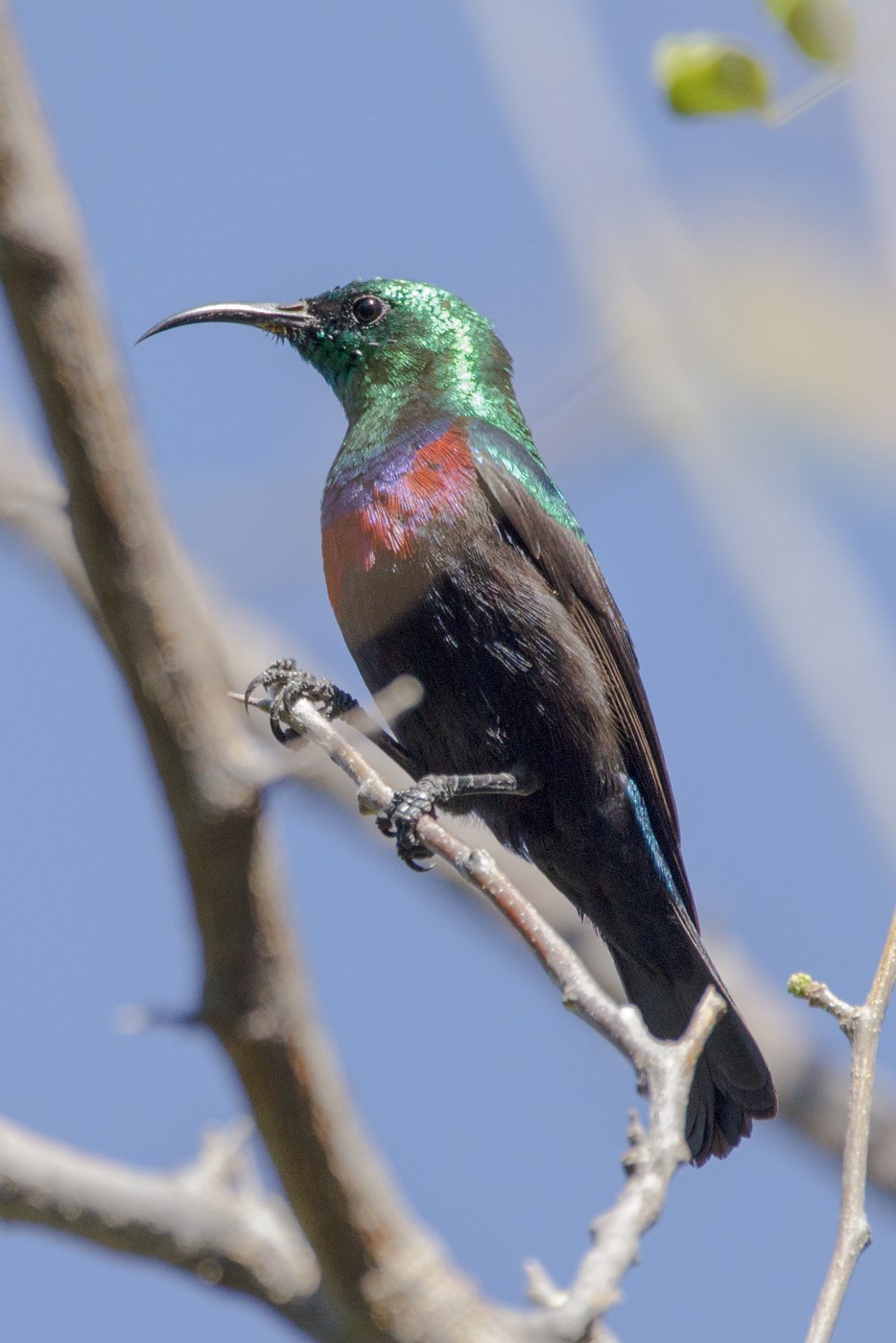
Marico Sunbird
Cinnyris mariquensis
A robust southern African sunbird with a broad maroon breast band and jet-black belly, common in acacia savanna and dry woodland.
- Size
- About 13-15 cm long, a relatively large sunbird
- Habitat
- Acacia savanna, broadleaved woodland and semi-arid bush in southern Africa
- Type
- songbird
Spotted a bird like this?
Identify any bird from a photo, free.
Overview
The Marico Sunbird is a relatively large, boldly patterned sunbird of drier savanna and woodland habitats in southern Africa. It is named after the Marico River region of South Africa where it was first described.
Appearance
Males display an iridescent metallic green head and throat, a broad maroon or wine-red band across the breast, and a black belly, with a dark, slightly decurved bill. Females are grey-brown above and pale, dull yellowish-grey below, without iridescence.
How to identify it
Key field marks
- Larger, more robust sunbird with a fairly long, strongly decurved bill
- Male: iridescent green head/throat, broad maroon breast band, black belly
- Female: grey-brown above, dull yellowish-grey below
- Typically found in drier acacia or broadleaved woodland rather than lush forest
Similar species
The broad maroon chest band and black belly separate male Marico Sunbirds from the similarly ranged White-bellied Sunbird, which has a much narrower dark band and a white belly. It can also resemble the Scarlet-chested Sunbird, but that species shows a scarlet, not maroon, band and lacks the iridescent green head. Females are best told from other sunbirds by range, habitat, and larger size with a longer bill.
Habitat & range
Habitat
Marico Sunbirds favor semi-arid and arid savanna, acacia thornveld, and broadleaved woodland, often in areas drier than those used by many other sunbird species.
Range
The species is found across southern Africa, including Angola, Namibia, Botswana, Zimbabwe, Zambia, Mozambique, and South Africa.
Migration
Mostly resident, with local movements tracking seasonal flowering of acacias and other nectar sources.
Behavior & voice
Behavior
Bold and territorial, Marico Sunbirds often perch conspicuously atop flowering acacias and aggressively defend good feeding sites from rivals, including other sunbird species.
Voice
The song is a fast, scratchy series of warbled notes; the call is a sharp, metallic "chip" or "tsip," often repeated.
Feeding
Nectar from acacia and aloe flowers forms a major part of the diet, supplemented by insects and spiders gleaned from foliage or caught in flight, especially when raising chicks.
Nesting
The nest is an oval, hanging structure of grass, bark fiber, and spider web with a side entrance, typically suspended from a thorny branch for protection. The female incubates the one to two eggs largely on her own.
Frequently asked questions
How do you tell a Marico Sunbird from a White-bellied Sunbird?
The Marico Sunbird has a broad maroon breast band and a black belly, while the White-bellied Sunbird has a narrow dark band and a white belly.
Where does the Marico Sunbird live?
It occurs across southern Africa in dry acacia savanna, broadleaved woodland, and thornveld, including Namibia, Botswana, Zimbabwe, and South Africa.
What does the Marico Sunbird eat?
Primarily nectar from flowers such as acacias and aloes, plus insects and spiders.
Why is it called the Marico Sunbird?
It is named after the Marico River district in South Africa's North West Province, where the species was first described.
Marico Sunbird guides
In-depth guides for identifying, finding, and understanding Marico Sunbird.
Other birds you may enjoy

Black Redstart
13-14.5 cm (5.1-5.7 in) long, 23-26 cm wingspan

Black-throated Sparrow
12-14 cm (4.7-5.5 in) long, about 19-20 cm (7.5-8 in) wingspan

Greater Bird-of-paradise
Body about 43 cm; males with additional flank plumes up to 50 cm and long tail wires

Blue Tit
11-12 cm (4.3-4.7 in) long, 17-20 cm wingspan

Red-billed Quelea
11.5–13 cm long, wingspan about 20–22 cm
White-plumed Antbird
13-14 cm (5-5.5 in) long

Pyrrhuloxia
19-22 cm (7.5-8.7 in) long, 30 cm wingspan

Blue-gray Tanager
16-18 cm (6-7 in) long

Blackburnian Warbler
11-13 cm (4.3-5.1 in) long, 20-22 cm wingspan

Bluethroat
13-14 cm (5.1-5.5 in) long, 20-22 cm wingspan

Eurasian Nuthatch
12-14.5 cm (4.7-5.7 in) long, 22.5-27 cm wingspan

Wood Thrush
19-21 cm (7.5-8.3 in) long, about 33 cm (13 in) wingspan