
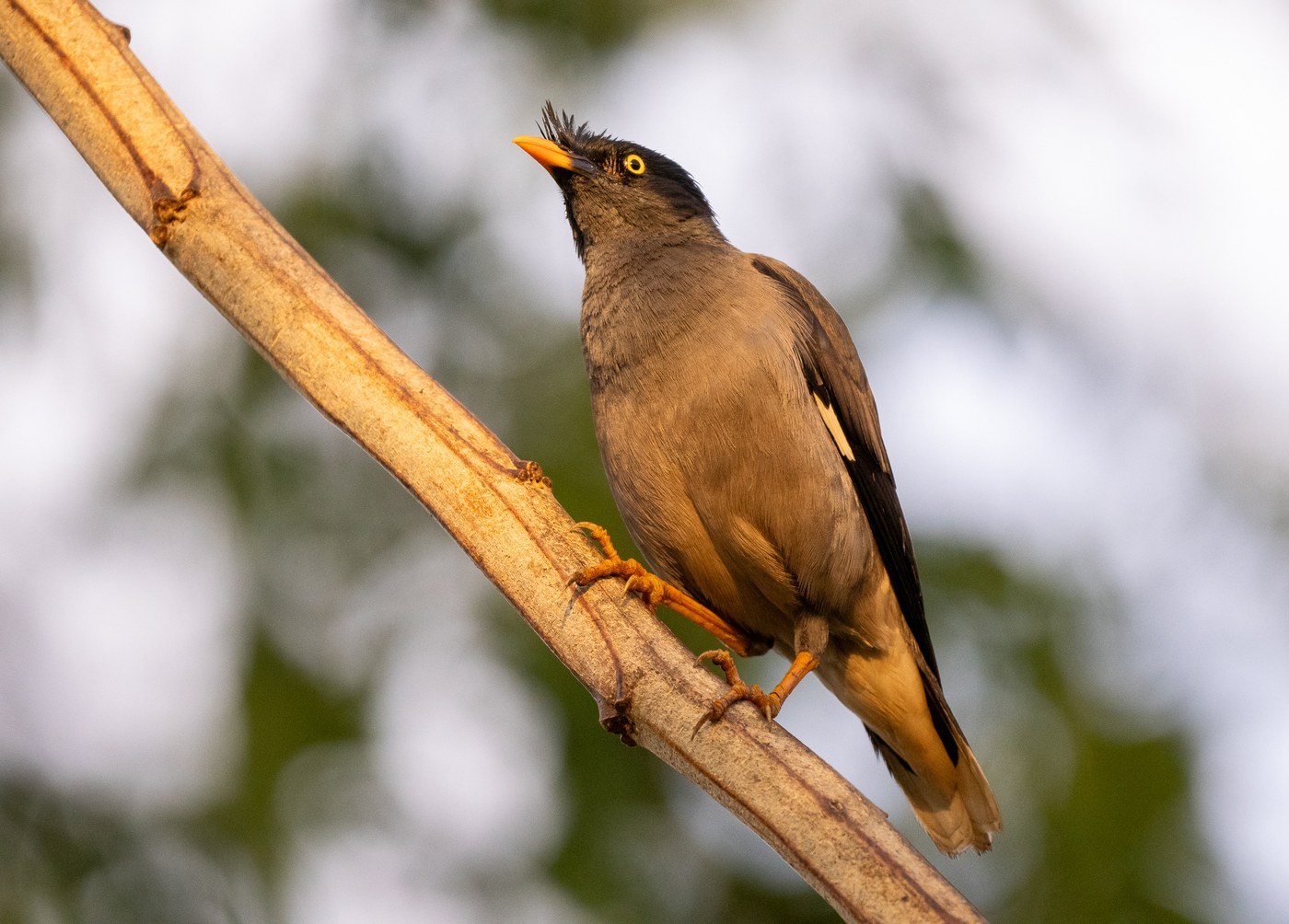
Jungle Myna
Acridotheres fuscus
A grey-brown myna with a distinctive tuft of feathers on the forehead and pale blue-white eyes, common across South and Southeast Asian towns and farmland.
- Size
- 21-23 cm (8-9 in) long, 33-38 cm wingspan
- Habitat
- open woodland, farmland, and towns, often near water
- Type
- songbird
Spotted a bird like this?
Identify any bird from a photo, free.
Overview
The Jungle Myna is a sturdy, gregarious songbird closely related to the more widespread Common Myna but distinguished by its overall greyer plumage and a small tuft of feathers projecting from the forehead above the bill. Its most distinctive feature at close range is the pale, almost white to blue-white iris, contrasting with the dark plumage of the head.
The bill is yellow with a bluish base, and in flight it shows white wing patches similar to the Common Myna, though it lacks that species' bright yellow bare eye patch.
How to identify it
Key field marks
- Grey-brown body, darker slate-grey head and neck
- Small, upright tuft of feathers on the forehead
- Pale blue-white eye, distinctive at close range
- Yellow bill with a bluish base; white wing patches in flight
Similar species
The Common Myna is browner overall with a yellow (not blue-white) bare eye patch and lacks the forehead tuft. The Bank Myna is paler with an orange eye patch and lacks the tuft as well.
Habitat & range
Range
Found across the Indian subcontinent and parts of Southeast Asia, including Myanmar, Thailand, and southern China.
Habitat
Occupies open woodland, farmland, grassland, and towns, often near water; more tolerant of semi-natural and rural habitats than the highly urban Common Myna, despite the misleading name.
Migration
Largely resident, with some local seasonal movements linked to food availability.
Behavior & voice
Behavior
Gregarious, typically seen in pairs or small flocks foraging on the ground or in trees, and roosting communally in large numbers at dusk.
Voice
A range of chattering, gurgling, and squeaky calls similar to other mynas, often given in noisy group interactions.
Feeding
An omnivorous forager, taking insects, fruit, seeds, and scraps, often walking on open ground or following grazing animals to catch disturbed insects.
Nesting and breeding
Nests in tree cavities or building crevices, lined with grass and other soft material. Lays 4-5 eggs, with both parents involved in raising the young.
Frequently asked questions
How do you tell a Jungle Myna from a Common Myna?
The Jungle Myna is greyer overall, has a small feather tuft on the forehead, and shows a pale blue-white eye, whereas the Common Myna is browner with a yellow bare eye patch and no tuft.
Despite its name, does the Jungle Myna live in dense jungle?
Not typically; it favors open woodland, farmland, and towns rather than dense forest, despite the common name.
What does the Jungle Myna eat?
It is an omnivore, feeding on insects, fruit, seeds, and food scraps.
Where is the Jungle Myna found?
Across the Indian subcontinent and into parts of Southeast Asia, including Myanmar, Thailand, and southern China.
Jungle Myna guides
In-depth guides for identifying, finding, and understanding Jungle Myna.
Other birds you may enjoy

Black Redstart
13-14.5 cm (5.1-5.7 in) long, 23-26 cm wingspan

Black-throated Sparrow
12-14 cm (4.7-5.5 in) long, about 19-20 cm (7.5-8 in) wingspan

Greater Bird-of-paradise
Body about 43 cm; males with additional flank plumes up to 50 cm and long tail wires

Blue Tit
11-12 cm (4.3-4.7 in) long, 17-20 cm wingspan

Red-billed Quelea
11.5–13 cm long, wingspan about 20–22 cm
White-plumed Antbird
13-14 cm (5-5.5 in) long

Pyrrhuloxia
19-22 cm (7.5-8.7 in) long, 30 cm wingspan

Blue-gray Tanager
16-18 cm (6-7 in) long

Blackburnian Warbler
11-13 cm (4.3-5.1 in) long, 20-22 cm wingspan

Bluethroat
13-14 cm (5.1-5.5 in) long, 20-22 cm wingspan

Eurasian Nuthatch
12-14.5 cm (4.7-5.7 in) long, 22.5-27 cm wingspan

Wood Thrush
19-21 cm (7.5-8.3 in) long, about 33 cm (13 in) wingspan