
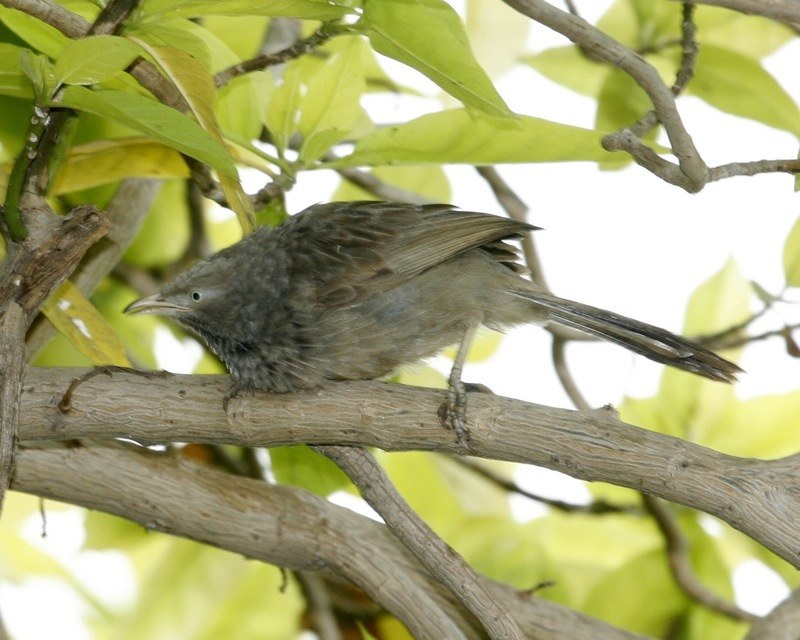
Jungle Babbler
Argya striata
A drab, noisy, sociable babbler almost always seen in chattering flocks of half a dozen or more, earning it the nickname 'Seven Sisters.'
- Size
- 23-25 cm (9-10 in) long
- Habitat
- scrub, gardens, farmland, and open woodland across the Indian subcontinent
- Type
- songbird
Spotted a bird like this?
Identify any bird from a photo, free.
Overview
The Jungle Babbler is a plain, greyish-brown bird best known not for its appearance but for its highly social behavior — it is almost never seen alone, instead moving through gardens, scrub, and farmland in noisy, cohesive flocks typically of six to ten birds, which has earned it the popular nickname "Seven Sisters" across much of India. Plumage is fairly uniform dull brown-grey with faint darker streaking on the upperparts, a pale yellowish or whitish eye, and a slightly curved yellowish bill.
While individually unremarkable in looks, Jungle Babblers are fascinating for their cooperative social structure, in which flock members help defend territory, mob predators together, and even assist in raising each other's young.
How to identify it
Key field marks
- Uniform dull grey-brown plumage with faint dark streaking above
- Pale yellowish or whitish eye
- Slightly curved, yellowish-horn bill
- Almost always in noisy flocks of 6 or more, moving and foraging together
Similar species
Other babbler species in the region, such as the Large Grey Babbler, are paler and greyer with a longer tail and white outer tail feathers. The Jungle Babbler's combination of drab plumage, pale eye, and strongly social, noisy flocking behavior is a reliable identification aid even when plumage details are hard to see.
Habitat & range
Jungle Babblers are found throughout much of the Indian subcontinent, including India, Nepal, Bangladesh, and Sri Lanka, in scrub, gardens, farmland, open woodland, and areas close to human habitation. They are highly adaptable and often quite tame, thriving in both rural and urban green spaces.
The species is entirely resident and non-migratory, with flocks maintaining fairly stable territories.
Behavior & voice
Voice
A constant, harsh chattering and squealing chorus produced by the flock as it moves and forages together, one of the most familiar background sounds of Indian gardens and scrub.
Feeding
Jungle Babblers forage mostly on the ground and in low vegetation, taking insects, seeds, fruit, and occasionally nectar, often flipping over leaf litter as a group in search of food.
Nesting and breeding
The species exhibits cooperative breeding, in which multiple flock members — not just the breeding pair — help build the nest, incubate eggs, and feed and defend the chicks, a social system that improves nesting success and predator defense for the whole group.
Frequently asked questions
Why is the Jungle Babbler called 'Seven Sisters'?
Because it is almost always seen in noisy, cohesive flocks of around six to ten birds, a group size that inspired the popular nickname across parts of India.
Do Jungle Babblers help raise each other's chicks?
Yes, the species practices cooperative breeding, where multiple flock members help incubate eggs and feed and protect chicks beyond just the parent pair.
How can you identify a Jungle Babbler?
Look for a drab grey-brown bird with a pale eye and yellowish bill, almost always traveling in a noisy flock rather than alone.
What do Jungle Babblers eat?
Mainly insects, seeds, and fruit, foraged cooperatively on the ground and in low vegetation.
Jungle Babbler guides
In-depth guides for identifying, finding, and understanding Jungle Babbler.
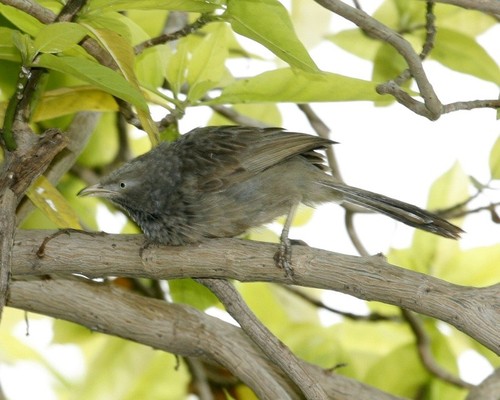
Jungle Babbler identified by the community
Real birds identified with Bird Identifier.

Other birds you may enjoy

Black Redstart
13-14.5 cm (5.1-5.7 in) long, 23-26 cm wingspan

Black-throated Sparrow
12-14 cm (4.7-5.5 in) long, about 19-20 cm (7.5-8 in) wingspan

Greater Bird-of-paradise
Body about 43 cm; males with additional flank plumes up to 50 cm and long tail wires

Blue Tit
11-12 cm (4.3-4.7 in) long, 17-20 cm wingspan

Red-billed Quelea
11.5–13 cm long, wingspan about 20–22 cm
White-plumed Antbird
13-14 cm (5-5.5 in) long

Pyrrhuloxia
19-22 cm (7.5-8.7 in) long, 30 cm wingspan

Blue-gray Tanager
16-18 cm (6-7 in) long

Blackburnian Warbler
11-13 cm (4.3-5.1 in) long, 20-22 cm wingspan

Bluethroat
13-14 cm (5.1-5.5 in) long, 20-22 cm wingspan

Eurasian Nuthatch
12-14.5 cm (4.7-5.7 in) long, 22.5-27 cm wingspan

Wood Thrush
19-21 cm (7.5-8.3 in) long, about 33 cm (13 in) wingspan