
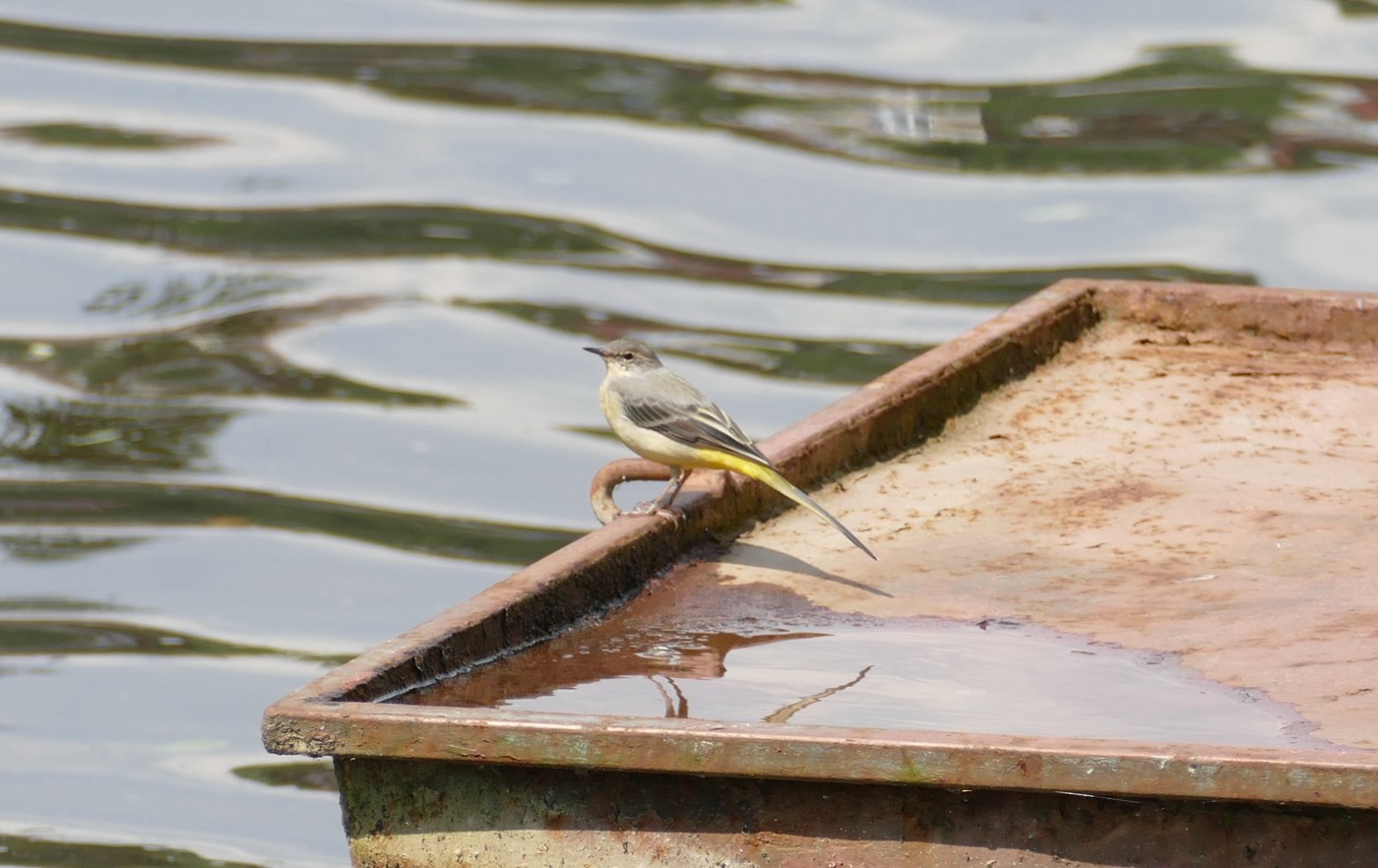
Grey Wagtail
Motacilla cinerea
A slender, strikingly long-tailed wagtail with bright yellow underparts, closely tied to fast-flowing streams and rivers where it bobs along rocks and weirs.
- Size
- 18-19 cm (7-7.5 in) long, 25-27 cm wingspan
- Habitat
- fast-flowing streams and rivers, weirs, and, in winter, lowland waterways and urban water features
- Type
- songbird
Spotted a bird like this?
Identify any bird from a photo, free.
Overview
The Grey Wagtail is a slender, elegant bird with a proportionately longer tail than any other European wagtail, a feature that is constantly wagged as the bird forages along rocks and streamside vegetation. Despite its name emphasising grey, its most eye-catching feature is bright yellow underparts, which become especially vivid and lemon-yellow under the tail.
Breeding males add a neat black bib to the yellow throat, framed by a clean white moustachial stripe, while the back and head remain blue-grey year-round. Females and non-breeding birds lack the black bib but retain the same long tail and yellow underparts.
More than any other wagtail, this species is closely tied to fast-flowing water, favouring rocky streams, weirs, and waterfalls where it darts after insects disturbed by the rushing current.
How to identify it
Key field marks
- Blue-grey upperparts contrasting with bright yellow underparts
- Exceptionally long tail relative to body size, constantly wagged
- Black bib in breeding males, framed by a white moustachial stripe
- Bright lemon-yellow undertail coverts, vivid even in non-breeding plumage
- Pinkish legs
Similar species
- Western Yellow Wagtail: shorter tail, olive-green (not blue-grey) upperparts, and typically found in wet grassland and farmland rather than fast-flowing streams.
- White/Pied Wagtail: black, white, and grey plumage with no yellow underparts, and a shorter tail relative to body size.
- No other European wagtail combines a blue-grey back, bright yellow underparts, and such an exceptionally long tail.
Habitat & range
Grey Wagtails breed across much of Europe and Asia, strongly associated with fast-flowing, well-oxygenated streams and rivers, particularly in upland and hilly areas, as well as weirs, mill races, and waterfalls where turbulent water supports abundant aquatic insect life.
Outside the breeding season, many individuals move to lower elevations and a wider range of watery habitats, including lowland rivers, canals, sewage works, and urban water features, sometimes turning up well away from the fast streams used for breeding.
Some northern and upland populations are partial migrants, moving south or to milder lowland and coastal areas for winter, while others remain resident near their breeding streams year-round.
Behavior & voice
Voice
The call is a sharp, metallic "tzi-tzi" or "chit-ik," often given in flight and audible over the sound of rushing water. The song is a simple, rapid extension of the call notes, delivered from a rock or nearby perch.
Feeding
Grey Wagtails feed on insects and other small invertebrates, caught by darting along rocks, bobbing at the water's edge, and making short aerial sallies to snatch insects flushed by the moving water, including aquatic larvae emerging near the surface.
Nesting and breeding
The nest is a cup of grass and moss tucked into a crevice near water, such as a rock ledge, wall, or bridge structure close to the stream. Clutches typically contain four to six eggs.
Frequently asked questions
How do you identify a Grey Wagtail?
Look for a slender wagtail with blue-grey upperparts, bright yellow underparts, and an exceptionally long tail, typically found bobbing along fast-flowing streams and rivers.
How is Grey Wagtail different from Yellow Wagtail?
Grey Wagtail has a blue-grey back, a much longer tail, and favours fast-flowing streams, while Yellow Wagtail has an olive-green back, a shorter tail, and prefers wet grassland and farmland.
What habitat does the Grey Wagtail prefer?
It is closely tied to fast-flowing, well-oxygenated streams and rivers, weirs, and waterfalls, though it uses a wider range of watery habitats outside the breeding season.
Do Grey Wagtails migrate?
Some populations, especially in the north and at higher elevations, are partial migrants moving to milder lowland or coastal areas in winter, while others remain resident near their breeding streams.
What does a Grey Wagtail eat?
It feeds on insects and other small aquatic invertebrates, caught by darting along rocks and making short sallies to snatch prey disturbed by moving water.
Grey Wagtail guides
In-depth guides for identifying, finding, and understanding Grey Wagtail.

Other birds you may enjoy

Black Redstart
13-14.5 cm (5.1-5.7 in) long, 23-26 cm wingspan

Black-throated Sparrow
12-14 cm (4.7-5.5 in) long, about 19-20 cm (7.5-8 in) wingspan

Greater Bird-of-paradise
Body about 43 cm; males with additional flank plumes up to 50 cm and long tail wires

Blue Tit
11-12 cm (4.3-4.7 in) long, 17-20 cm wingspan

Red-billed Quelea
11.5–13 cm long, wingspan about 20–22 cm
White-plumed Antbird
13-14 cm (5-5.5 in) long

Pyrrhuloxia
19-22 cm (7.5-8.7 in) long, 30 cm wingspan

Blue-gray Tanager
16-18 cm (6-7 in) long

Blackburnian Warbler
11-13 cm (4.3-5.1 in) long, 20-22 cm wingspan

Bluethroat
13-14 cm (5.1-5.5 in) long, 20-22 cm wingspan

Eurasian Nuthatch
12-14.5 cm (4.7-5.7 in) long, 22.5-27 cm wingspan

Wood Thrush
19-21 cm (7.5-8.3 in) long, about 33 cm (13 in) wingspan