
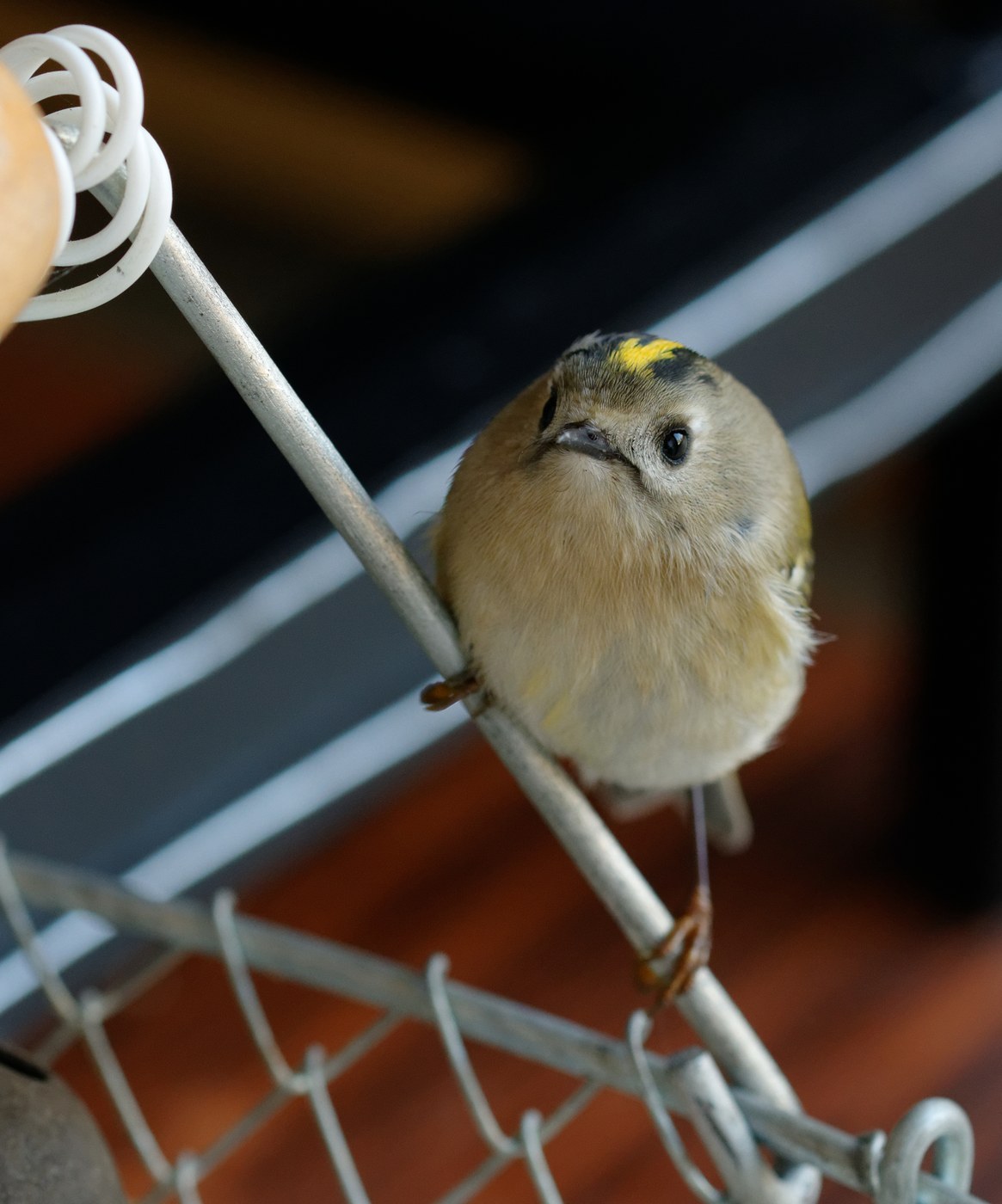
Goldcrest
Regulus regulus
One of Europe's smallest birds, a tiny olive-green sprite with a vivid black-bordered crown stripe, constantly flitting through conifer foliage.
- Size
- 8.5-9.5 cm (3.3-3.7 in) long, 13.5-15.5 cm wingspan
- Habitat
- coniferous and mixed woodland
- Type
- songbird
Spotted a bird like this?
Identify any bird from a photo, free.
Overview
The Goldcrest is among the smallest birds in Europe, a tiny, round-bodied, olive-green bird that weighs little more than a few grams. Its most distinctive feature is a bright crown stripe bordered by black lines, orange in the centre for males and yellow for females, which can be raised into a small crest during display or excitement.
The wings show two pale wingbars and a dark panel, and the plain face lacks any bold eyestripe, giving it a slightly blank, wide-eyed expression compared to its close relative, the Firecrest.
Despite its minute size, the Goldcrest is remarkably hardy, surviving cold northern winters by feeding almost constantly on tiny insects and huddling together with others at night to conserve heat.
How to identify it
Key field marks
- Tiny, rounded body, among the smallest birds in Europe
- Bright crown stripe bordered in black: orange (male) or yellow (female)
- Olive-green upperparts, paler buffy-white underparts
- Two pale wingbars with a dark panel between them
- Plain face with a large dark eye and no bold eyestripe
Similar species
- Firecrest: shows a bold white supercilium and black eyestripe that the Goldcrest lacks, along with a bronze shoulder patch and generally brighter, more contrasty plumage.
- Willow Warbler/Chiffchaff: both larger, with a pale supercilium but lacking the bright crown stripe entirely.
- Coal Tit: has a black cap and white nape patch, a completely different pattern from the Goldcrest's central crown stripe.
Habitat & range
Goldcrests are found across much of Europe and into Asia, strongly associated with coniferous and mixed woodland, particularly spruce, pine, and other conifers where their tiny size and fine bill allow them to forage among dense needle clusters unavailable to larger birds.
Northern and montane populations may move to lower elevations or milder areas in winter, sometimes forming loose flocks with tits and other small woodland birds, though the species is not a long-distance migrant across most of its range.
Despite their fragility, Goldcrests can withstand harsh winters remarkably well, though populations can still suffer noticeable declines after especially severe cold spells.
Behavior & voice
Voice
The song is extremely high-pitched and thin, a rapid series of very high "zi-zi-zi" notes ending in a slight flourish, at the very upper edge of human hearing for some listeners. The call is similarly high and thin, a repeated "zee-zee-zee."
Feeding
Goldcrests feed almost constantly on tiny insects, spiders, and their eggs, gleaned from needle clusters and twigs, often hovering briefly to reach prey at the tips of branches. Their high metabolic rate requires near-continuous foraging, especially in cold weather.
Nesting and breeding
The nest is a tiny, deep cup of moss and spider silk, typically suspended beneath a conifer branch. Clutches are large for such a small bird, often seven to twelve eggs, and pairs may raise two broods in a season.
Frequently asked questions
How small is a Goldcrest?
At around 8.5-9.5 cm long and weighing just a few grams, the Goldcrest is one of the smallest birds in Europe.
How do you tell a Goldcrest from a Firecrest?
Firecrest has a bold white eyebrow stripe and black eyestripe plus a bronze shoulder patch, all of which the plainer-faced Goldcrest lacks.
What does a Goldcrest eat?
It feeds almost constantly on tiny insects, spiders, and their eggs, gleaned from conifer needles and twigs, needing near-continuous foraging due to its high metabolism.
Where do Goldcrests live?
They are strongly associated with coniferous and mixed woodland across Europe and Asia, particularly spruce and pine forests.
How do Goldcrests survive cold winters?
They feed almost continuously to fuel their high metabolism and often huddle together with other Goldcrests at night to conserve body heat during freezing conditions.
Goldcrest guides
In-depth guides for identifying, finding, and understanding Goldcrest.
Other birds you may enjoy

Black Redstart
13-14.5 cm (5.1-5.7 in) long, 23-26 cm wingspan

Black-throated Sparrow
12-14 cm (4.7-5.5 in) long, about 19-20 cm (7.5-8 in) wingspan

Greater Bird-of-paradise
Body about 43 cm; males with additional flank plumes up to 50 cm and long tail wires

Blue Tit
11-12 cm (4.3-4.7 in) long, 17-20 cm wingspan

Red-billed Quelea
11.5–13 cm long, wingspan about 20–22 cm
White-plumed Antbird
13-14 cm (5-5.5 in) long

Pyrrhuloxia
19-22 cm (7.5-8.7 in) long, 30 cm wingspan

Blue-gray Tanager
16-18 cm (6-7 in) long

Blackburnian Warbler
11-13 cm (4.3-5.1 in) long, 20-22 cm wingspan

Bluethroat
13-14 cm (5.1-5.5 in) long, 20-22 cm wingspan

Eurasian Nuthatch
12-14.5 cm (4.7-5.7 in) long, 22.5-27 cm wingspan

Wood Thrush
19-21 cm (7.5-8.3 in) long, about 33 cm (13 in) wingspan