
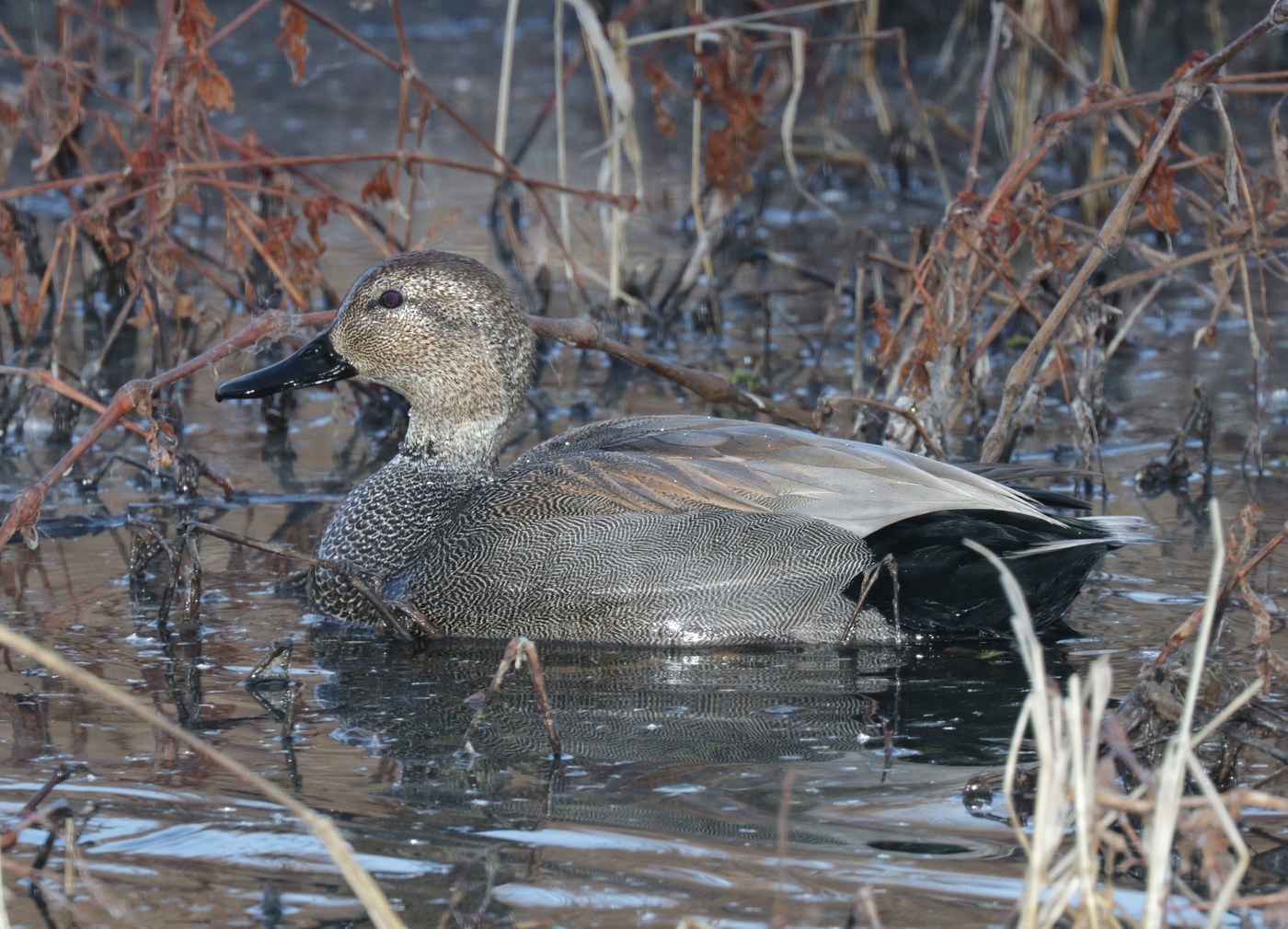
Gadwall
Mareca strepera
A subtly patterned gray dabbling duck whose understated plumage reveals intricate vermiculated markings and a black rear end when seen up close.
- Size
- 46-56 cm (18-22 in) long, 78-90 cm wingspan
- Habitat
- marshes, lakes, ponds, and prairie wetlands across North America, Europe, and Asia
- Type
- waterfowl
Spotted a bird like this?
Identify any bird from a photo, free.
Overview
The Gadwall is a medium-sized dabbling duck that appears plain gray-brown from a distance but reveals fine, intricate barring and scaling across the breast and flanks when viewed closely. The breeding drake is patterned in subtle grays with a black rear end (undertail coverts) that contrasts sharply with the paler body, along with a thin black bill.
Females resemble female Mallards but are more uniformly patterned, with a thinner orange-edged bill and a distinctive white speculum (wing patch) that helps separate them from other female dabbling ducks in flight.
How to identify it
Key Field Marks
- Breeding drake: fine gray vermiculated pattern overall, black rear end, black bill, chestnut-and-black patch on the wing coverts
- Female: mottled brown similar to female Mallard but with a thinner bill (orange sides, dark culmen) and squarer head
- White speculum bordered in black, visible in flight on both sexes — a key distinguishing mark
Similar Species
Female Mallards are bulkier with a broader orange-and-black bill and a blue (not white) speculum. The male Gadwall's understated gray pattern and bold black rear end are unlike any other common dabbling duck.
Habitat & range
Gadwalls breed across the prairie pothole region and other wetlands of North America, as well as temperate Europe and Asia, favoring marshes, lakes, and ponds with abundant submerged and emergent vegetation. They are migratory in northern parts of their range, wintering across the southern and coastal United States, Mexico, and comparable latitudes elsewhere, often on reservoirs, coastal marshes, and impoundments.
Gadwall populations have generally increased over recent decades, and the species has expanded its breeding and wintering range in North America.
Behavior & voice
Gadwalls feed primarily by dabbling and tipping up in shallow water to reach submerged aquatic vegetation and algae, and are notably more vegetarian in diet than many other dabbling ducks, though they take some invertebrates as well. They are also known to steal food brought to the surface by diving ducks and American Coots.
The male's call is a low, hoarse, croaking note quite different from a Mallard's quack, while the female's quack is similar to but softer than a Mallard hen's. Nests are built on the ground in grass or shrub cover near water, often on islands where available to reduce predation risk, with females incubating 7-12 eggs alone.
Frequently asked questions
How do you identify a male Gadwall?
Look for an overall gray, finely patterned body, a black rear end, a black bill, and a chestnut-and-black wing patch.
How is a female Gadwall different from a female Mallard?
The female Gadwall has a thinner, mostly orange bill and a white (rather than blue) speculum, versus the Mallard's broader bill and blue speculum.
What do Gadwalls eat?
They feed mainly on aquatic vegetation and algae, supplemented with some invertebrates.
Do Gadwalls steal food from other birds?
Yes, they sometimes take aquatic plants brought to the surface by diving ducks and American Coots.
Where do Gadwalls breed?
They breed widely across the prairie pothole region of North America as well as wetlands in Europe and Asia.
Gadwall guides
In-depth guides for identifying, finding, and understanding Gadwall.
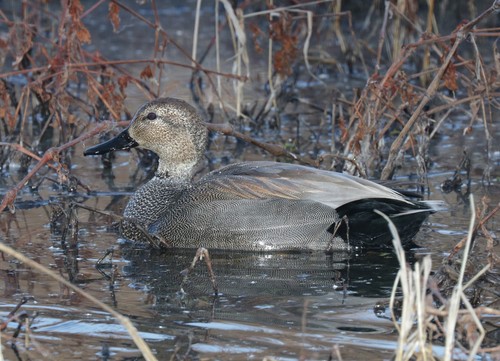
Gadwall identified by the community
Real birds identified with Bird Identifier.

Other birds you may enjoy
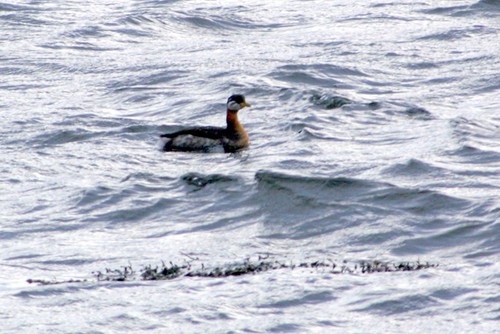
Red-necked Grebe
40-55 cm (16-22 in) long, 77-85 cm wingspan
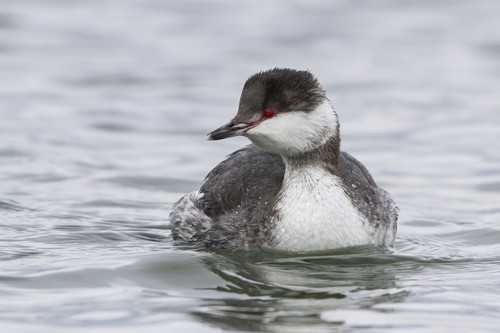
Horned Grebe
31-38 cm (12-15 in) long, 46-55 cm wingspan
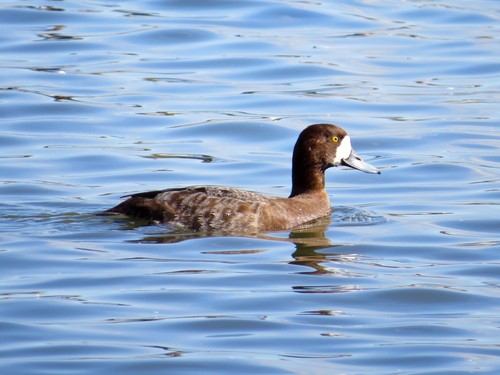
Greater Scaup
42-51 cm (16.5-20 in) long, 71-84 cm wingspan
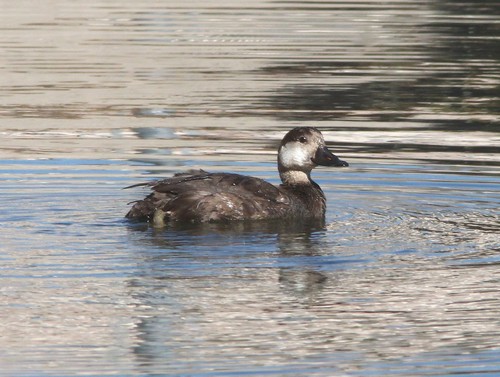
Black Scoter
43-54 cm (17-21 in) long, 79-90 cm wingspan
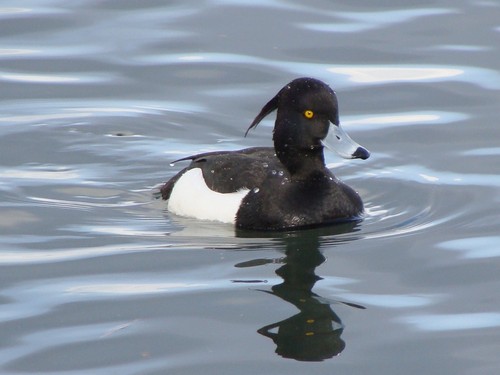
Tufted Duck
40-47 cm (16-18.5 in) long, 67-73 cm wingspan
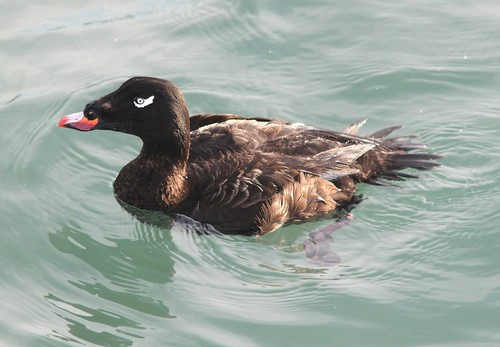
White-winged Scoter
48-58 cm (19-23 in) long, 86-99 cm wingspan
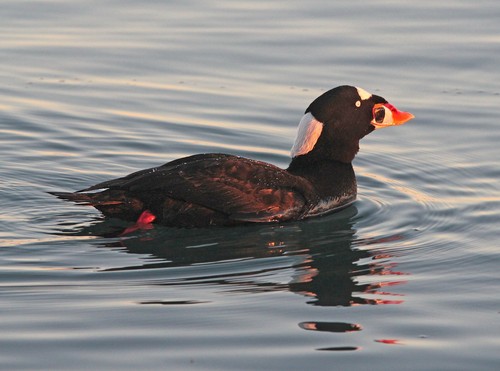
Surf Scoter
45-56 cm (18-22 in) long, 78-92 cm wingspan
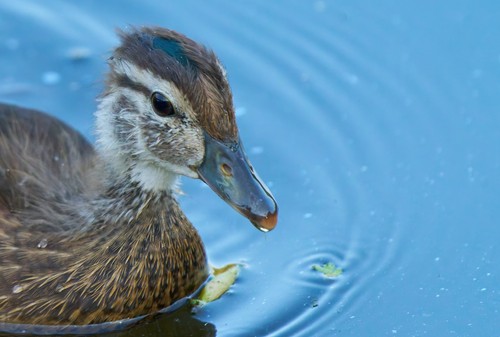
Wood Duck
47-54 cm (18.5-21 in) long, 66-73 cm wingspan
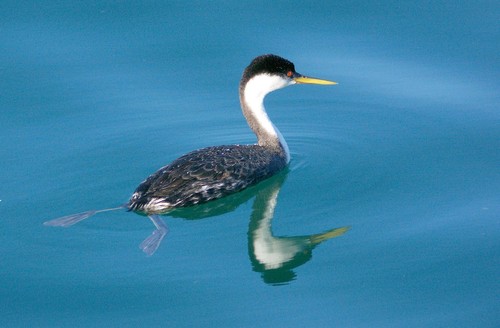
Western Grebe
56-74 cm (22-29 in) long, 79-102 cm wingspan
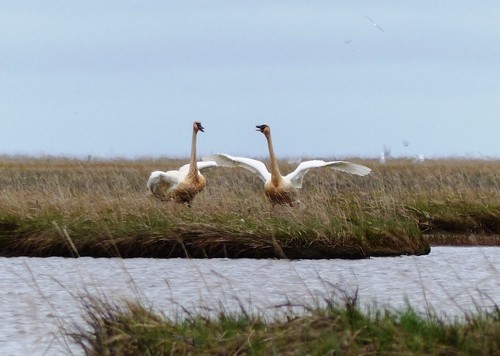
Tundra Swan
115-150 cm (45-59 in) long, about 180 cm wingspan
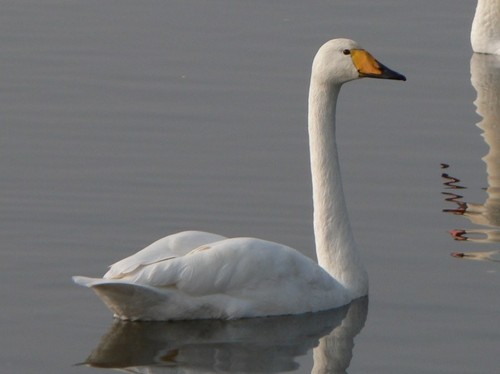
Whooper Swan
140-165 cm (55-65 in) long, 205-235 cm wingspan
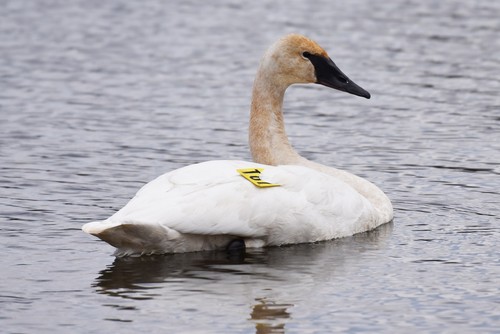
Trumpeter Swan
150-180 cm (59-71 in) long, up to 300 cm wingspan