Gadwall Identification Guide
A subtly patterned dabbling duck often overlooked among Mallards, best identified by the male's intricate gray vermiculated body, black rear end, and the diagnostic white speculum patch shared by both sexes.
Read the full Gadwall encyclopedia entry →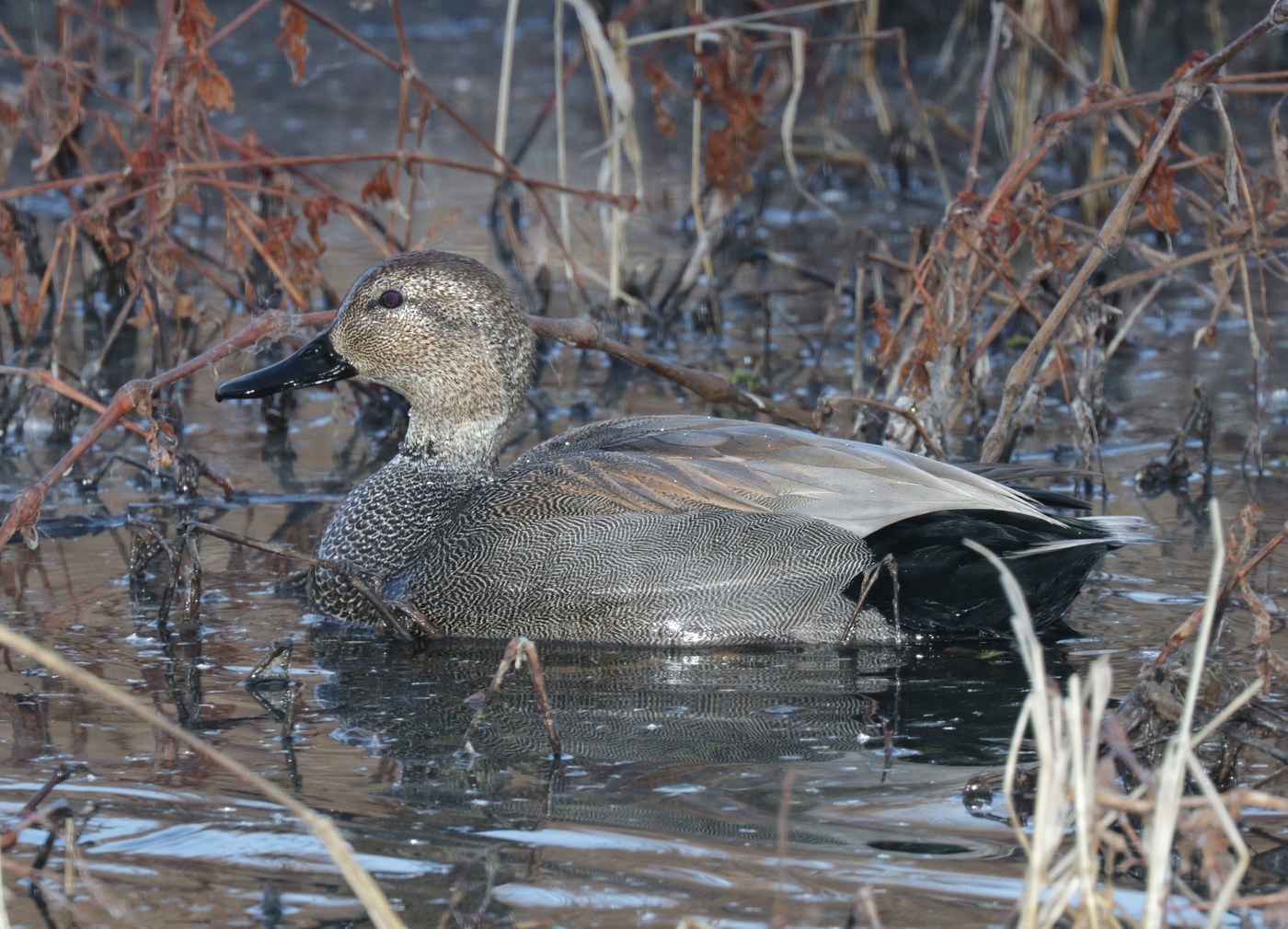
Key Field Marks
- Size & shape: A medium-sized dabbling duck, slightly smaller and slimmer than a Mallard, with a fairly steep forehead and a thin, squared-off bill.
- Male plumage: At a distance appears plain gray-brown, but up close shows fine black-and-white vermiculated (wavy-line) patterning over the body, a gray head, black rear end (undertail coverts), and a chestnut patch on the upper wing coverts often hard to see.
- Female plumage: Mottled brown overall, closely resembling a female Mallard, but with a thinner, more orange-edged bill with a dark culmen (Mallard females have a more uniformly orange bill) and a steeper forehead profile.
- Speculum: Both sexes show a small but distinctive white patch on the trailing edge of the inner wing (speculum) bordered by black, visible in flight and often visible at rest as a small white square on the folded wing — the single best mark to confirm Gadwall at any distance.
- Behavior: A classic dabbler, tipping up to feed on submerged vegetation rather than diving; often associates in mixed flocks with other dabbling ducks, especially American Wigeon, sometimes stealing food that wigeon bring to the surface.
Similar Species
- Female Mallard is bulkier, has a more uniformly orange bill (versus Gadwall's thinner bill with more black on the culmen), and lacks the white speculum patch, showing a blue speculum bordered with white bars instead.
- American Wigeon male has a green eye-patch and cream crown stripe, quite different from Gadwall's plain gray head; female Wigeon has a grayer head contrasting with a browner body, and both wigeon sexes lack the Gadwall's white speculum.
- The small white wing speculum, visible even on swimming or standing birds as a bright white square, is the most dependable field mark separating Gadwall from all similar brown/gray dabbling ducks.
Where & When to See It
- Range: Breeds across the northern prairies of the U.S. and Canada, as well as parts of Eurasia; winters across most of the U.S., Mexico, and southern Eurasia.
- Habitat: Prefers marshes, shallow lakes, and ponds with abundant submerged and emergent vegetation, including urban park ponds in winter.
- Season: A common winter resident across much of North America and a widespread breeder on the northern Great Plains; present year-round in parts of its range.
Voice & Behavior Cues
- Male gives a low, nasal "raeb" or reedy croaking note, quieter and less strident than a Mallard's quack.
- Female Gadwall gives a Mallard-like quack, but typically higher-pitched and less loud; often first detected by close association with American Wigeon flocks rather than a distinctive call alone.
Frequently asked questions
What is the easiest way to identify a Gadwall?
Look for the small white patch (speculum) on the trailing edge of the wing, visible on swimming or flying birds of both sexes, combined with the male's overall gray vermiculated body and black rear end.
How do I tell a female Gadwall from a female Mallard?
Female Gadwall has a thinner bill with more black on the upper edge, a steeper forehead, and a white (not blue) speculum, versus the female Mallard's more uniformly orange bill and blue speculum bordered in white.
Why are Gadwalls often seen near American Wigeon?
Gadwalls frequently associate with diving American Wigeon flocks and will steal aquatic vegetation that wigeon bring up from below, a notable foraging association.
Is the Gadwall a diving or dabbling duck?
It is a dabbling duck, feeding by tipping up at the surface to reach submerged vegetation rather than diving underwater like pochards or scaup.
Gadwall identified by the community
Recent Gadwall sightings identified with Bird Identifier.