
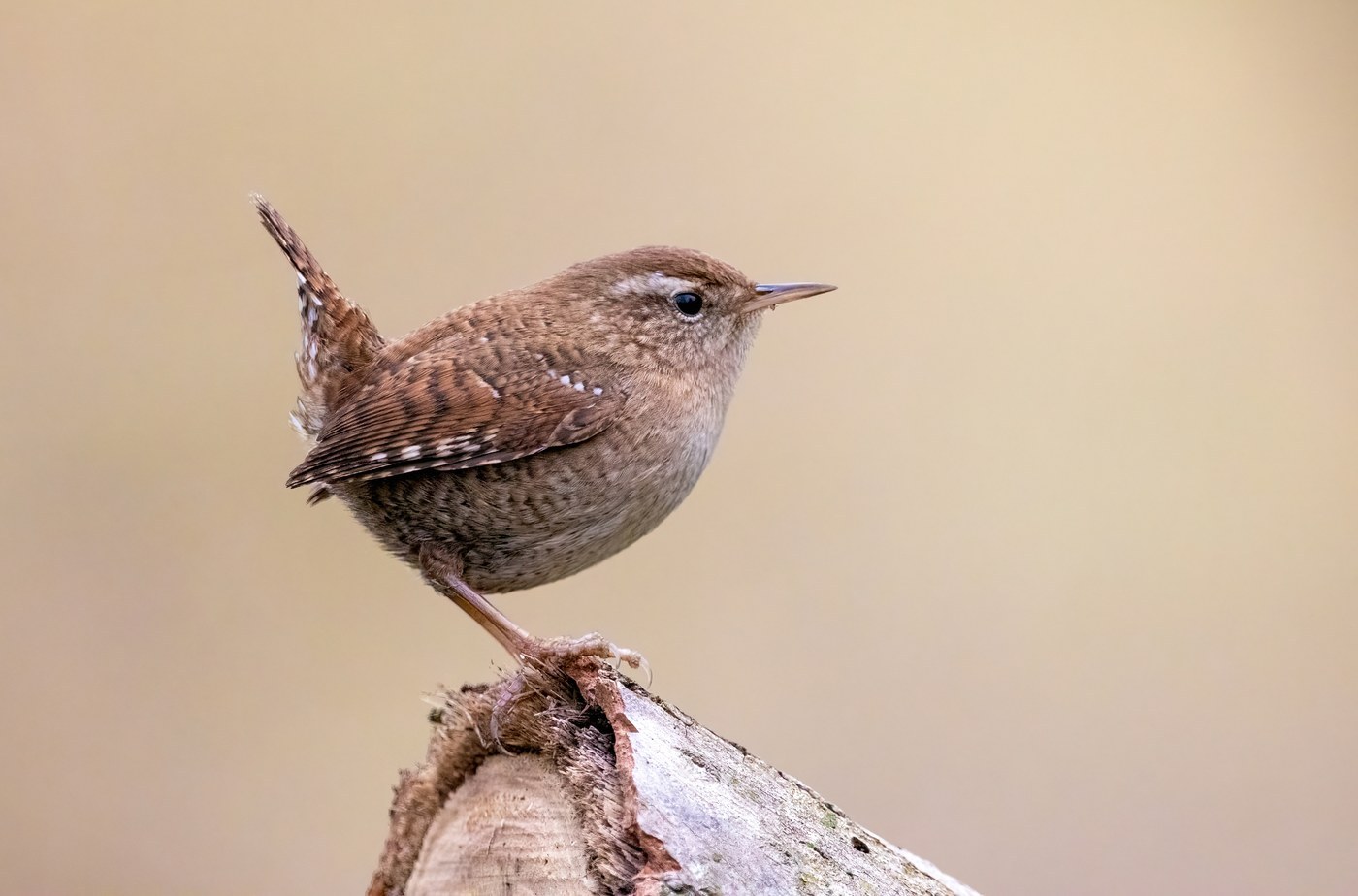
Eurasian Wren
Troglodytes troglodytes
A tiny, energetic brown songbird with a characteristically cocked tail and a surprisingly loud, powerful song.
- Size
- 9-10 cm (3.5-4 in) long, 13-17 cm wingspan
- Habitat
- woodlands, hedgerows, gardens, and dense undergrowth
- Type
- songbird
Spotted a bird like this?
Identify any bird from a photo, free.
Overview
The Eurasian Wren is one of the smallest songbirds in Europe, a rotund, russet-brown bird with fine dark barring on its wings, flanks, and tail. It is most often recognized by its habitually cocked tail, held almost vertically, and its restless, mouse-like habit of creeping through low vegetation, rarely still for long.
Despite its diminutive size, the Wren produces a remarkably loud, rapid, and powerful song, delivering far more volume per gram of body weight than almost any other bird.
How to identify it
Key field marks
- Very small, rounded body
- Warm russet-brown plumage with fine dark barring
- Short, frequently cocked tail
- Fast, whirring, low flight between cover
Similar species
- Dunnock is larger with gray underparts and a thin bill, lacking the Wren's cocked tail and barred plumage.
- No other common European songbird combines such tiny size with a constantly cocked tail.
Habitat & range
Habitat
Inhabits woodlands, hedgerows, scrub, gardens, and any habitat with dense low cover, including sea cliffs and moorland edges.
Range
Widespread across Europe, North Africa, and much of temperate Asia.
Migration
Mostly resident, though northern populations may move short distances in severe winters; populations can crash after very cold winters due to the bird's tiny size and high heat loss.
Behavior & voice
Behavior
Creeps and hops through dense low vegetation, rarely flying far, foraging actively and constantly; males may build several dummy nests for the female to choose from and can be polygamous.
Voice
An astonishingly loud, fast, warbling, trilling song for such a small bird, often ending in a distinctive rattle; call is a hard, scolding "tic-tic-tic."
Feeding
Gleans insects and spiders from crevices, leaf litter, and low vegetation, rarely taking seeds or berries.
Nesting
Builds a domed, ball-shaped nest of moss, leaves, and grass in dense cover, a bank, or crevice; lays 5-8 white eggs with fine reddish speckling.
Frequently asked questions
How small is the Eurasian Wren?
It is only about 9-10 cm (3.5-4 in) long, one of the smallest songbirds in Europe.
Why does the Wren hold its tail cocked up?
It's a characteristic posture of the species, held almost vertically, which along with its tiny rounded body is one of the easiest ways to identify it.
Why is the Wren's song so loud for its size?
Wrens have a specially structured song muscle and delivery that lets them produce extremely loud, rapid, powerful songs relative to their tiny body size.
Do Wren populations decline in cold winters?
Yes, because of their tiny size and high surface-area-to-volume ratio, Wrens can suffer significant population crashes after unusually cold winters.
Eurasian Wren guides
In-depth guides for identifying, finding, and understanding Eurasian Wren.
Other birds you may enjoy

Black Redstart
13-14.5 cm (5.1-5.7 in) long, 23-26 cm wingspan

Black-throated Sparrow
12-14 cm (4.7-5.5 in) long, about 19-20 cm (7.5-8 in) wingspan

Greater Bird-of-paradise
Body about 43 cm; males with additional flank plumes up to 50 cm and long tail wires

Blue Tit
11-12 cm (4.3-4.7 in) long, 17-20 cm wingspan

Red-billed Quelea
11.5–13 cm long, wingspan about 20–22 cm
White-plumed Antbird
13-14 cm (5-5.5 in) long

Pyrrhuloxia
19-22 cm (7.5-8.7 in) long, 30 cm wingspan

Blue-gray Tanager
16-18 cm (6-7 in) long

Blackburnian Warbler
11-13 cm (4.3-5.1 in) long, 20-22 cm wingspan

Bluethroat
13-14 cm (5.1-5.5 in) long, 20-22 cm wingspan

Eurasian Nuthatch
12-14.5 cm (4.7-5.7 in) long, 22.5-27 cm wingspan

Wood Thrush
19-21 cm (7.5-8.3 in) long, about 33 cm (13 in) wingspan