
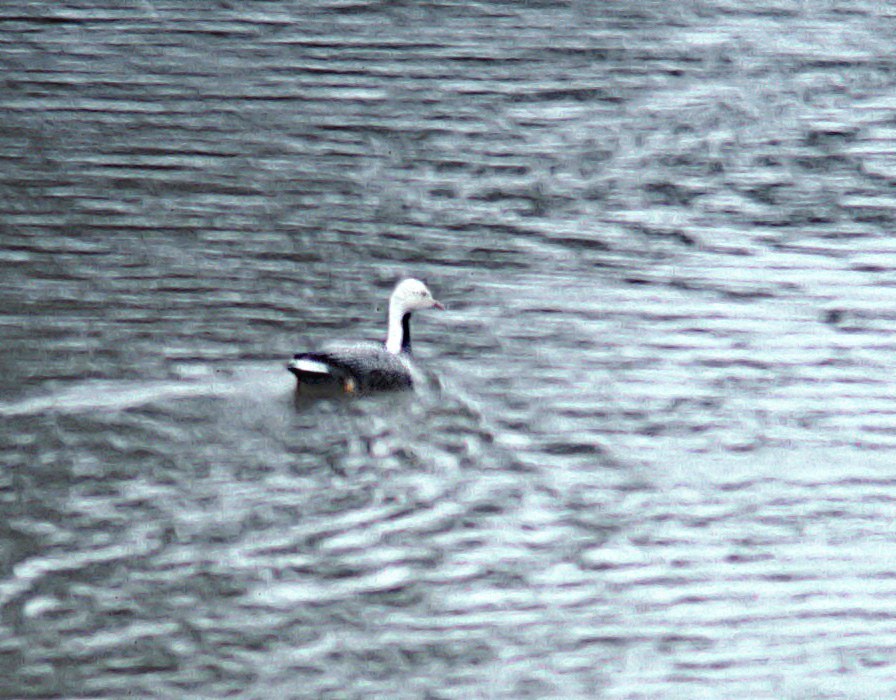
Emperor Goose
Anser canagicus
A stocky, silvery-grey goose with a scaled feather pattern, a white head and hindneck, and a strong preference for rocky Arctic and subarctic coastlines.
- Size
- 66-89 cm (26-35 in) long, about 130-145 cm wingspan
- Habitat
- coastal tundra, estuaries, and rocky or gravel beaches of the Bering Sea region
- Type
- waterfowl
Spotted a bird like this?
Identify any bird from a photo, free.
Overview
The Emperor Goose is one of the most distinctive geese in the world, with overall bluish-grey plumage finely edged in black and white, giving each feather a scalloped, tile-like appearance. The head and back of the neck are white, often stained rusty-orange from iron-rich water, while the chin and throat are black, and the short bill is pink.
Smaller and more compact than most "grey geese," it has a stocky build, short neck, and thick orange legs that set it apart from other geese sharing its Alaskan and Siberian range.
How to identify it
Key field marks
- Silvery-grey body with black-and-white scalloped feather edges
- White head and nape (frequently rust-stained), black throat and chin
- Short pink bill and bright orange legs
- Compact, short-necked, barrel-chested profile
Similar species
No other North American goose shares the scaled grey plumage and white head combination, making the Emperor Goose essentially unmistakable within its range. Juveniles are duller grey overall without the white head, but the scaled body pattern and stocky build still distinguish them from other young geese.
Habitat & range
Range and habitat
Emperor Geese breed almost entirely along the coastal tundra of western Alaska (notably the Yukon-Kuskokwim Delta) and adjacent coastal Chukotka in far eastern Russia, nesting near ponds and wetlands close to the sea.
Migration
Unlike most geese, Emperor Geese are strongly coastal year-round, wintering chiefly on rocky and gravel shorelines of the Alaska Peninsula and the Aleutian Islands, where they forage in the intertidal zone rather than moving far inland.
Behavior & voice
Behavior
Emperor Geese are wary but highly social, gathering in dense flocks on beaches and mudflats, often walking and foraging along the tideline rather than swimming far offshore.
Voice
The call is a distinctive nasal, repeated "kla-ha, kla-ha" or "u-lugh-uk," harsher and more rasping than typical goose honks.
Feeding
On the breeding grounds they graze on grasses, sedges, and berries; in winter they shift to a largely intertidal diet of mussels, clams, and other invertebrates picked from rocks and mudflats.
Nesting and breeding
Nests are shallow, down-lined scrapes on the open tundra near water, typically well hidden among vegetation; females alone incubate the clutch while males stand guard nearby.
Frequently asked questions
Where do Emperor Geese live?
They are found almost entirely along coastal western Alaska and far eastern Russia, breeding on coastal tundra and wintering on rocky Aleutian and Alaska Peninsula shorelines.
What makes the Emperor Goose different from other geese?
Its scaled silvery-grey plumage, white head and neck, black throat, and strongly coastal, intertidal lifestyle set it apart from other geese.
Why do Emperor Geese have rust-colored heads sometimes?
Iron oxide staining from the mineral-rich water they feed and preen in can tint the white feathers of the head and neck orange.
Is the Emperor Goose rare?
It has a relatively small, geographically restricted population and is classified as Near Threatened, having declined in the 20th century before partially recovering.
Emperor Goose guides
In-depth guides for identifying, finding, and understanding Emperor Goose.
Other birds you may enjoy
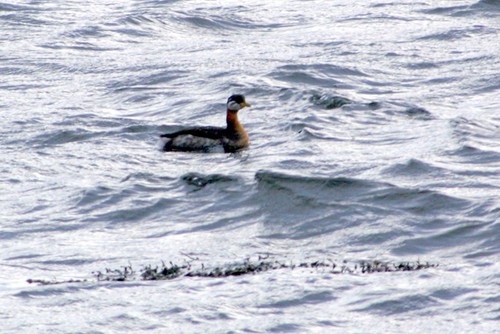
Red-necked Grebe
40-55 cm (16-22 in) long, 77-85 cm wingspan
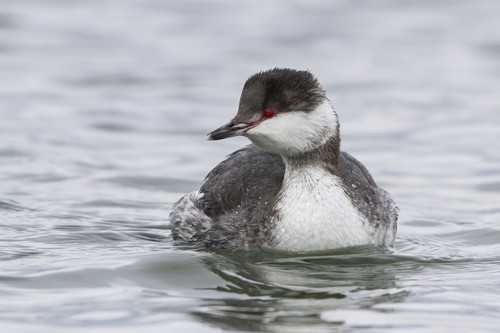
Horned Grebe
31-38 cm (12-15 in) long, 46-55 cm wingspan
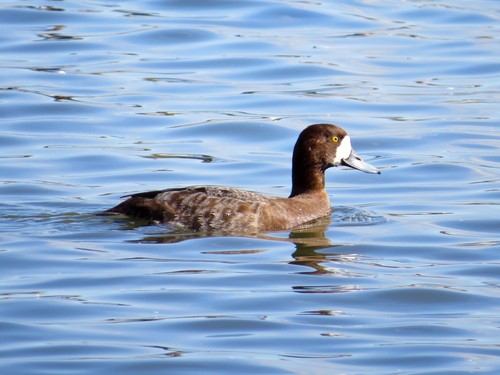
Greater Scaup
42-51 cm (16.5-20 in) long, 71-84 cm wingspan
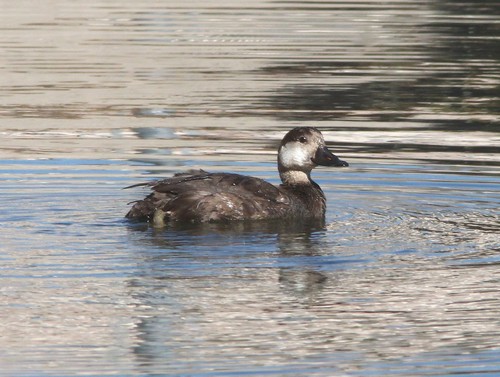
Black Scoter
43-54 cm (17-21 in) long, 79-90 cm wingspan
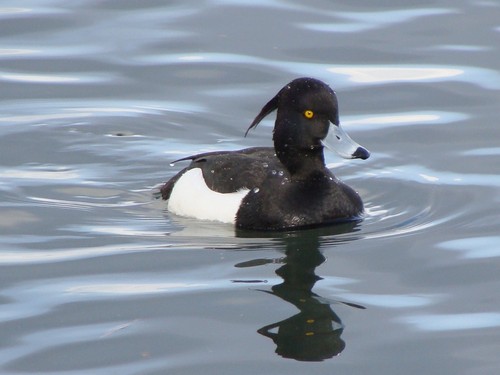
Tufted Duck
40-47 cm (16-18.5 in) long, 67-73 cm wingspan
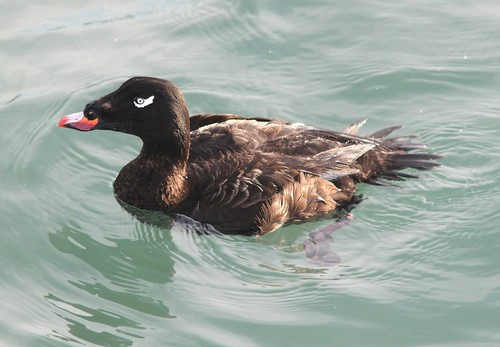
White-winged Scoter
48-58 cm (19-23 in) long, 86-99 cm wingspan
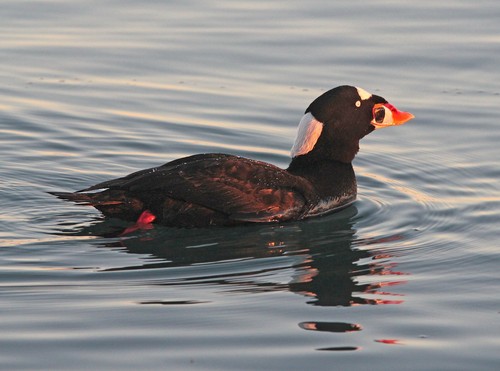
Surf Scoter
45-56 cm (18-22 in) long, 78-92 cm wingspan
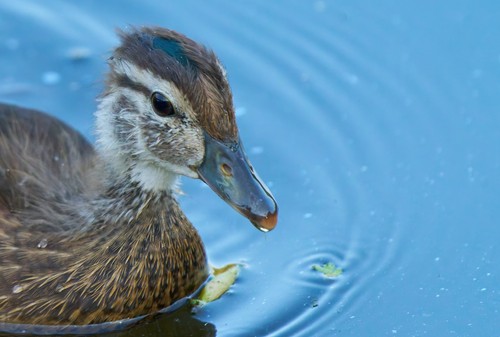
Wood Duck
47-54 cm (18.5-21 in) long, 66-73 cm wingspan
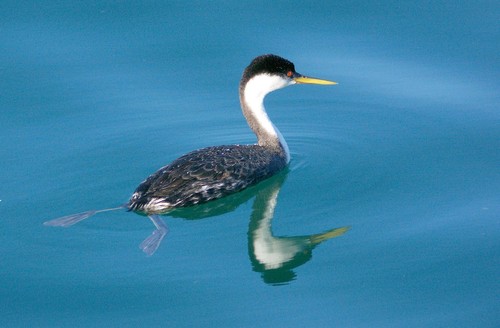
Western Grebe
56-74 cm (22-29 in) long, 79-102 cm wingspan
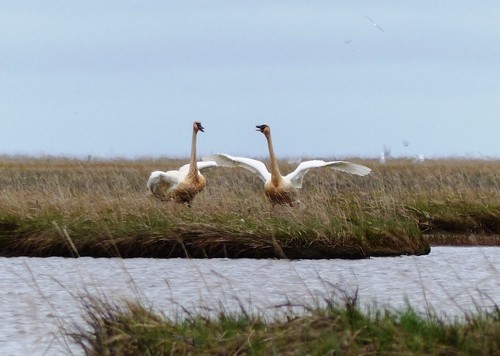
Tundra Swan
115-150 cm (45-59 in) long, about 180 cm wingspan
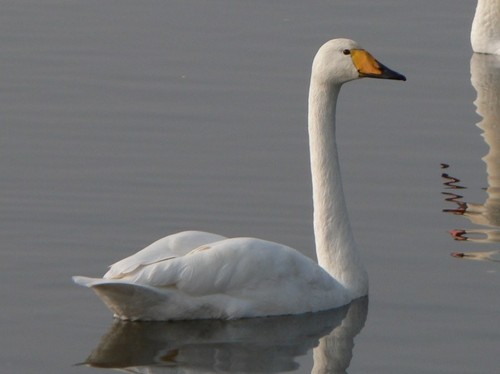
Whooper Swan
140-165 cm (55-65 in) long, 205-235 cm wingspan
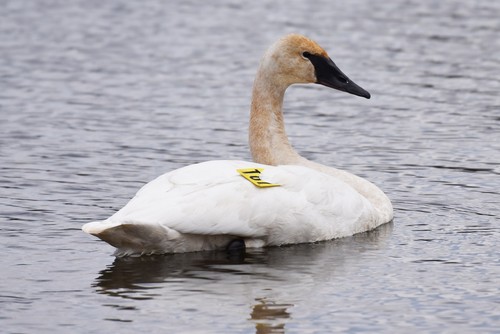
Trumpeter Swan
150-180 cm (59-71 in) long, up to 300 cm wingspan