
Emperor Goose Identification Guide
A striking, stocky Arctic goose with scaly silver-gray plumage, a white head and hindneck, and a short pink bill, restricted mainly to Alaska and the Russian Far East.
Read the full Emperor Goose encyclopedia entry →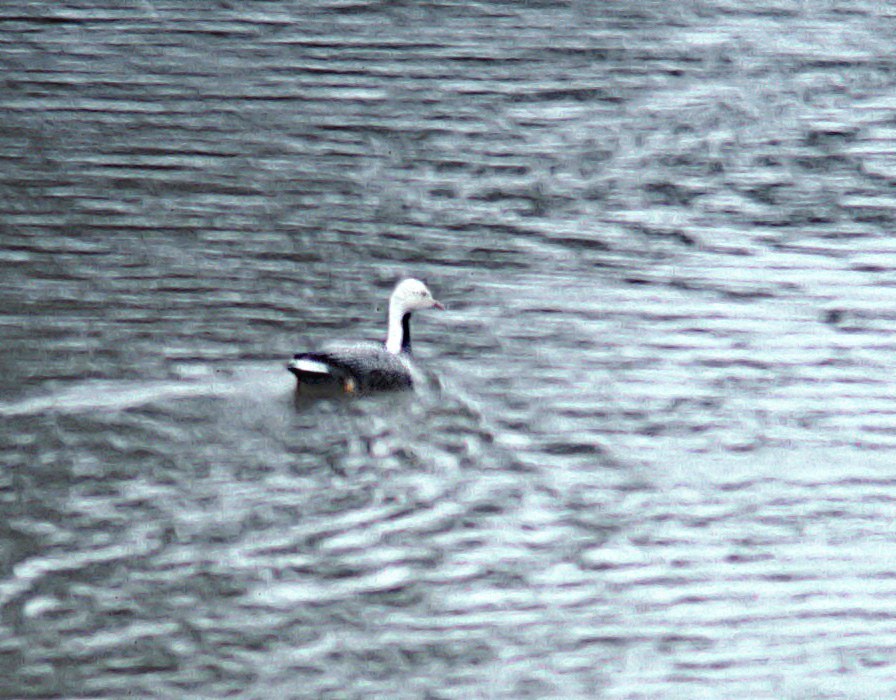
Overview
The Emperor Goose (Anser canagicus) is a compact, boldly patterned goose of Arctic and subarctic coastal habitats, breeding mainly on the Yukon-Kuskokwim Delta of western Alaska and along the Chukotka coast of the Russian Far East. It is one of the least numerous and most restricted-range geese in North America, and a much-sought target for birders visiting coastal Alaska.
Key Field Marks
- Size and shape: A relatively small, stocky goose, about 66-89 cm (26-35 in) long, with a short neck and short pink bill giving it a distinctively compact, thick-necked silhouette compared to other geese.
- Plumage: Overall silvery blue-gray body feathers, each tipped with black and white, creating a striking scaled or barred appearance across the back, flanks, and underparts.
- Head and neck: White head and hindneck contrasting with a black throat and foreneck (in breeding adults), often stained rusty-orange from iron-rich water at some times of year.
- Bill and legs: Short, stubby pink to purplish-pink bill and bright orange-yellow legs and feet — both colors stand out against the gray body and are useful at a distance.
- Juveniles: Duller gray-brown overall with a dark head lacking the clean white of adults, gradually acquiring the white head over the first year or two.
Separating Emperor Goose from Similar Species
No other goose shares the combination of scaly silver-gray body, white head/neck, black throat, and pink bill — it is essentially unmistakable in adult plumage. Ross's Goose and Snow Goose are white-bodied, not gray-scaled, and have different bill and leg colors. Brant, which shares some coastal habitat, is much darker overall with a black head, neck, and breast, lacking the scaled gray back and white head of Emperor Goose.
Where and When to See One
Emperor Geese breed on coastal tundra of the Yukon-Kuskokwim Delta in western Alaska and along the coast of Chukotka, Russia, nesting near ponds and coastal marshes. Nearly the entire population winters along the Alaska Peninsula and Aleutian Islands, particularly around Izembek Lagoon and Kodiak Island, making it one of the few geese that winters almost entirely within Alaska rather than migrating far south. The best times to see them are during the breeding season (May-August) on the YK Delta, or in winter (November-March) among rocky, kelp-lined shorelines and tidal flats of the Aleutians and Alaska Peninsula.
Behavior
Emperor Geese are strongly coastal and marine in habits outside the breeding season, feeding on eelgrass, algae, and invertebrates in intertidal zones and rocky shores rather than inland fields favored by many other geese. They form tight, often single-species flocks, and are notably wary and quick to flush compared to some other waterfowl.
Voice
Gives a distinctive, nasal, high-pitched "kla-ha, kla-ha" or similar repeated call, higher-pitched and more clipped than the calls of Canada or Snow Goose.
Quick Reference
- Compact goose with scaly silver-gray body, white head/hindneck, black throat
- Short pink bill, bright orange legs
- Breeds on Yukon-Kuskokwim Delta and Chukotka; winters almost entirely in coastal Alaska
- Strongly coastal, feeding on eelgrass and intertidal invertebrates
Frequently asked questions
Where is the best place to see an Emperor Goose?
The Alaska Peninsula and Aleutian Islands, especially around Izembek Lagoon and Kodiak Island, host the vast majority of the population in winter, while the Yukon-Kuskokwim Delta is the core breeding area in summer.
What makes Emperor Goose plumage distinctive?
Its body feathers are silvery gray with crisp black-and-white tips, creating a scaled or barred look, combined with a clean white head and neck and a black throat.
Do Emperor Geese migrate long distances like other geese?
Unlike most geese, Emperor Geese migrate only short distances, with nearly the whole population wintering within coastal Alaska rather than traveling to temperate latitudes further south.
What habitat do Emperor Geese prefer outside the breeding season?
They are highly coastal and marine, favoring rocky shorelines, kelp beds, and tidal flats where they feed on eelgrass and invertebrates, rather than the inland farmland many other geese use.