
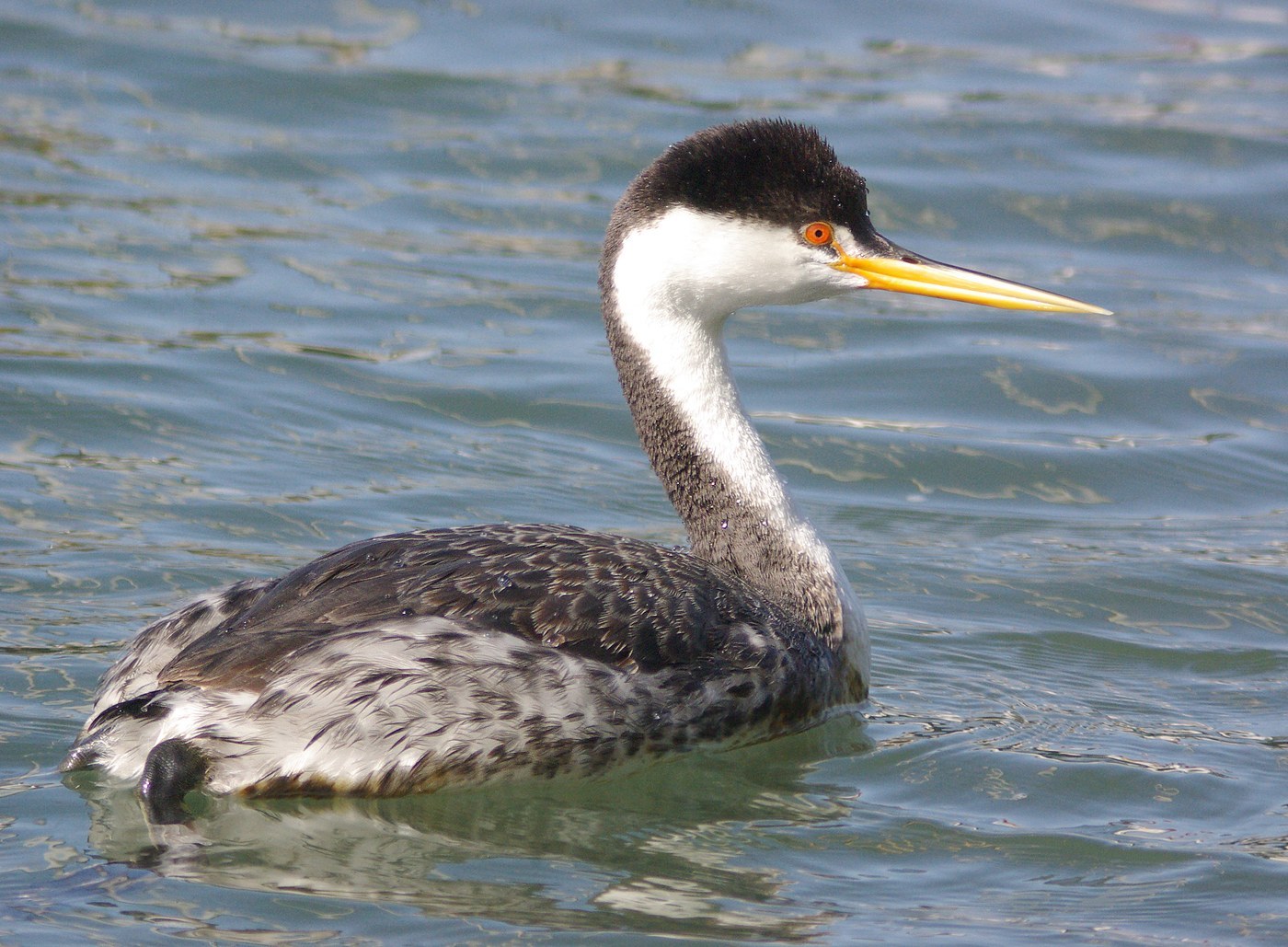
Clark's Grebe
Aechmophorus clarkii
A large, pale grebe closely resembling the Western Grebe, distinguished by a brighter orange bill and white plumage encircling the eye.
- Size
- 56-74 cm (22-29 in) long, 79-102 cm wingspan
- Habitat
- large freshwater lakes and marshes for breeding, coastal and open waters in winter
- Type
- waterfowl
Spotted a bird like this?
Identify any bird from a photo, free.
Overview
Clark's Grebe is a large, long-necked grebe nearly identical in size and shape to the Western Grebe, with which it often associates and occasionally hybridizes. It shows a bright orange-yellow bill, paler grey flanks, and white feathering that extends up and around the red eye, giving the face a cleaner, less masked appearance than its close relative. For many years it was considered merely a pale color morph of the Western Grebe before being recognized as a distinct species.
Like the Western Grebe, it inhabits large marshy lakes and performs similarly spectacular courtship displays.
How to identify it
Key field marks
- Bright orange-yellow bill, brighter than the Western Grebe's dull greenish bill
- White plumage surrounding the red eye, rather than a black mask through it
- Paler grey flanks compared to the Western Grebe
Similar species
- Western Grebe has a duller yellow-green bill and a black cap extending down through the eye, creating a masked look.
- The two species frequently occur together and can hybridize, occasionally producing birds with intermediate features.
Habitat & range
Habitat
Breeds on large marshy freshwater lakes with dense emergent vegetation; winters on coastal bays and large open waters.
Range
Breeds across parts of western North America, overlapping extensively with the Western Grebe; winters along the Pacific coast and into Mexico.
Migration
Migrates from inland breeding lakes to coastal or southern wintering areas.
Behavior & voice
Behavior
Performs the same elaborate "rushing" courtship display as the Western Grebe, with pairs sprinting across the water's surface side by side; often found in mixed flocks with Western Grebes.
Voice
Gives a single-noted "kreek" call, distinguishable with practice from the two-noted call of the Western Grebe.
Feeding
Dives to catch fish and aquatic invertebrates.
Nesting
Breeds colonially, often alongside Western Grebes, building a floating platform nest in marsh vegetation; typically lays 3-4 bluish-white eggs.
Frequently asked questions
How is Clark's Grebe different from the Western Grebe?
Clark's Grebe has a brighter orange-yellow bill and white plumage around the eye, while the Western Grebe has a duller bill and a black mask through the eye.
Do Clark's Grebes and Western Grebes interbreed?
Yes, the two closely related species occasionally hybridize where their ranges and habitats overlap.
What is unique about Clark's Grebe's call?
It gives a single-noted "kreek" call, in contrast to the two-noted call of the very similar Western Grebe.
Was Clark's Grebe always considered a separate species?
No, it was long treated as a pale color morph of the Western Grebe before ornithologists recognized it as a distinct species.
Clark's Grebe guides
In-depth guides for identifying, finding, and understanding Clark's Grebe.
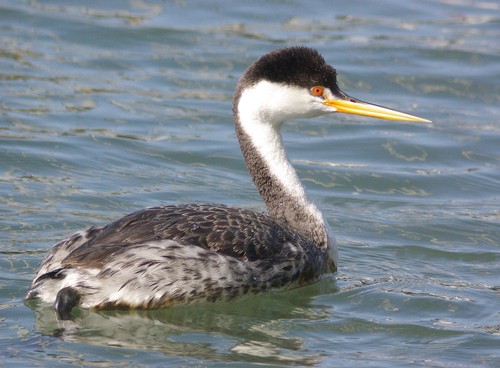
Other birds you may enjoy
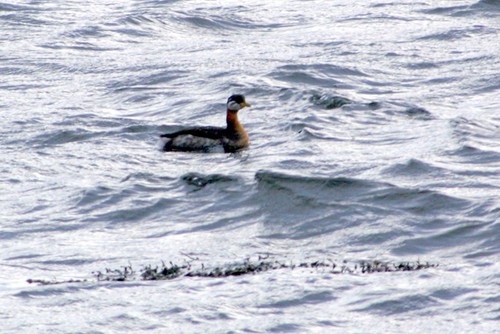
Red-necked Grebe
40-55 cm (16-22 in) long, 77-85 cm wingspan
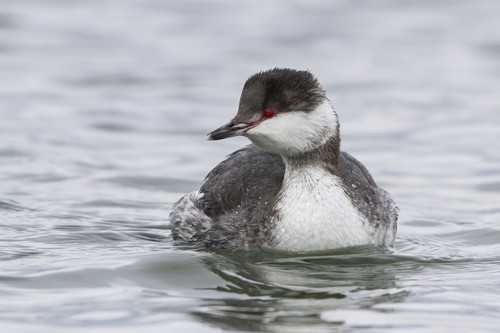
Horned Grebe
31-38 cm (12-15 in) long, 46-55 cm wingspan
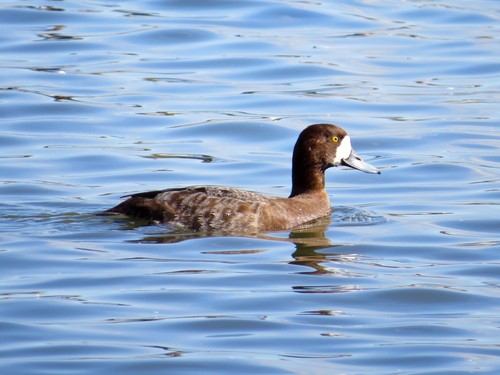
Greater Scaup
42-51 cm (16.5-20 in) long, 71-84 cm wingspan
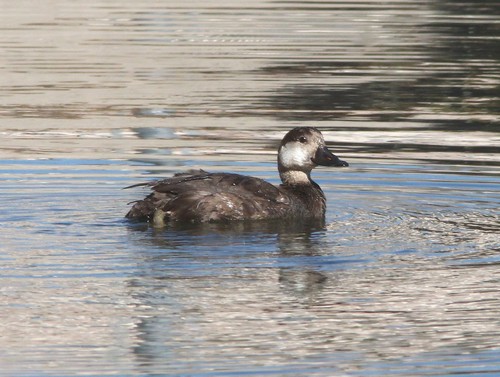
Black Scoter
43-54 cm (17-21 in) long, 79-90 cm wingspan
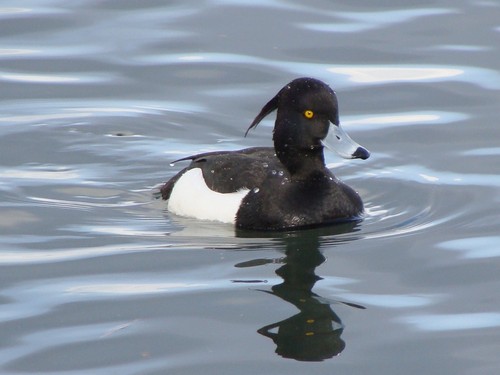
Tufted Duck
40-47 cm (16-18.5 in) long, 67-73 cm wingspan
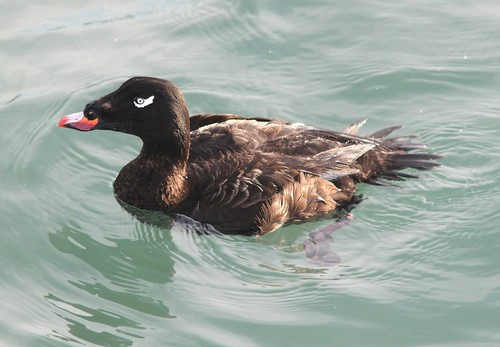
White-winged Scoter
48-58 cm (19-23 in) long, 86-99 cm wingspan
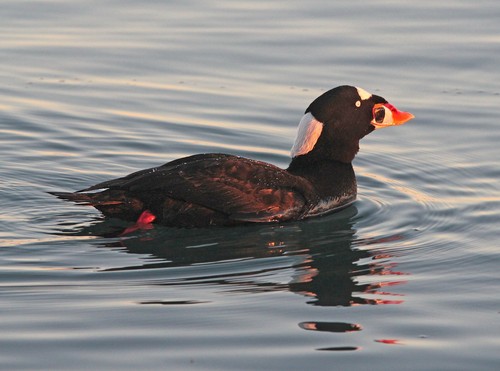
Surf Scoter
45-56 cm (18-22 in) long, 78-92 cm wingspan
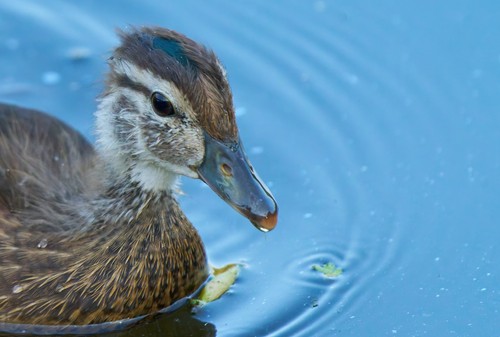
Wood Duck
47-54 cm (18.5-21 in) long, 66-73 cm wingspan
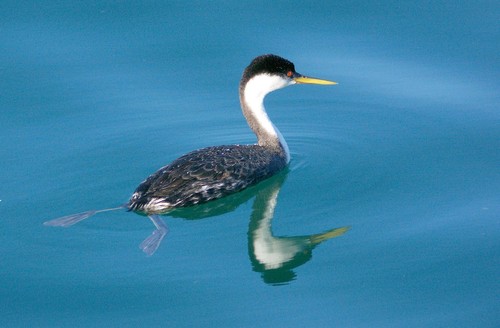
Western Grebe
56-74 cm (22-29 in) long, 79-102 cm wingspan
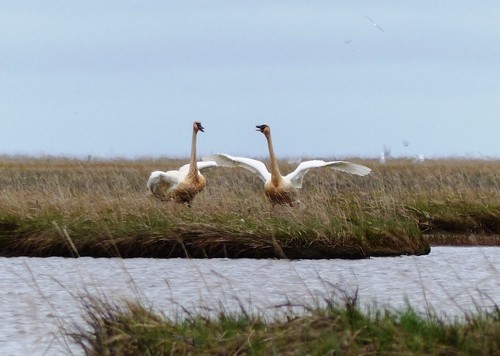
Tundra Swan
115-150 cm (45-59 in) long, about 180 cm wingspan
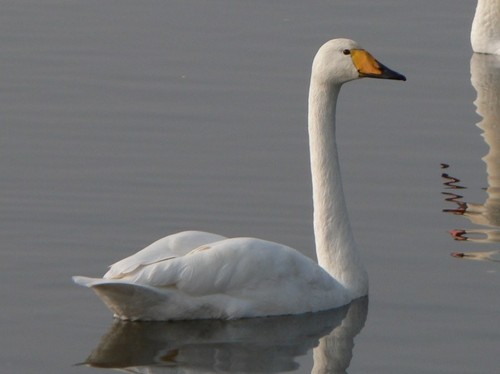
Whooper Swan
140-165 cm (55-65 in) long, 205-235 cm wingspan
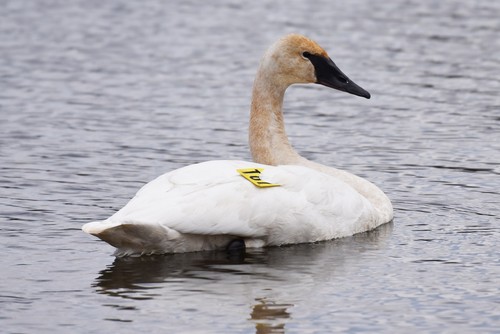
Trumpeter Swan
150-180 cm (59-71 in) long, up to 300 cm wingspan