
Clark's Grebe Identification Guide
A large, elegant black-and-white grebe of western lakes, nearly identical to Western Grebe but distinguished by a brighter orange bill and white feathering that surrounds the eye.
Read the full Clark's Grebe encyclopedia entry →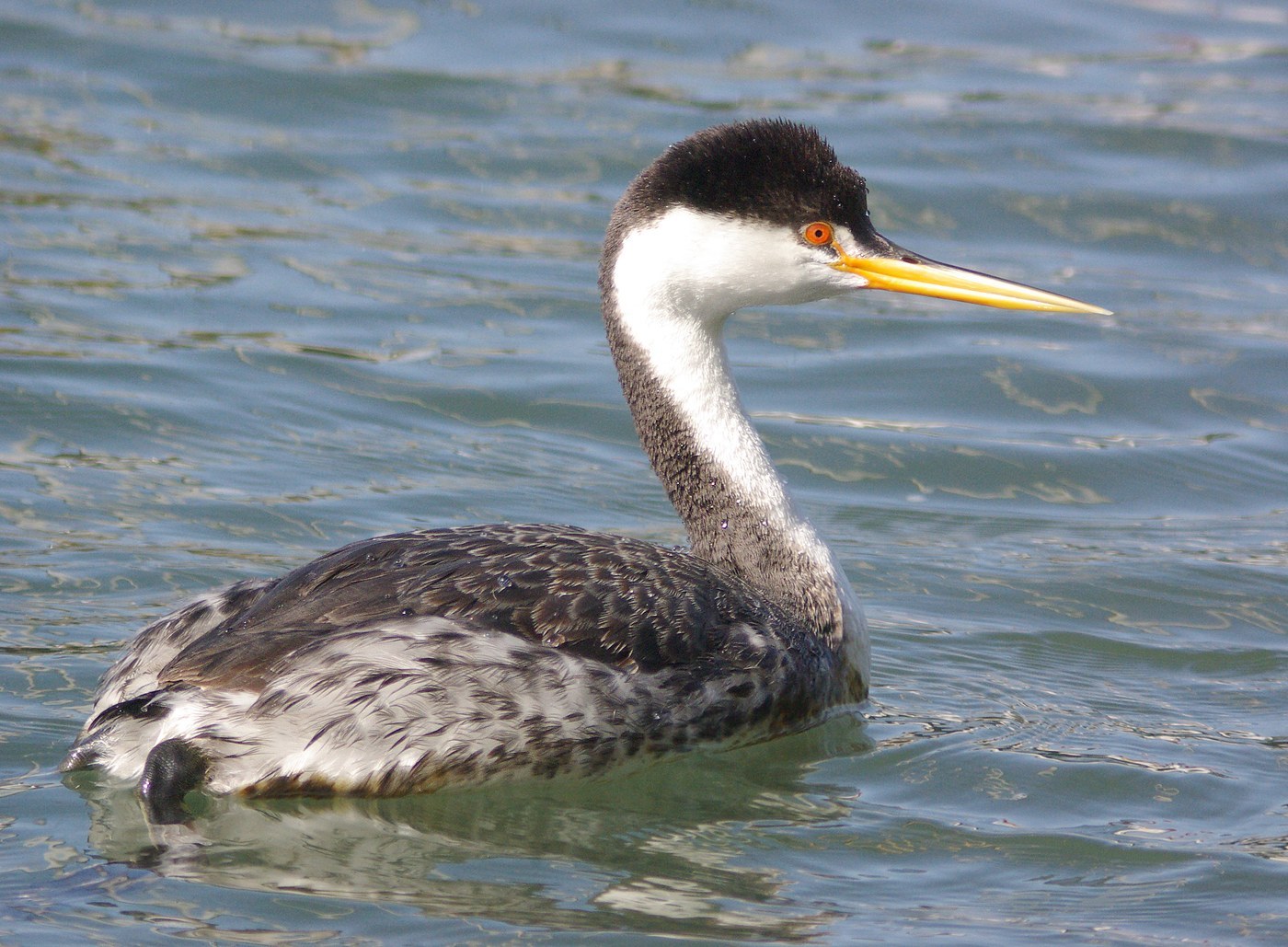
Key Field Marks
- Size & shape: A large, long-necked grebe (56-74 cm) with a slender swan-like neck, a straight dagger-like bill, and a low-riding profile on the water — structurally almost identical to Western Grebe.
- Plumage: Crisp black upperparts (crown, hindneck, back) contrasting with white underparts, foreneck, and face.
- Face pattern (key mark): In Clark's Grebe the black cap stops above the eye, leaving the eye surrounded by white — giving a brighter, cleaner-faced look. In Western Grebe the black extends down to include the eye, giving a darker, more masked look.
- Bill color: Clark's Grebe has a bright orange-yellow to yellow-orange bill; Western Grebe's bill is duller, more greenish-yellow to dull yellow-olive.
- Flank color: Clark's tends to show slightly paler gray flanks with less black extending onto the sides compared to Western.
Separating It From Similar Species
- Western Grebe: The primary confusion species — nearly identical in shape, size, range, and habits. Focus on the eye/face pattern and bill color described above; voice is also diagnostic (see below). The two species regularly associate and even hybridize, so some individuals show intermediate features.
- Other grebes (Red-necked, Horned, Eared): All are noticeably smaller and lack the long, slender swan-like neck and dagger bill shared by Western and Clark's Grebes.
Habitat, Range & Season
- Breeds colonially on large, marsh-fringed freshwater lakes and reservoirs across the western United States and interior Canada/Mexico, often alongside Western Grebe.
- Famous for its elaborate courtship "rushing" display, in which pairs race across the water surface in unison with necks arched.
- Winters mainly along the Pacific coast and on ice-free lakes and reservoirs in the interior and southern U.S. and Mexico, often forming large rafts on open water, sometimes mixed with Western Grebes.
- Generally less numerous than Western Grebe throughout the shared range.
Voice
- The most reliable field mark where views are poor: Clark's Grebe gives a single-note, upslurred "kreeed" call, whereas Western Grebe gives a two-note "krick-kreek" call. Listening to calling birds in a mixed flock is often the fastest way to sort the two species.
Frequently asked questions
What is the single best mark to separate Clark's Grebe from Western Grebe?
The face pattern: Clark's Grebe has white feathering that surrounds the eye, while Western Grebe's black cap extends down through the eye. Bill color (brighter orange in Clark's) and the single-note call are also reliable.
Do Clark's and Western Grebes hybridize?
Yes, the two species nest colonially together and hybrids with intermediate features do occur, which can make some individuals hard to identify with certainty.
Where can I see Clark's Grebe's courtship display?
On large western freshwater lakes during spring, where pairs perform a synchronized 'rushing' display, sprinting upright across the water surface side by side.
Is Clark's Grebe present year-round?
No — it breeds on interior lakes in summer and largely withdraws to milder coastal and interior wintering areas, though a few may linger where water stays open.