
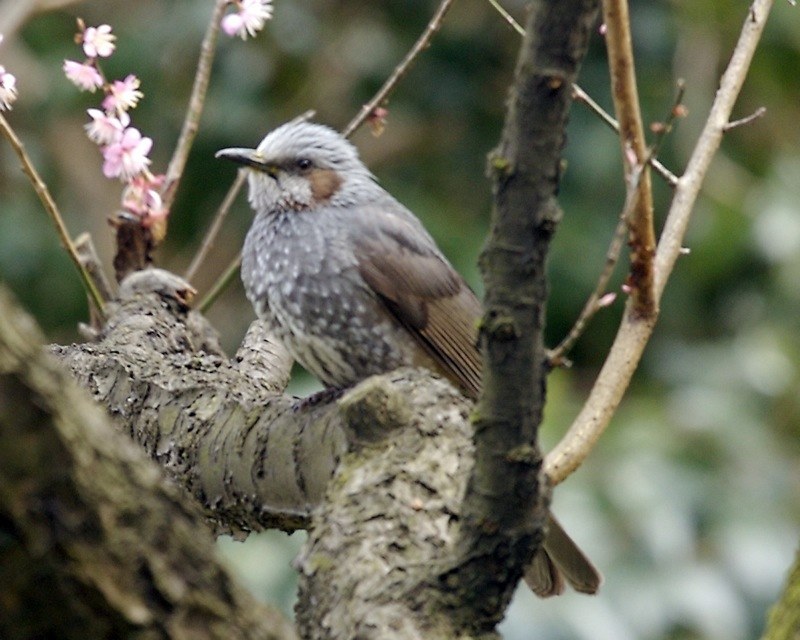
Brown-eared Bulbul
Hypsipetes amaurotis
A large, noisy grey bulbul with a distinctive chestnut-brown ear patch and a loud, far-carrying call.
- Size
- 27-29 cm (10.5-11.5 in) long
- Habitat
- forests, woodland edges, gardens, and urban parks
- Type
- songbird
Spotted a bird like this?
Identify any bird from a photo, free.
Overview
The Brown-eared Bulbul is a large, long-tailed songbird with mostly grey plumage, a shaggy, slightly crested crown, and a conspicuous chestnut-brown patch on the ear coverts that gives the species its name. The underparts show fine white spotting or streaking on a grey wash, and the wings and tail are darker grey-brown.
One of the most familiar and vocal birds across much of Japan and neighboring regions, it is equally at home in deep forest and busy city parks, where its loud, squealing calls are a near-constant backdrop, especially in fruiting trees during autumn and winter.
How to identify it
Key field marks
- Overall grey body with a shaggy, spiky crest
- Chestnut-brown ear patch on the side of the head
- Fine whitish spotting or streaking on the breast
- Long tail and somewhat hunched, large-headed silhouette
Similar species
- No other bulbul in its range combines the grey body with a chestnut ear patch, making it fairly distinctive.
- Light-vented Bulbul (Chinese Bulbul) is smaller, has a black cap with a white patch, and lacks the chestnut ear covert.
Habitat & range
Habitat
Uses a very wide range of wooded habitats, from mountain forests to lowland woodland, gardens, orchards, and urban parks with fruiting or flowering trees.
Range
Widespread across Japan, the Korean Peninsula, Taiwan, and the northern Philippines.
Migration
Northern and montane populations move to lower elevations or milder areas in winter, sometimes forming large, conspicuous migrating flocks, while many populations are resident.
Behavior & voice
Behavior
Bold, active, and often gregarious outside the breeding season, gathering in noisy flocks at fruiting or flowering trees; readily adapts to human-altered landscapes.
Voice
A loud, harsh, squealing "pee-yoh" or "hee-yo" call, along with a variety of other raucous, far-carrying notes.
Feeding
Feeds on fruit and berries, flower nectar (which it laps with a brush-tipped tongue), and insects, switching seasonally as availability changes.
Nesting
Builds a cup nest of twigs, grass, and moss in a tree or shrub; lays 3-5 pale eggs with reddish-brown speckling.
Frequently asked questions
How do you identify a Brown-eared Bulbul?
Look for a grey, shaggy-crested body with a distinctive chestnut-brown patch on the ear coverts and fine white spotting on the breast.
What does a Brown-eared Bulbul eat?
Mainly fruit and berries, flower nectar, and insects, with diet shifting seasonally depending on availability.
Why are Brown-eared Bulbuls so noisy?
They are highly vocal and social, especially outside the breeding season when flocks gather at fruiting trees and call loudly to each other.
Where does the Brown-eared Bulbul live?
Across Japan, Korea, Taiwan, and the northern Philippines, in forests, gardens, and urban parks.
Brown-eared Bulbul guides
In-depth guides for identifying, finding, and understanding Brown-eared Bulbul.
Other birds you may enjoy

Black Redstart
13-14.5 cm (5.1-5.7 in) long, 23-26 cm wingspan

Black-throated Sparrow
12-14 cm (4.7-5.5 in) long, about 19-20 cm (7.5-8 in) wingspan

Greater Bird-of-paradise
Body about 43 cm; males with additional flank plumes up to 50 cm and long tail wires

Blue Tit
11-12 cm (4.3-4.7 in) long, 17-20 cm wingspan

Red-billed Quelea
11.5–13 cm long, wingspan about 20–22 cm
White-plumed Antbird
13-14 cm (5-5.5 in) long

Pyrrhuloxia
19-22 cm (7.5-8.7 in) long, 30 cm wingspan

Blue-gray Tanager
16-18 cm (6-7 in) long

Blackburnian Warbler
11-13 cm (4.3-5.1 in) long, 20-22 cm wingspan

Bluethroat
13-14 cm (5.1-5.5 in) long, 20-22 cm wingspan

Eurasian Nuthatch
12-14.5 cm (4.7-5.7 in) long, 22.5-27 cm wingspan

Wood Thrush
19-21 cm (7.5-8.3 in) long, about 33 cm (13 in) wingspan