
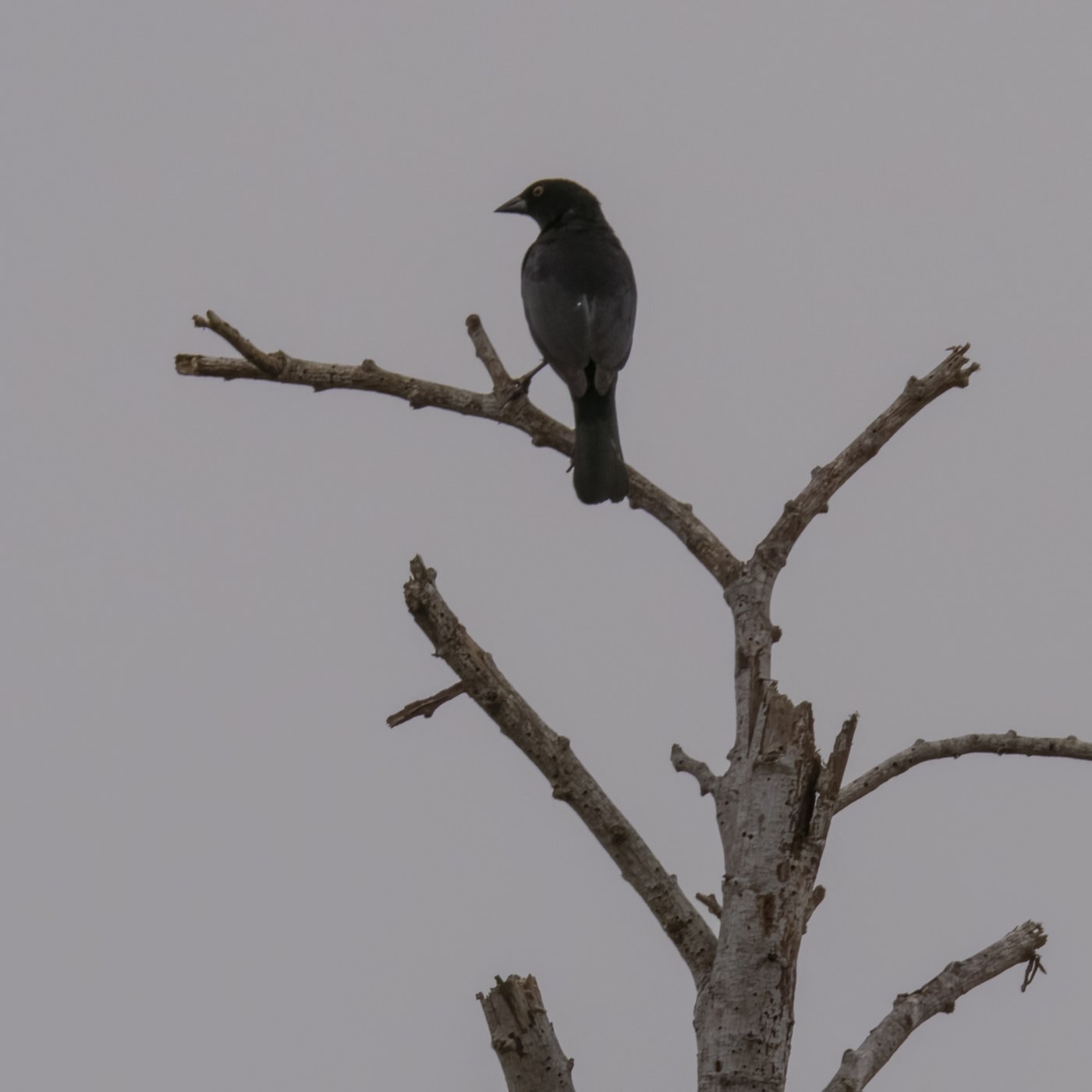
Bronzed Cowbird
Molothrus aeneus
A stocky blackbird with a distinctive ruff of neck feathers and striking red eyes that, like other cowbirds, lays its eggs in the nests of other birds.
- Size
- 18-22 cm (7-8.7 in) long, 28-37 cm wingspan
- Habitat
- open grasslands, agricultural fields, brushy edges, and suburban areas near livestock
- Type
- songbird
Spotted a bird like this?
Identify any bird from a photo, free.
Overview
The Bronzed Cowbird is a medium-sized, stocky blackbird named for the greenish-bronze sheen of the male's plumage, which can appear almost black in poor light. Males have a distinctive ruff of elongated neck feathers that they can raise into a hackle, especially during display, along with striking bright-red eyes. Females are duller gray-brown with the same red eye, though in some southern populations female eye color can be brown.
Like all cowbirds, the Bronzed Cowbird is a brood parasite, laying its eggs in the nests of other songbirds rather than building its own nest or raising its young, a strategy tied to its historically nomadic, livestock-following lifestyle.
How to identify it
Key Field Marks
- Stocky build with a short tail and thick, conical bill
- Males: glossy greenish-black to bronze body plumage, raised neck ruff, bright red eyes
- Females: plainer gray-brown, smaller ruff, red eyes
- Short, squared tail compared to grackles
Similar Species
- Brown-headed Cowbird males have a contrasting brown head against a glossy black body and dark eyes, and lack the neck ruff.
- Brewer's Blackbird males have yellow (not red) eyes and lack the ruff.
- Great-tailed Grackle is much larger with a very long tail.
Habitat & range
Habitat
Bronzed Cowbirds favor open country, including grasslands, pastures, agricultural fields, and suburban lawns, often near cattle or other grazing animals that stir up insects.
Range
Found from the southwestern and south-central United States (Arizona, Texas, and parts of the Gulf Coast) south through Mexico and Central America into northern South America.
Migration
Some northern populations are migratory, withdrawing from the northernmost parts of their U.S. range in winter, while southern populations are largely resident.
Behavior & voice
Behavior
Bronzed Cowbirds forage on the ground, often walking among grazing livestock or following farm machinery to catch flushed insects. Males display by fluffing the neck ruff, hovering briefly above a female, and singing.
Voice
The song is a series of harsh, creaky gurgles and squeaks; calls include sharp chattering notes.
Feeding
Primarily eats seeds and grain, supplemented with insects, especially during the breeding season.
Nesting & Breeding
As an obligate brood parasite, the Bronzed Cowbird builds no nest of its own. Females seek out the nests of other songbird species, particularly orioles and other icterids, and lay a single egg per host nest, leaving the host parents to incubate and raise the chick.
Frequently asked questions
Why does the Bronzed Cowbird have red eyes?
Bright red eyes are a distinctive feature of the species, present in both sexes in most populations, and are thought to play a role in display and species recognition.
Does the Bronzed Cowbird build its own nest?
No, it is a brood parasite that lays its eggs in the nests of other bird species, particularly orioles, and never builds a nest of its own.
How is the Bronzed Cowbird different from the Brown-headed Cowbird?
Bronzed Cowbirds have red eyes and a raised neck ruff in males, while Brown-headed Cowbirds have dark eyes and a contrasting brown head with no ruff.
Where do Bronzed Cowbirds live?
They are found in open country of the southwestern and south-central United States, Mexico, and Central America, often near livestock.
Bronzed Cowbird guides
In-depth guides for identifying, finding, and understanding Bronzed Cowbird.
Other birds you may enjoy

Black Redstart
13-14.5 cm (5.1-5.7 in) long, 23-26 cm wingspan

Black-throated Sparrow
12-14 cm (4.7-5.5 in) long, about 19-20 cm (7.5-8 in) wingspan

Greater Bird-of-paradise
Body about 43 cm; males with additional flank plumes up to 50 cm and long tail wires

Blue Tit
11-12 cm (4.3-4.7 in) long, 17-20 cm wingspan

Red-billed Quelea
11.5–13 cm long, wingspan about 20–22 cm
White-plumed Antbird
13-14 cm (5-5.5 in) long

Pyrrhuloxia
19-22 cm (7.5-8.7 in) long, 30 cm wingspan

Blue-gray Tanager
16-18 cm (6-7 in) long

Blackburnian Warbler
11-13 cm (4.3-5.1 in) long, 20-22 cm wingspan

Bluethroat
13-14 cm (5.1-5.5 in) long, 20-22 cm wingspan

Eurasian Nuthatch
12-14.5 cm (4.7-5.7 in) long, 22.5-27 cm wingspan

Wood Thrush
19-21 cm (7.5-8.3 in) long, about 33 cm (13 in) wingspan