
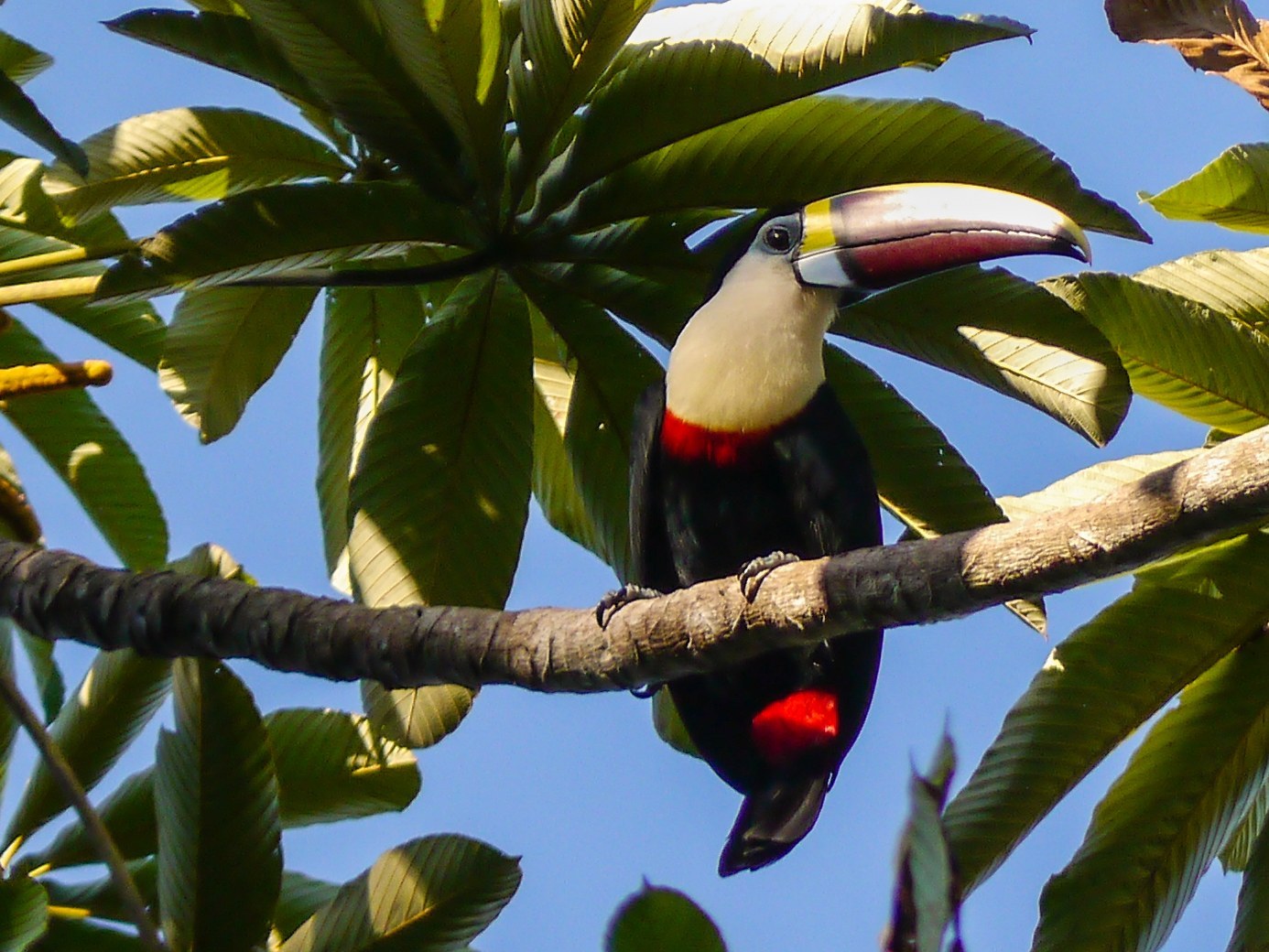
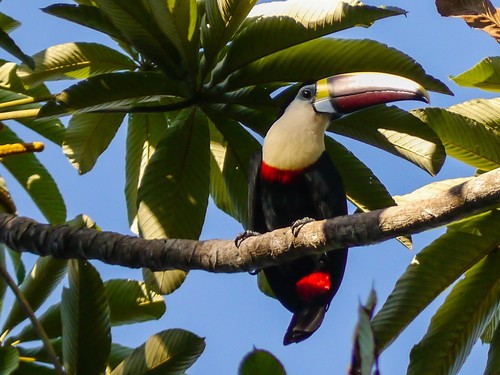
White-throated Toucan
Ramphastos tucanus
A large Amazonian rainforest bird famous for its massive orange-and-black bill, glossy black body, and bright white throat and chest patch.
- Size
- 53-61 cm (21-24 in) long including the large bill; bill alone up to 15-19 cm
- Habitat
- lowland tropical rainforest, forest edges, and riverside woodlands of the Amazon basin
- Type
- other
Spotted a bird like this?
Identify any bird from a photo, free.
Overview
The White-throated Toucan is one of the largest and most spectacular members of the toucan family, instantly recognizable by its oversized, brightly colored bill perched atop a stocky, mostly black body. The plumage is a deep glossy black over the back, wings, and belly, contrasted sharply by a clean white throat and upper breast, a patch of red on the lower belly and undertail coverts, and a ring of bare blue or purple-blue skin around the eye. The enormous bill is a striking mix of colors depending on subspecies, most commonly showing black on the upper mandible with a broad band of yellow-orange or red-orange, and blending toward the base with black and a thin white line - despite its size, the bill is remarkably lightweight, made of a keratin sheath over a honeycombed bony core. Two well-known subspecies groups exist: the nominate 'Red-billed Toucan' of the Amazon south and east of the Amazon River, and the 'Ariel Toucan' or 'Cuvier's Toucan' forms found on the north and west sides, which differ mainly in bill color pattern. Toucans use their giant bill for reaching fruit at the tips of branches, for display, and for thermoregulation, radiating excess body heat through the bill's rich blood supply.
How to identify it
Key Field Marks
- Very large size for a canopy bird, with an unmistakably oversized, colorful bill nearly as long as the body
- Overall glossy black plumage with a crisp white bib covering the throat and upper chest
- Red patch on the lower belly/undertail area, visible from below or when the bird turns
- Bare blue-toned skin around the eye
- Bill pattern varies by region: mostly black with orange-yellow markings (Red-billed Toucan) versus more extensively colorful with green-yellow-red tones (Ariel/Cuvier's forms)
Similar Species
- Channel-billed Toucan (Ramphastos vitellinus) is smaller with a yellow throat/chest instead of white, and a more uniformly dark bill
- Toco Toucan (Ramphastos toco) has an all-orange bill and a mostly white (not black) body aside from a black cap and wings, and prefers more open habitats
- Channel-billed and Red-billed Toucans overlap in parts of the Amazon, but the white (versus yellow) throat of the White-throated Toucan is diagnostic at close range
- Its deep, far-carrying yelping call is also a reliable way to separate it from smaller toucans and toucanets in mixed-species canopy flocks
Habitat & range
Habitat
The White-throated Toucan inhabits the canopy and mid-story of humid lowland and foothill tropical rainforest, including terra firme forest, varzea (seasonally flooded) forest, forest edges, and secondary growth, generally staying below about 1,200-1,400 m elevation.
Range
This species is widespread across the Amazon Basin of South America, occurring in Brazil, Colombia, Venezuela, the Guianas, Ecuador, Peru, and Bolivia, with its range split by the Amazon and Rio Negro rivers into distinct subspecies groups that some authorities treat as separate species.
Migration
The White-throated Toucan is a non-migratory, sedentary resident, generally remaining within its home forest territory year-round, though pairs and small groups may wander locally in search of fruiting trees.
Behavior & voice
Behavior
White-throated Toucans are typically seen in pairs or small family groups moving through the upper and middle canopy, hopping heavily along branches rather than making long flights, and often engaging in bill-clacking and playful sparring between individuals, sometimes tossing fruit to one another. They can appear somewhat ungainly in flight, with shallow, undulating wingbeats interspersed with glides.
Voice
The call is a loud, far-carrying, croaking or yelping series of notes, often rendered as a repeated 'dios-te-de, dios-te-de' or barking 'kew-kew-kew,' delivered from a high exposed perch, especially at dawn and dusk; this vocalization can carry for over a kilometer through the forest.
Feeding
The diet is predominantly fruit, which the bird plucks with the tip of its long bill and tosses back to swallow whole; it supplements this with large insects, and it is also an opportunistic nest predator, raiding the nests of smaller birds for eggs and chicks.
Nesting and Breeding
White-throated Toucans nest in natural tree cavities or abandoned woodpecker holes high in the canopy, where the female lays a small clutch of white eggs; both parents share incubation and chick-feeding duties, and the young are born naked and helpless, fledging after several weeks in the nest.
Frequently asked questions
How big is a White-throated Toucan's bill?
The bill can measure 15-19 cm (6-7.5 in) long, nearly a third of the bird's total body length, though it is lightweight due to its hollow, honeycombed internal structure.
What does a White-throated Toucan eat?
It primarily eats fruit, plucked from canopy trees with the tip of its bill, along with large insects, and it occasionally raids other birds' nests for eggs and nestlings.
Where do White-throated Toucans live?
They inhabit lowland tropical rainforest throughout the Amazon Basin in South America, including Brazil, Peru, Colombia, Venezuela, Ecuador, Bolivia, and the Guianas.
How can you tell a White-throated Toucan from a Toco Toucan?
The White-throated Toucan has a mostly black body with a white throat patch and a black-and-orange bill, while the Toco Toucan has a mostly white body, black wings, and an entirely bright orange bill.
What sound does a White-throated Toucan make?
It gives a loud, repetitive croaking or yelping call, often described as sounding like 'dios-te-de,' which carries widely through the forest canopy, especially at dawn and dusk.
Do White-throated Toucans migrate?
No, they are non-migratory residents that stay within their forest home range year-round, though they may move locally to follow fruiting trees.
White-throated Toucan guides
In-depth guides for identifying, finding, and understanding White-throated Toucan.
Other birds you may enjoy
Kiwi
35-55 cm (14-22 in) long; roughly chicken-sized
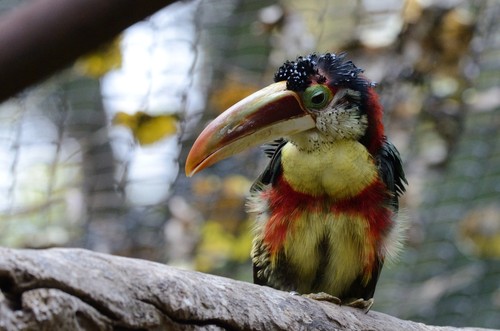
Curl-crested Aracari
41-46 cm (16-18 in) long, including a long bill and tail
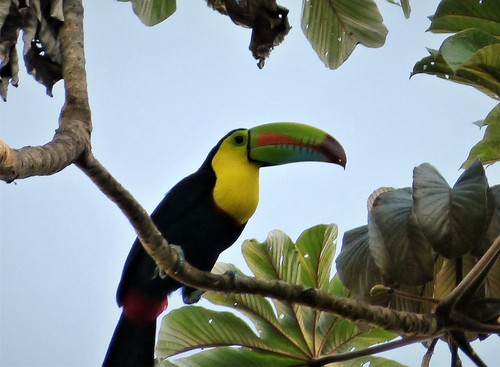
Keel-billed Toucan
42-55 cm (17-22 in) long including bill
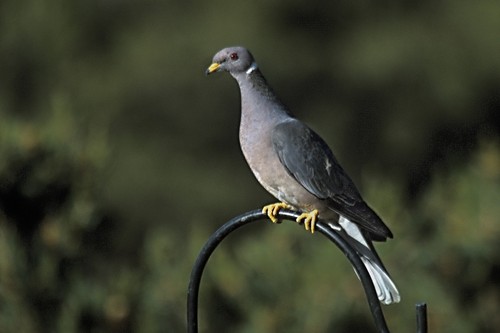
Band-tailed Pigeon
33-38 cm (13-15 in) long, wingspan about 66 cm (26 in)
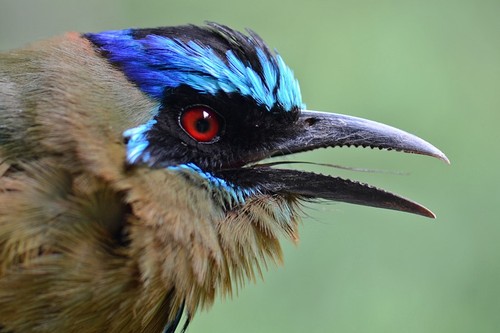
Blue-crowned Motmot
38-43 cm (15-17 in) long including tail
White-tipped Dove
27-30 cm (10.5-12 in) long, 38-43 cm wingspan
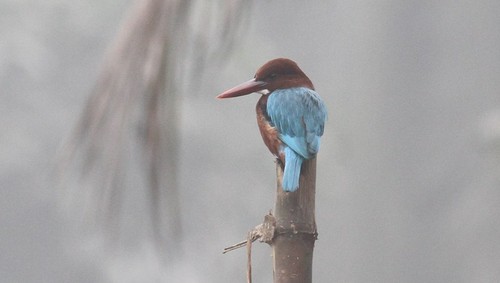
White-throated Kingfisher
27-28 cm (10.5-11 in) long
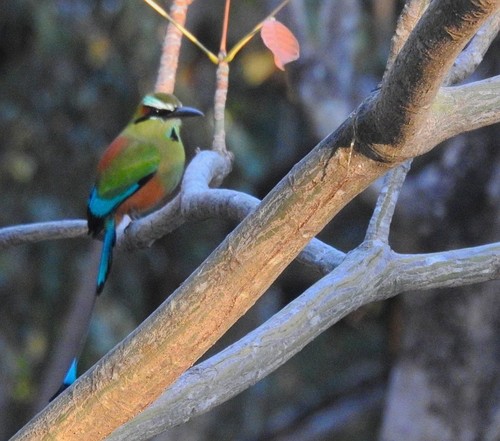
Turquoise-browed Motmot
34 cm (13 in) long including tail
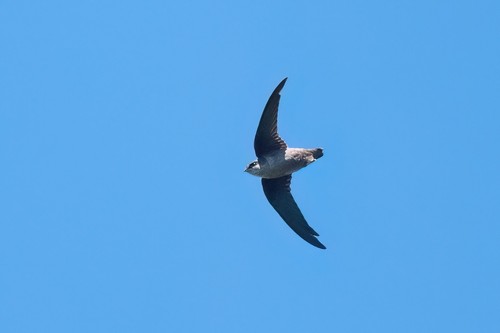
Vaux's Swift
10-12 cm (4-4.5 in) long, 27-30 cm wingspan
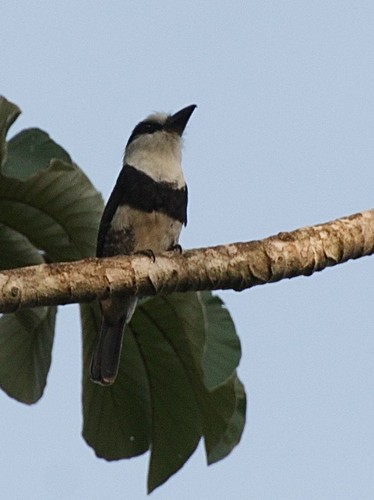
White-necked Puffbird
22-24 cm (8.5-9.5 in) long
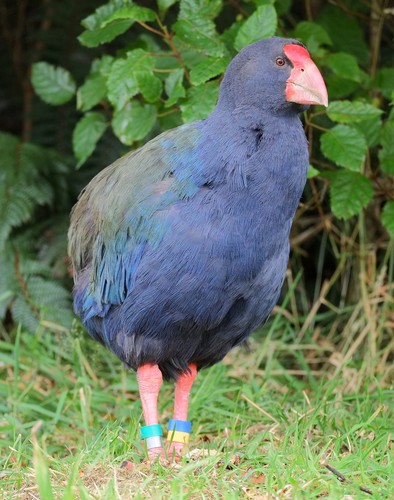
Takahe
50 cm (20 in) long, up to 3.5 kg; flightless
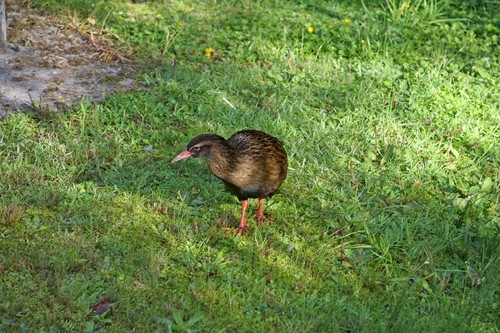
Weka
50-60 cm (20-24 in) long; flightless