
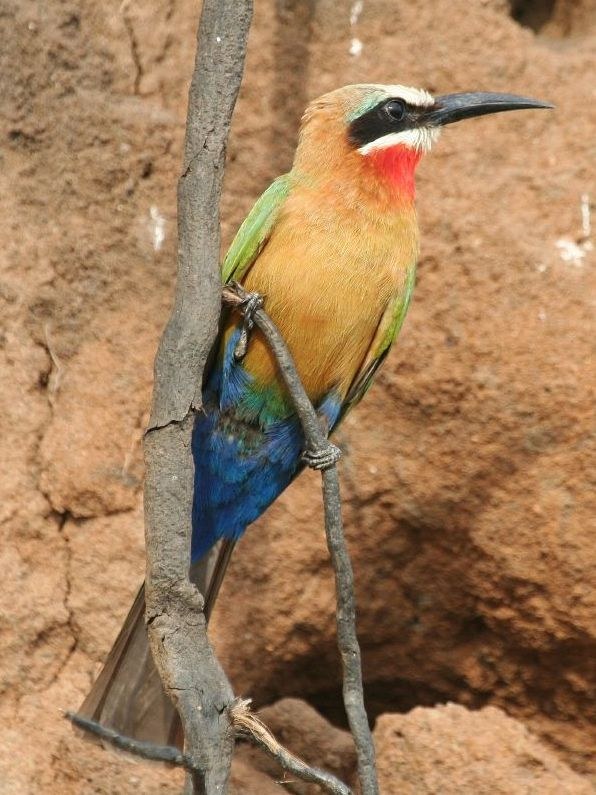
White-fronted Bee-eater
Merops bullockoides
A colorful, colonially nesting African bee-eater with a white forehead, crimson throat patch, and green body, best known for its cooperative breeding system.
- Size
- 22–24 cm long, wingspan roughly 30–35 cm
- Habitat
- Riverine woodland and savanna near sandy riverbanks, in East and southern Africa
- Type
- other
Spotted a bird like this?
Identify any bird from a photo, free.
Overview
The White-fronted Bee-eater is a medium-sized, sociable bee-eater closely tied to river valleys, where it nests in dense colonies in sandy banks.
Appearance
- White forehead and a broad black mask through the eye
- Bright crimson-red throat patch bordered below by a pale sky-blue band
- Green back and wings, cinnamon-buff belly
- Blue rump, visible in flight
- Slightly notched tail
Sexes are similar; juveniles show a duller throat patch and less contrast overall.
How to identify it
Key field marks
- White forehead band contrasting with the black facial mask
- Deep red (crimson) throat patch edged with pale blue
- Green upperparts with a buffy-cinnamon belly and blue rump
Similar species
- Carmine Bee-eaters lack the white forehead and have overall pink-red body plumage rather than green with a red throat patch.
- Little Bee-eater is much smaller with a yellow, not red, throat.
- The white forehead combined with the crimson throat patch is unique among African bee-eaters.
Habitat & range
Range
Found across East and southern Africa, from Kenya and Uganda south through Tanzania, Zambia, Zimbabwe, and Botswana to South Africa.
Habitat
Closely associated with rivers and lakes bordered by open woodland or savanna, since it needs vertical sandy banks for nest burrows; also uses road cuttings and quarries.
Movements
Largely resident near permanent water, though some local dispersal occurs outside the breeding season.
Behavior & voice
Behavior
Highly social, living in colonies of dozens to hundreds of pairs that dig burrows into cliffs and banks; family groups often include non-breeding helpers that assist in feeding chicks.
Voice
A nasal, burry "gooor" or "quop" contact call, often given in chorus by colony members, plus various chattering notes at the colony.
Feeding
Catches bees, wasps, and other flying insects in swooping sallies from an exposed perch, beating prey on the perch before eating it.
Nesting
Excavates long tunnel nests (up to 1–2 m) into sandy riverbanks or cliffs; breeding is cooperative, with related helpers assisting the breeding pair, and colonies can be dense and long-lived.
Frequently asked questions
What makes the White-fronted Bee-eater's throat patch distinctive?
It has a bright crimson-red throat patch bordered by a pale blue band beneath a white forehead and black eye mask — a combination unique among African bee-eaters.
Where do White-fronted Bee-eaters nest?
They dig long tunnel burrows into sandy riverbanks and cliffs, nesting in large, dense colonies near rivers and lakes.
Do White-fronted Bee-eaters help raise each other's young?
Yes, they are known for cooperative breeding, in which non-breeding relatives act as helpers, assisting in feeding chicks at the nest.
How does the White-fronted Bee-eater differ from Carmine Bee-eaters?
White-fronted Bee-eaters have green upperparts, a buff belly, and a white forehead with a red throat patch, whereas Carmine Bee-eaters are largely pink-red overall with a turquoise crown.
White-fronted Bee-eater guides
In-depth guides for identifying, finding, and understanding White-fronted Bee-eater.
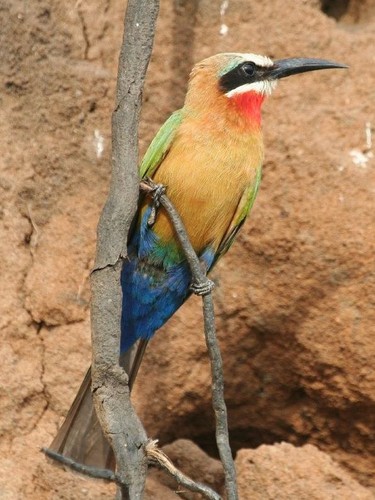
White-fronted Bee-eater identified by the community
Real birds identified with Bird Identifier.
Other birds you may enjoy
Kiwi
35-55 cm (14-22 in) long; roughly chicken-sized
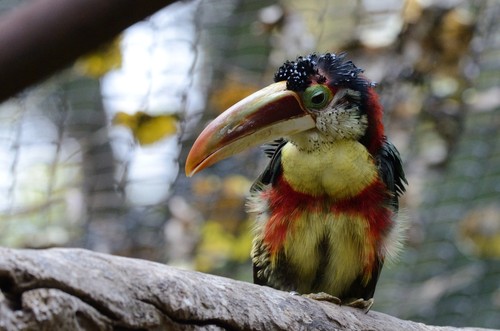
Curl-crested Aracari
41-46 cm (16-18 in) long, including a long bill and tail
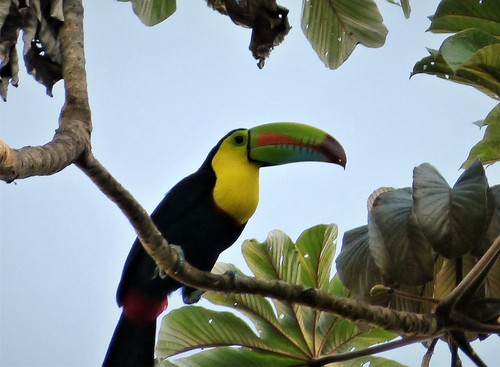
Keel-billed Toucan
42-55 cm (17-22 in) long including bill
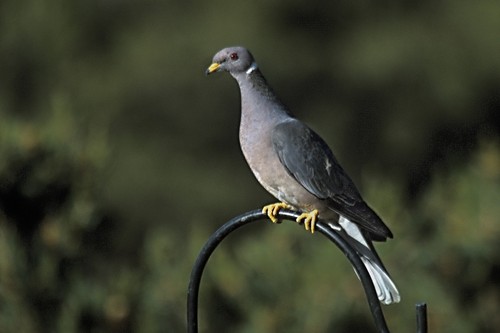
Band-tailed Pigeon
33-38 cm (13-15 in) long, wingspan about 66 cm (26 in)
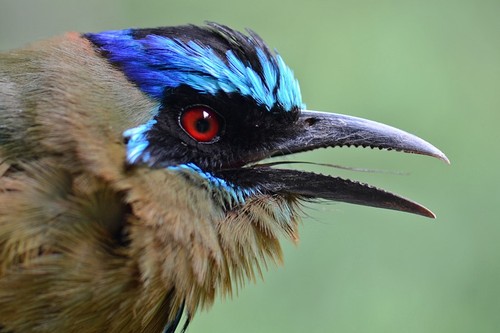
Blue-crowned Motmot
38-43 cm (15-17 in) long including tail
White-tipped Dove
27-30 cm (10.5-12 in) long, 38-43 cm wingspan
White-throated Kingfisher
27-28 cm (10.5-11 in) long
Turquoise-browed Motmot
34 cm (13 in) long including tail
Vaux's Swift
10-12 cm (4-4.5 in) long, 27-30 cm wingspan
White-necked Puffbird
22-24 cm (8.5-9.5 in) long
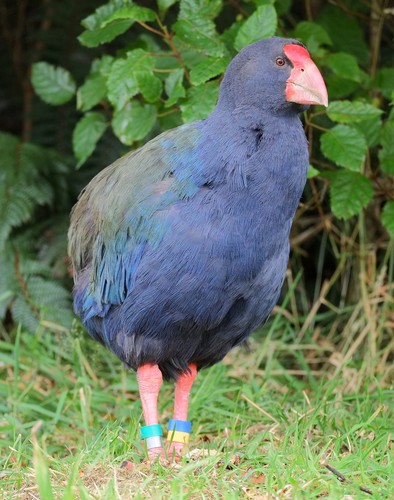
Takahe
50 cm (20 in) long, up to 3.5 kg; flightless
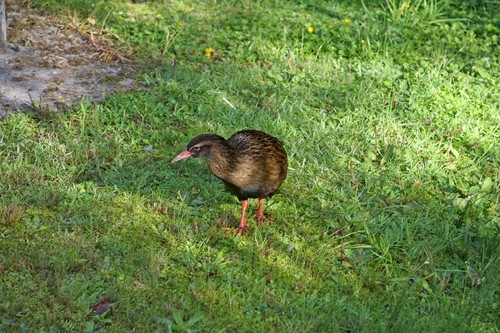
Weka
50-60 cm (20-24 in) long; flightless