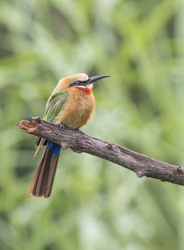
White-fronted Bee-eater Identification Guide
A vividly colored African bee-eater with a white forehead, crimson throat patch, and turquoise-green body, often seen hawking insects from riverside perches in colonial groups.
Read the full White-fronted Bee-eater encyclopedia entry →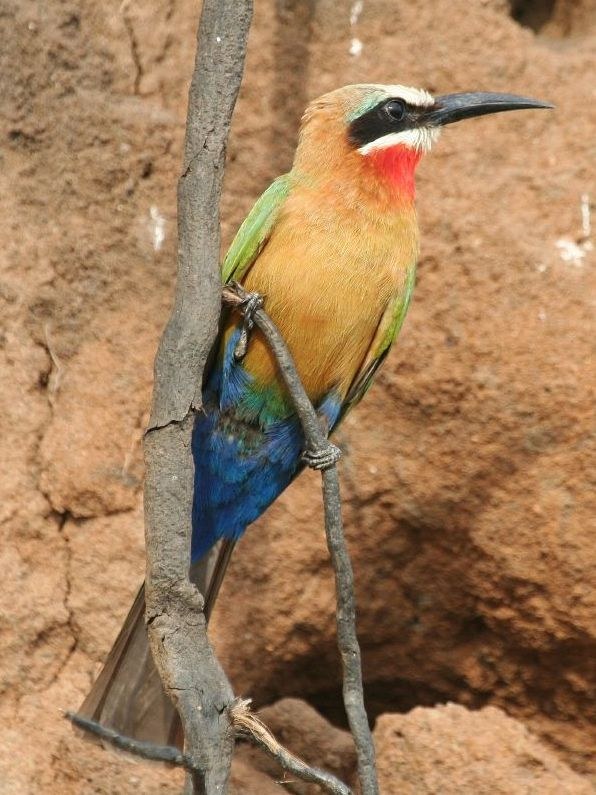
Key Field Marks
- Size & shape: A medium-sized bee-eater around 22-24 cm (9 in) long, with the slender, slightly decurved bill and pointed wings typical of the family, plus a moderately elongated central tail.
- Face: White forehead and a black mask through the eye contrasting with a bright crimson-red throat patch, the most distinctive feature of the species.
- Body: Green upperparts, a turquoise-blue rump and vent, and a buffy to cinnamon-washed lower breast and belly.
- Throat: The vivid red throat is bordered below by a narrow black band separating it from the pale belly.
- Flight: Graceful, acrobatic flight typical of bee-eaters, with glides interspersed with quick wingbeats while hawking insects.
Similar Species
- Little Bee-eater: Much smaller, with a yellow (not red) throat and lacks the white forehead.
- Red-throated Bee-eater: Very similar red throat, but lacks the white forehead (has a more chestnut crown) and occurs in different, more westerly range in Africa.
- Southern Carmine Bee-eater: Much more extensively pink-red overall with a turquoise crown and throat, rather than a localized red throat patch.
Behavior
- Highly social, nesting and roosting in colonies in burrows dug into vertical sandy riverbanks or earthen cliffs.
- Sallies from exposed perches such as bare branches or wires to catch bees, wasps, and other flying insects on the wing, returning to the same perch.
- Cooperative breeder in some populations, with helpers assisting at nests, and colonies can be extremely dense with dozens to hundreds of nest burrows.
Habitat & Range
- Found across sub-Saharan Africa, particularly in savanna and woodland habitats near rivers, lakes, and other water bodies with suitable earthen banks for nesting.
- Common in East and southern Africa, including well-known populations along major rivers in game reserves.
Voice
- Gives nasal, burry "kwink" or "pruik" calls, often in a chattering series when in colonies or in flight.
- Colonies can be quite noisy with overlapping calls from many individuals.
Seasonal Notes
- Present year-round in much of its range, though some populations make local or seasonal movements tied to food and water availability.
- Breeding colonies are most active and conspicuous in the dry season when riverbanks are exposed and suitable for burrow excavation.
Frequently asked questions
What is the key field mark of the White-fronted Bee-eater?
A white forehead paired with a bright crimson-red throat patch bordered by a black band, set against green body plumage.
How is it different from the Red-throated Bee-eater?
Red-throated Bee-eater lacks the white forehead and has a more chestnut-colored crown, and occupies a more westerly range in Africa.
Where do White-fronted Bee-eaters nest?
In burrows excavated into vertical sandy or earthen riverbanks, often in large, dense colonies.
What do White-fronted Bee-eaters eat?
Primarily flying insects such as bees and wasps, caught in acrobatic aerial sallies from a perch.
Is the White-fronted Bee-eater social?
Yes, it is highly colonial and often shows cooperative breeding, with related birds helping raise young at the same colony.
White-fronted Bee-eater identified by the community
Recent White-fronted Bee-eater sightings identified with Bird Identifier.