
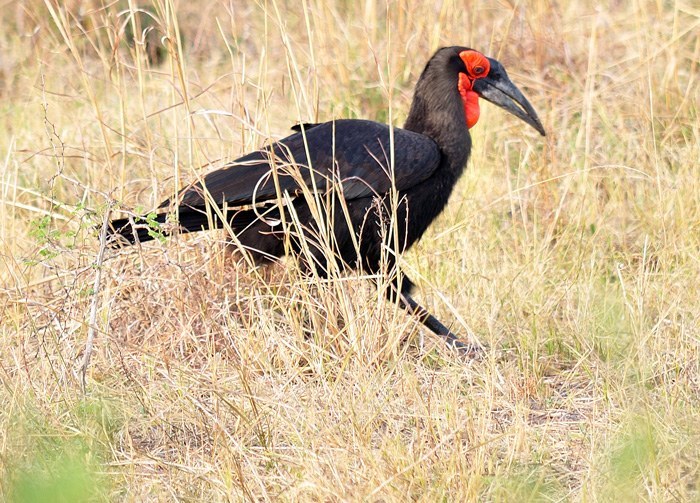
Southern Ground Hornbill
Bucorvus leadbeateri
A large, mostly ground-dwelling African hornbill with black plumage, vivid red facial skin, and deep, booming dawn calls, walking savannas in tight-knit family groups.
- Size
- 90-129 cm long; large, heavy-bodied, largely terrestrial
- Habitat
- Savanna, grassland, and open woodland of southern and eastern Africa
- Type
- other
Spotted a bird like this?
Identify any bird from a photo, free.
Overview
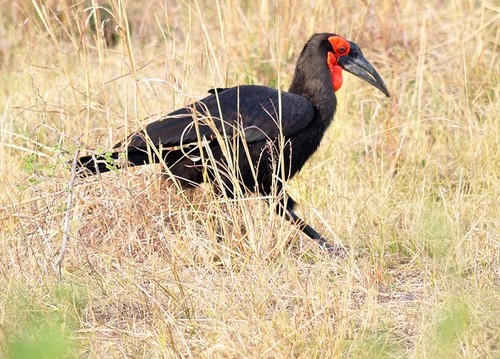
The Southern Ground Hornbill is a giant, turkey-sized hornbill that spends most of its life walking on the ground rather than flying, hunting for animal prey across the savannas of southern and eastern Africa. It is one of the most distinctive birds of the African bushveld, both for its size and its striking bare red facial and throat skin.
Plumage is mostly black, with white primary flight feathers visible only in flight. Males have entirely red bare skin on the face and throat, while females show a patch of violet-blue skin on the throat. Long, thick black eyelashes and heavy bills give the bird a distinctive, almost prehistoric appearance.
How to identify it
Key field marks
- Large black body, walking on the ground in small groups
- Bright red bare skin on face and throat (males); violet-blue throat patch (females)
- White primary feathers visible only when flying, otherwise appears all black
- Heavy, dark bill without an elaborate casque
Similar species
- No other African hornbill approaches its size or ground-dwelling habits; smaller arboreal hornbills (e.g., Southern Yellow-billed Hornbill) are far smaller, fly readily, and have colorful bills rather than plain dark ones.
Habitat & range
Habitat
Southern Ground Hornbills favor open savanna, grassland, and lightly wooded habitats where they can walk long distances while foraging.
Range
Found across southern and eastern Africa, including South Africa, Zimbabwe, Botswana, Mozambique, Kenya, and Tanzania.
Migration
The species is non-migratory and sedentary, with family groups maintaining large territories year-round.
Behavior & voice
Behavior
Southern Ground Hornbills live in cooperative family groups of up to a dozen birds, walking together across open country while foraging and roosting communally in trees at night.
Voice
Groups produce deep, resonant, booming duet calls, often given at dawn and audible over several kilometers; the sound is sometimes mistaken for a lion's roar.
Feeding
Unlike most hornbills, this species is almost entirely carnivorous, walking and hunting on the ground for insects, reptiles (including venomous snakes), amphibians, and small mammals.
Nesting and breeding
Groups are cooperative breeders with a dominant pair assisted by helper birds. Nests are built in large tree cavities or rock crevices; breeding is slow, with pairs typically fledging only one chick every several years, contributing to the species' vulnerability.
Frequently asked questions
Can Southern Ground Hornbills fly?
Yes, but they spend most of their time walking on the ground and only fly short distances, typically to reach roosting or nesting trees.
What do Southern Ground Hornbills eat?
They are largely carnivorous, hunting insects, reptiles including snakes, amphibians, and small mammals on the ground.
How can you tell a male from a female Southern Ground Hornbill?
Males have entirely red bare throat and facial skin, while females show a patch of violet-blue skin on the throat.
Is the Southern Ground Hornbill endangered?
It is classified as Vulnerable globally, with Endangered status in parts of its range, mainly due to habitat loss and its very slow breeding rate.
Why do Southern Ground Hornbills live in groups?
They are cooperative breeders, living in family groups where non-breeding helpers assist the dominant pair in raising chicks and defending territory.
Southern Ground Hornbill guides
In-depth guides for identifying, finding, and understanding Southern Ground Hornbill.
Other birds you may enjoy
Kiwi
35-55 cm (14-22 in) long; roughly chicken-sized
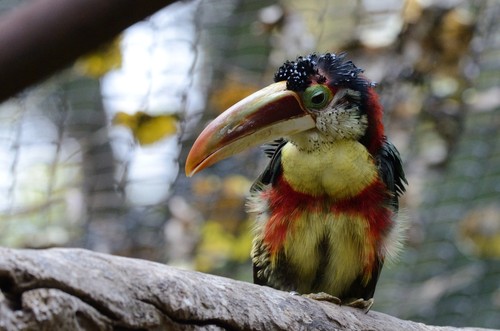
Curl-crested Aracari
41-46 cm (16-18 in) long, including a long bill and tail
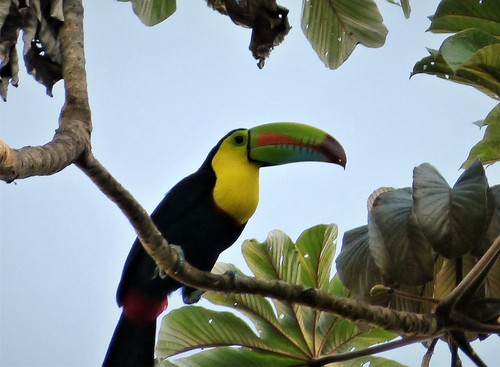
Keel-billed Toucan
42-55 cm (17-22 in) long including bill
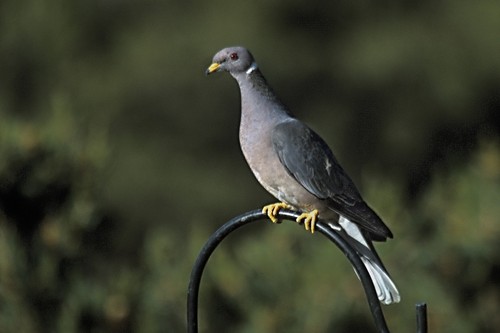
Band-tailed Pigeon
33-38 cm (13-15 in) long, wingspan about 66 cm (26 in)
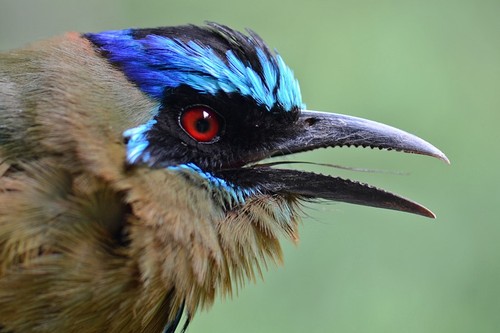
Blue-crowned Motmot
38-43 cm (15-17 in) long including tail
White-tipped Dove
27-30 cm (10.5-12 in) long, 38-43 cm wingspan
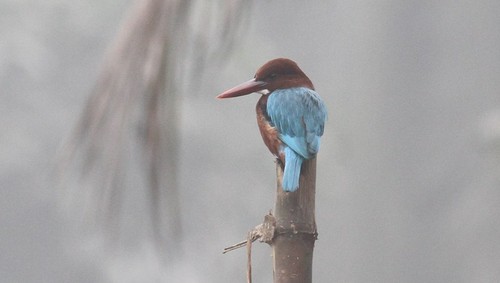
White-throated Kingfisher
27-28 cm (10.5-11 in) long
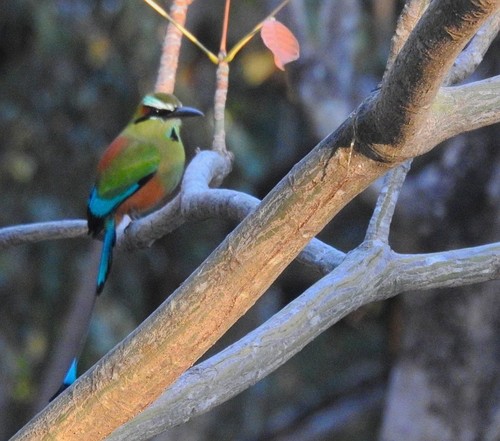
Turquoise-browed Motmot
34 cm (13 in) long including tail
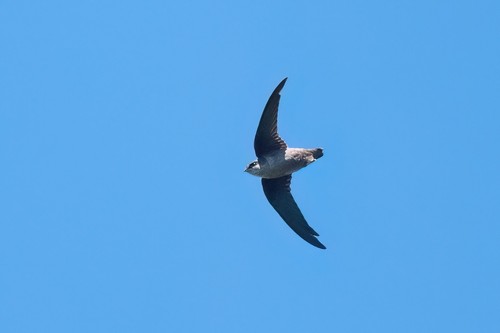
Vaux's Swift
10-12 cm (4-4.5 in) long, 27-30 cm wingspan
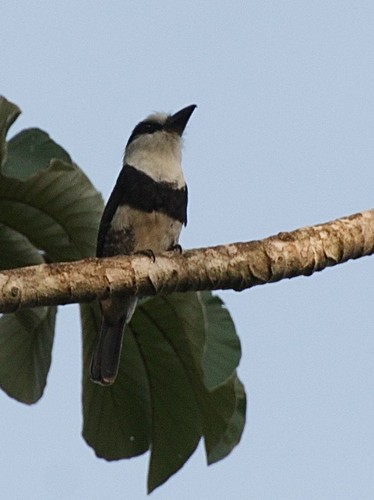
White-necked Puffbird
22-24 cm (8.5-9.5 in) long
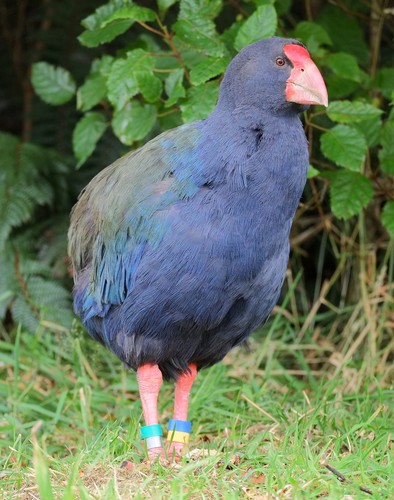
Takahe
50 cm (20 in) long, up to 3.5 kg; flightless
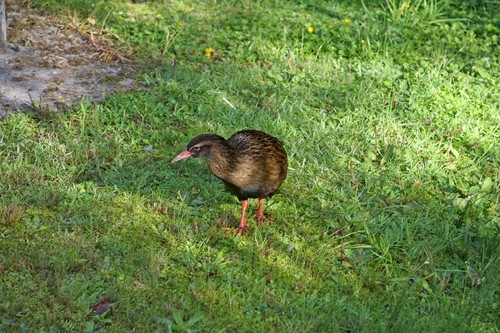
Weka
50-60 cm (20-24 in) long; flightless