
Southern Ground Hornbill Identification Guide
A huge, turkey-sized black hornbill of African savanna, unmistakable for its red facial skin, massive black bill, and habit of walking the ground in family groups.
Read the full Southern Ground Hornbill encyclopedia entry →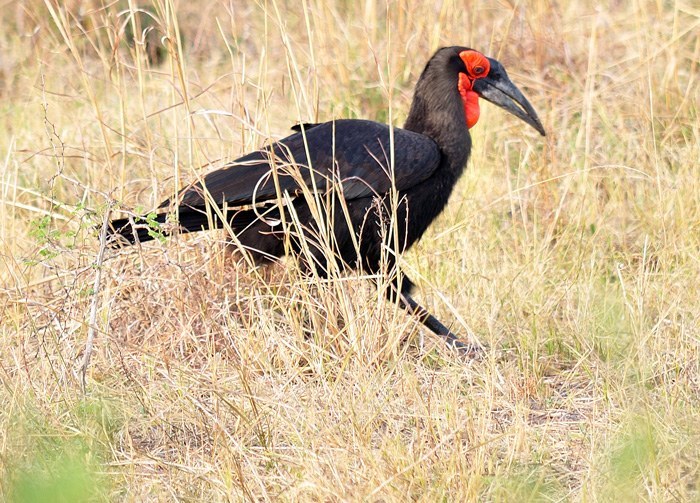
Key Field Marks
- Size & shape: One of the largest hornbills in the world, standing about 90–130 cm tall, with a heavy body, long black legs, and a mostly terrestrial, walking habit rather than climbing or perching like most hornbills.
- Plumage: Overall glossy black body plumage; white primary flight feathers are hidden at rest but flash conspicuously in flight.
- Facial skin: Bare, brightly colored skin on the face and throat — males show entirely red skin, while females show a patch of violet-blue skin on the throat surrounded by red, making sex identification straightforward in the field.
- Bill: Massive, black, downcurved bill with a prominent casque on top.
- Eyes: Long dark eyelashes are visible at close range, giving a distinctive "eyelash" look.
Separating It From Similar Species
- Abyssinian (Northern) Ground Hornbill is very similar but shows blue facial skin that extends around and above the eye in males (versus all-red in Southern Ground Hornbill males), and occupies a more northern range across the Sahel and parts of East Africa; the two species' ranges do not significantly overlap.
- No other African bird combines this huge size, all-black body, and bare red/blue facial skin, so within its southern and eastern African range it is essentially unmistakable once seen well.
Where and When to See It
Southern Ground Hornbills are non-migratory residents of savanna, grassland, and open woodland across eastern and southern Africa, from Kenya south to South Africa. They live in cooperative family groups of typically 2–9 birds, walking slowly across the ground hunting insects, small reptiles, amphibians, and small mammals. They can be seen year-round in protected savanna reserves such as Kruger National Park, the Okavango Delta, and the Serengeti-Mara ecosystem; early morning is often best, when groups are actively foraging and calling.
Voice
A deep, resonant, booming series of calls, often given at dawn by the group in a duet-like fashion — the low, far-carrying sound is sometimes mistaken for a distant lion's roar.
Frequently asked questions
How do you tell male and female Southern Ground Hornbills apart?
Males have entirely red bare facial and throat skin, while females show a patch of violet-blue skin on the throat surrounded by red — an easy and reliable way to sex the species in the field.
What is the difference between Southern and Abyssinian Ground Hornbill?
Abyssinian (Northern) Ground Hornbill males show blue facial skin extending around the eye, while Southern Ground Hornbill males have all-red facial skin. Their ranges are also largely separate, with Abyssinian found in the Sahel/East Africa and Southern found from Kenya southward.
Do Southern Ground Hornbills fly much?
They can fly but spend the vast majority of their time walking on the ground foraging in family groups, only flying short distances such as to reach roosting trees.
What sound do Southern Ground Hornbills make?
A deep, booming, resonant call often given at dawn, sometimes mistaken for a distant lion's roar due to its low pitch and carrying power.