
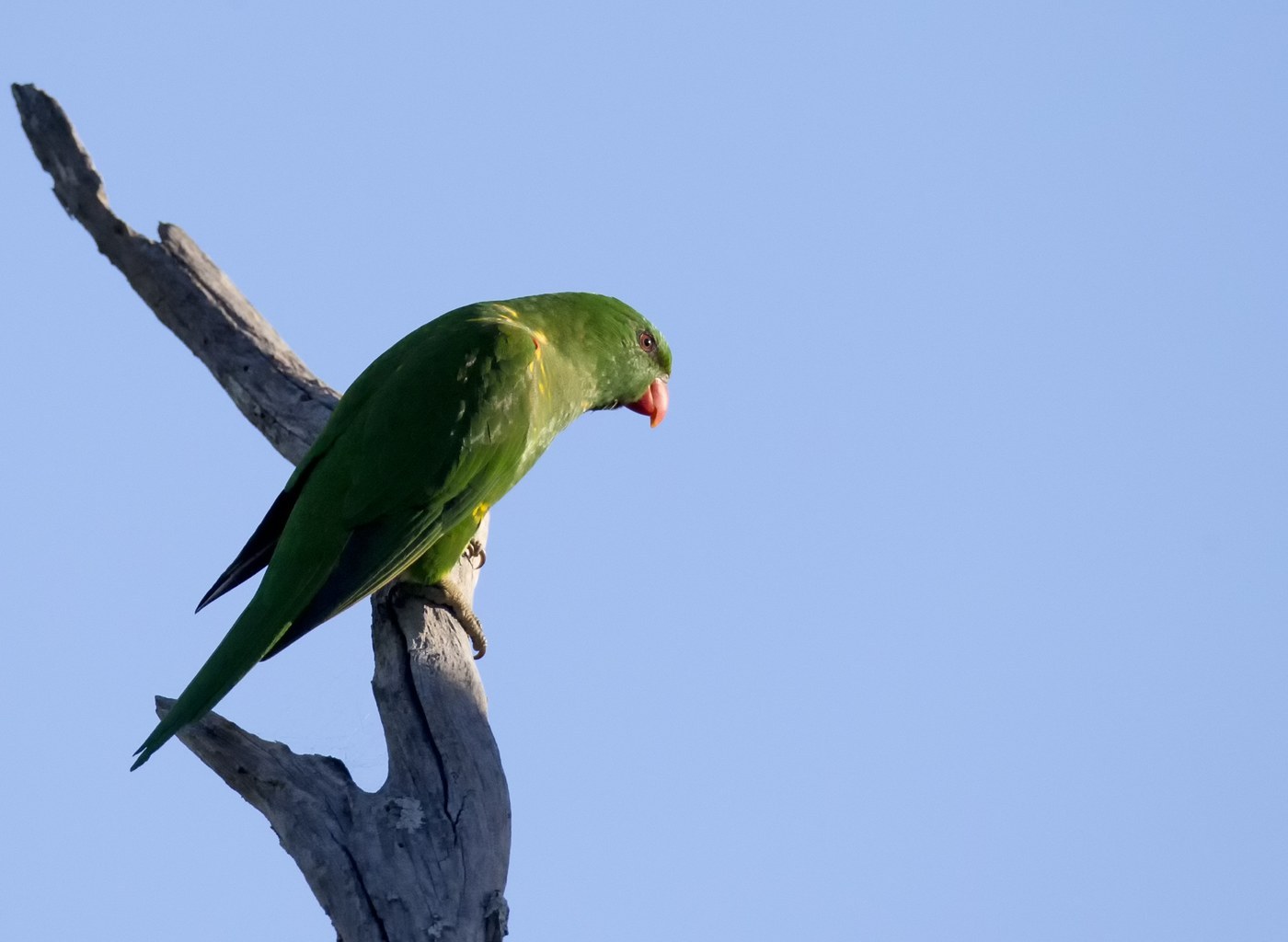
Scaly-breasted Lorikeet
Trichoglossus chlorolepidotus
A small, mostly green lorikeet of eastern Australia named for the scalloped yellow "scaly" pattern across its breast.
- Size
- About 23 cm long
- Habitat
- Coastal forests, woodlands, orchards, parks and gardens
- Type
- parrot
Spotted a bird like this?
Identify any bird from a photo, free.
Overview
The Scaly-breasted Lorikeet is a small, brightly colored parrot found along the eastern coast of Australia. Its plumage is predominantly bright green, with a slightly yellower green on the underparts.
The breast feathers are edged in yellow, creating a distinctive scalloped or "scaly" appearance that gives the species its name. The bill is orange-red, and the eye is orange-red as well. Unlike its close relative the Rainbow Lorikeet, it lacks any blue on the head.
How to identify it
Key field marks
- Overall green body with no blue on the head
- Yellow scalloped edging across the breast feathers (the "scaly" look)
- Orange-red bill
- Fast, direct flight on rapidly beating wings
Similar species
The Rainbow Lorikeet (Trichoglossus moluccanus) is similar in size and shape but has a deep blue head and an orange-and-yellow breast band, making it much more colorful overall. The two species regularly flock together and can hybridize where ranges overlap.
Habitat & range
Range
Endemic to eastern Australia, occurring from around Cape York Peninsula, Queensland, south through New South Wales to the Victorian border, mostly along the coast and adjacent ranges.
Habitat
Favors coastal and near-coastal eucalypt forest, woodland, paperbark swamps, orchards, farmland with flowering trees, and suburban parks and gardens with nectar-producing plants.
Movement
Largely sedentary but locally nomadic, moving in response to flowering eucalypts and other blossom.
Behavior & voice
Voice
Noisy and vocal, giving sharp, shrill screeches and chattering notes, especially in flight and while feeding in flocks.
Feeding
Uses a specialized brush-tipped tongue to feed on nectar and pollen from eucalypt and other native blossoms, also taking fruit and some seed. Often forms large, noisy mixed flocks with Rainbow Lorikeets at flowering trees.
Breeding
Nests in tree hollows, typically laying two eggs. Both parents help raise the chicks.
Frequently asked questions
How is the Scaly-breasted Lorikeet different from the Rainbow Lorikeet?
The Scaly-breasted Lorikeet has an all-green head and a yellow-scalloped green breast, while the Rainbow Lorikeet has a blue head and an orange-yellow breast band.
Where are Scaly-breasted Lorikeets found?
Along the eastern Australian coast from around Cape York, Queensland, south to the New South Wales-Victoria border.
What do Scaly-breasted Lorikeets eat?
Mainly nectar and pollen from flowering eucalypts, along with fruit and some seed, gathered with a specialized brush-tipped tongue.
Do Scaly-breasted Lorikeets flock with other lorikeets?
Yes, they commonly mix with Rainbow Lorikeets at flowering trees and can occasionally hybridize with them.
Scaly-breasted Lorikeet guides
In-depth guides for identifying, finding, and understanding Scaly-breasted Lorikeet.
Other birds you may enjoy
Eclectus Parrot
35-42 cm (14-16.5 in) long
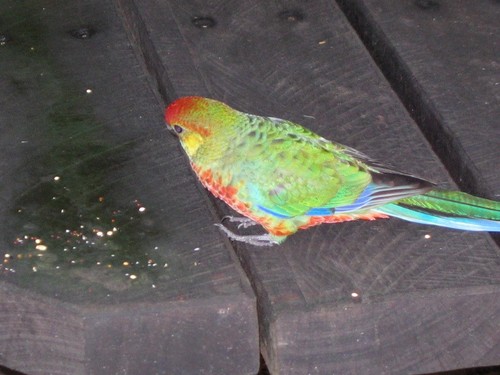
Western Rosella
25-30 cm (10-12 in) long
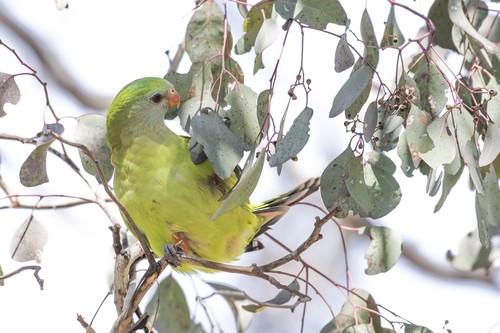
Superb Parrot
About 40 cm (16 in) long including a long tail
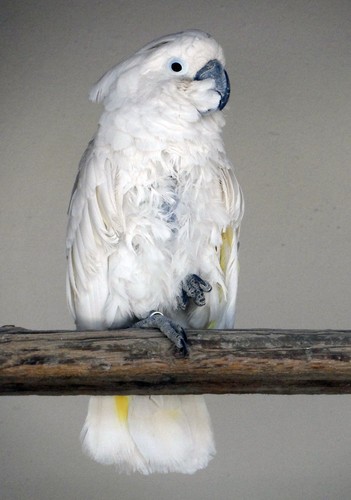
Umbrella Cockatoo
About 46 cm (18 in) long
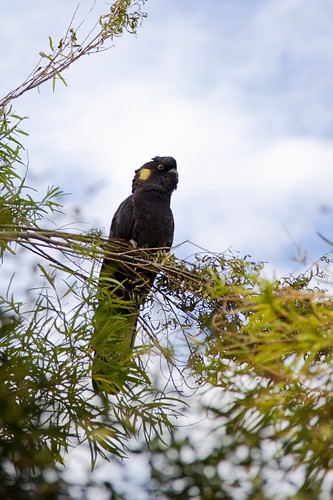
Yellow-tailed Black Cockatoo
55-65 cm long; wingspan up to about 130 cm
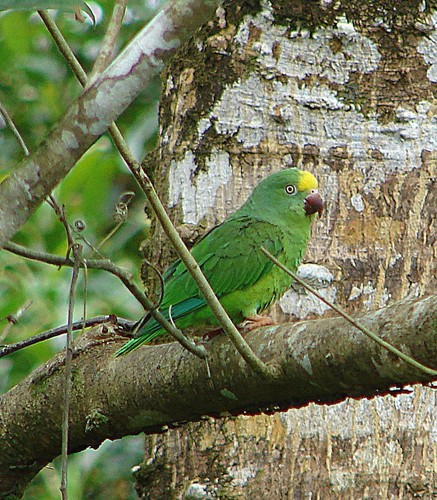
Yellow-crowned Amazon
About 35-38 cm (14-15 in) long
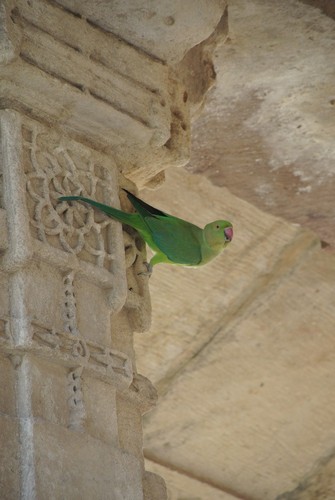
Rose-ringed Parakeet
40 cm (16 in) long including long tail
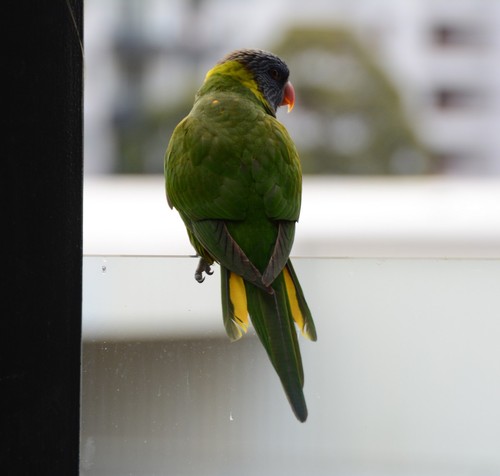
Rainbow Lorikeet
25-30 cm (10-12 in) long
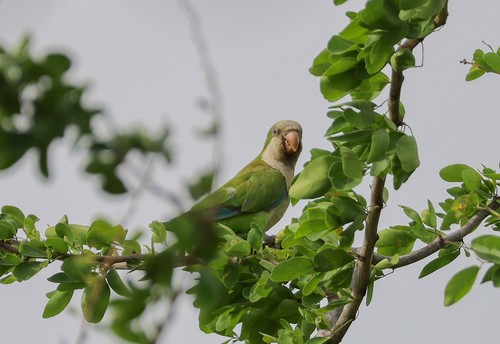
Quaker Parrot
28-31 cm (11-12 in) long
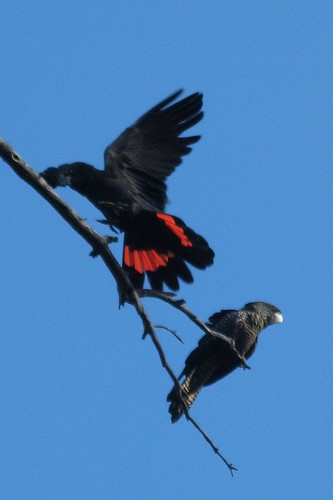
Red-tailed Black Cockatoo
55-65 cm long
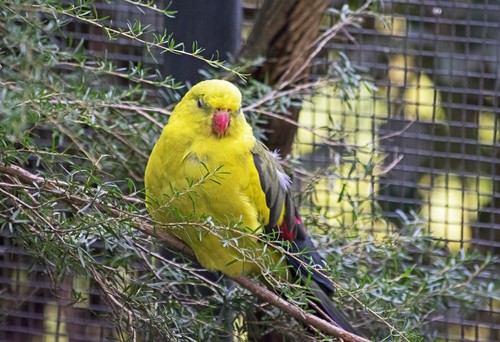
Regent Parrot
37-42 cm (15-17 in) long, including a long tail
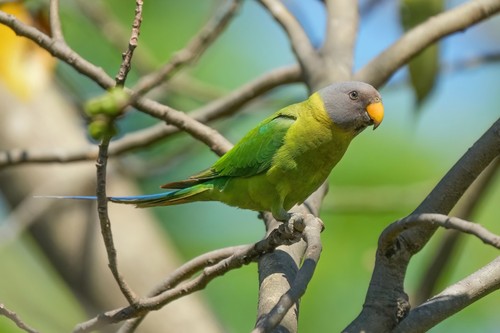
Plum-headed Parakeet
33 cm (13 in) long including tail