
Scaly-breasted Lorikeet Identification Guide
A mostly green Australian lorikeet named for the yellow scalloped 'scaly' pattern across its breast, best told from Rainbow Lorikeet by its all-green head and lack of blue.
Read the full Scaly-breasted Lorikeet encyclopedia entry →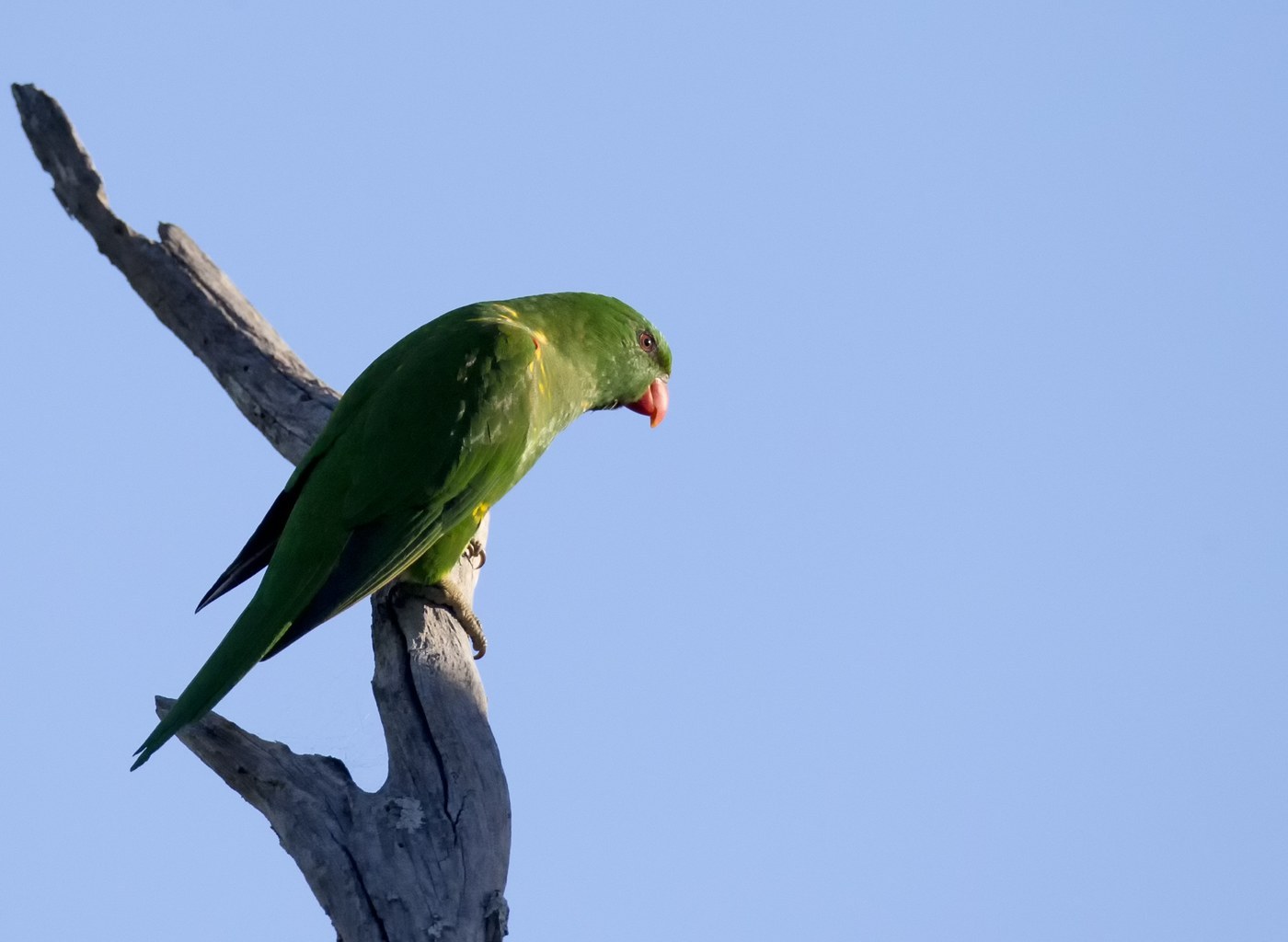
Key Field Marks
- Size & shape: A medium-small, slender parrot with a pointed tail and fast, direct flight typical of lorikeets, similar in size to Rainbow Lorikeet but slightly more streamlined.
- Plumage: Predominantly bright green overall, including the head (no blue) — a key difference from Rainbow Lorikeet.
- Breast pattern: Yellow feathers edged in green across the breast and belly create a distinctive scalloped, scaly appearance, giving the species its name.
- Underwing: Shows a red-orange patch at the base of the underwing in flight, visible as birds fly overhead.
- Bill: Orange-red bill, similar in color to Rainbow Lorikeet's.
- Behavior: Noisy, fast-flying, and highly social, often forming large nomadic flocks that follow flowering eucalypts; frequently seen mixed with Rainbow Lorikeets at food sources.
Separating Scaly-breasted Lorikeet from Similar Species
- Rainbow Lorikeet: Shows a bold blue head and belly, orange-yellow breast band, and green back/wings — a much more multicolored bird overall compared to the essentially all-green Scaly-breasted Lorikeet with its subtler yellow scalloping.
- Musk Lorikeet: Smaller, with a red forehead/face patch and a yellow wing patch visible at rest, plus a more olive-green tone; lacks the scaled breast pattern.
- Little Lorikeet: Much smaller, with a red face mask restricted to around the bill and eye, and no yellow scalloping on the underparts.
- In flight: The combination of all-green body plus a red-orange underwing patch (without any blue) is diagnostic for Scaly-breasted Lorikeet among the commonly overlapping lorikeet species in eastern Australia.
Where & When to See One
Scaly-breasted Lorikeet is found along the eastern coast and ranges of Australia, from Cape York Peninsula in Queensland south through New South Wales, in eucalypt forests, woodlands, parks, and gardens, generally at slightly lower densities and drier habitats than Rainbow Lorikeet, though the two frequently overlap and flock together. It is largely resident but shows nomadic movements tracking eucalypt and other flowering trees, which provide the nectar and pollen that make up most of its diet. Watch and listen for noisy flocks feeding in flowering gums, often audible before they're visible.
Voice
Sharp, shrill screeching and chattering calls given in flight and while feeding, generally similar in quality to Rainbow Lorikeet's calls but often described as slightly higher-pitched or thinner.
Frequently asked questions
How do you tell Scaly-breasted Lorikeet from Rainbow Lorikeet?
Scaly-breasted Lorikeet is essentially all green including the head, with only subtle yellow scalloping on the breast, while Rainbow Lorikeet has a bold blue head and an orange-yellow breast band that make it much more colorful.
What causes the 'scaly' pattern on this lorikeet's breast?
Individual breast feathers are yellow at the base with green edges, and when layered together they create a scalloped, fish-scale-like pattern across the chest, giving the species its descriptive name.
What habitat does Scaly-breasted Lorikeet prefer?
It occupies eucalypt forests, woodlands, and increasingly urban parks and gardens along eastern Australia, often favoring slightly drier habitats than the closely associated Rainbow Lorikeet.
Do Scaly-breasted Lorikeets flock with other lorikeets?
Yes, they very commonly mix with Rainbow Lorikeets and other nectar-feeding parrots at flowering eucalypts, so careful attention to head color and breast pattern is needed to separate them in mixed flocks.
Is the Scaly-breasted Lorikeet migratory?
It is not a true long-distance migrant but is nomadic, moving locally and regionally in response to the flowering patterns of eucalypts and other nectar-producing trees that form the bulk of its diet.