
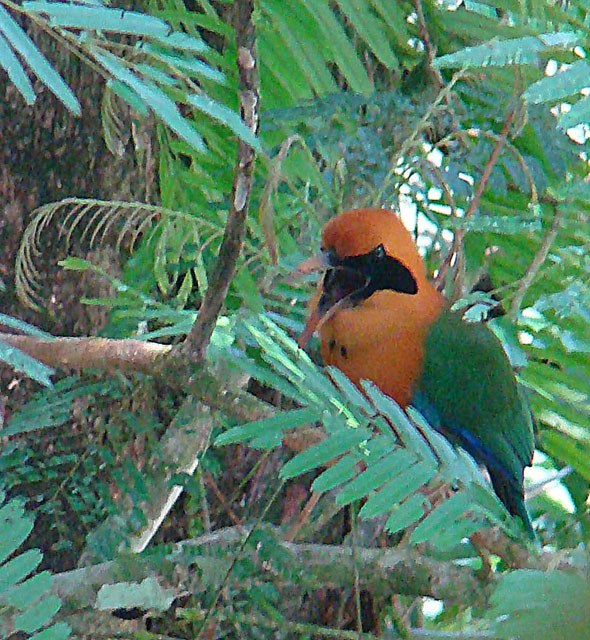
Rufous Motmot
Baryphthengus martii
The largest motmot species, with rich rufous-orange underparts and head, a green back, and a long tail ending in bare-shafted racket tips.
- Size
- 43-48 cm (17-19 in) long including tail
- Habitat
- humid lowland and foothill rainforest
- Type
- other
Spotted a bird like this?
Identify any bird from a photo, free.
Overview
The Rufous Motmot is the largest member of the motmot family, a big, richly colored bird with warm rufous-orange feathering covering the head, neck, and underparts, broken by a black mask through the eye and a small black spot on the chest. The back and wings are a deep green, contrasting handsomely with the glowing orange tones of the head and body.
Like its relatives, it possesses a long tail ending in two bare-shafted racket tips, which it swings gently from side to side while perched quietly in the forest understorey, patiently watching for prey before making a sudden sallying strike.
How to identify it
Key field marks
- Large size, the biggest motmot species
- Rich rufous-orange head, neck, and underparts
- Green back and wings, black mask through the eye
- Long tail with bare-shafted racket tips
Similar species
- Broad-billed Motmot is much smaller with more limited rufous coloring confined mainly to the chest, rather than covering the whole head and underparts.
- Blue-crowned Motmot shows a blue-and-black crown pattern and green-washed underparts rather than the extensive rufous coloring of the Rufous Motmot.
Habitat & range
Habitat
Inhabits humid lowland and foothill rainforest, favoring the shaded understorey.
Range
Found from Honduras and Nicaragua south through Central America and into western Colombia, Ecuador, and the western Amazon basin.
Migration
Non-migratory and sedentary, remaining within a fixed territory.
Behavior & voice
Behavior
Typically solitary or in pairs, perching quietly in the shaded understorey and sallying out to capture prey; swings its long tail slowly from side to side while perched.
Voice
A deep, resonant, hooting call, lower-pitched than that of many smaller motmots.
Feeding
Feeds on insects, small reptiles, and fruit, typically caught by sallying from a low to mid-level perch.
Nesting
Excavates a nesting burrow in an earthen bank, sometimes quite deep; lays 3-4 white eggs.
Frequently asked questions
How do you identify a Rufous Motmot?
Look for a large motmot with rich rufous-orange coloring over the head, neck, and underparts, a green back, and a long racket-tipped tail.
Is the Rufous Motmot the largest motmot species?
Yes, it is generally considered the largest member of the motmot family.
What does a Rufous Motmot eat?
Insects, small reptiles, and fruit, caught by sallying from a quiet perch in the forest understorey.
Where does the Rufous Motmot live?
In humid lowland and foothill rainforest from Honduras and Nicaragua south through Central America into western South America.
Rufous Motmot guides
In-depth guides for identifying, finding, and understanding Rufous Motmot.
Other birds you may enjoy
Kiwi
35-55 cm (14-22 in) long; roughly chicken-sized
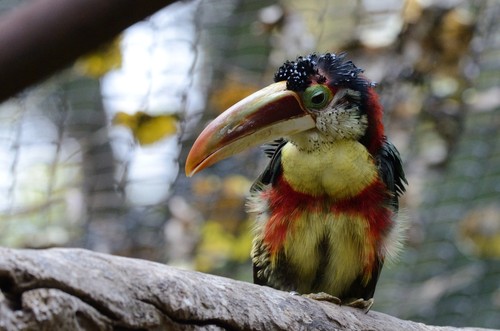
Curl-crested Aracari
41-46 cm (16-18 in) long, including a long bill and tail
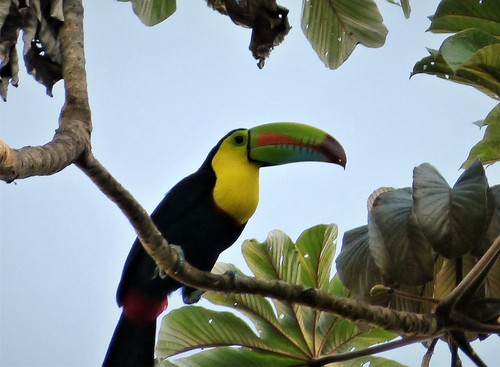
Keel-billed Toucan
42-55 cm (17-22 in) long including bill
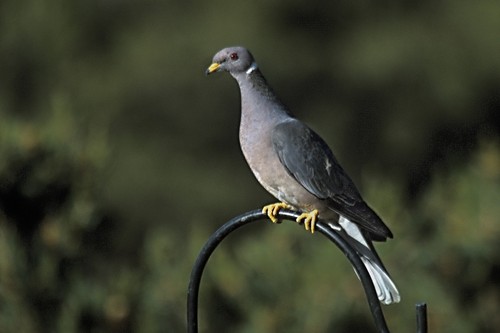
Band-tailed Pigeon
33-38 cm (13-15 in) long, wingspan about 66 cm (26 in)
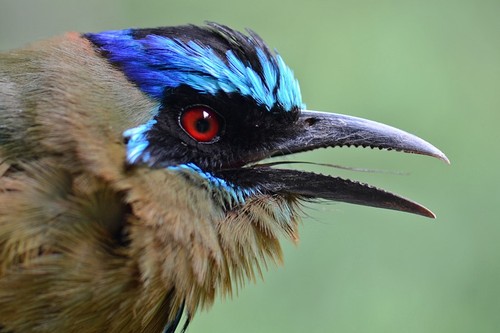
Blue-crowned Motmot
38-43 cm (15-17 in) long including tail
White-tipped Dove
27-30 cm (10.5-12 in) long, 38-43 cm wingspan
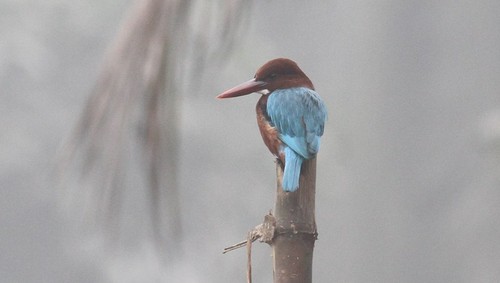
White-throated Kingfisher
27-28 cm (10.5-11 in) long
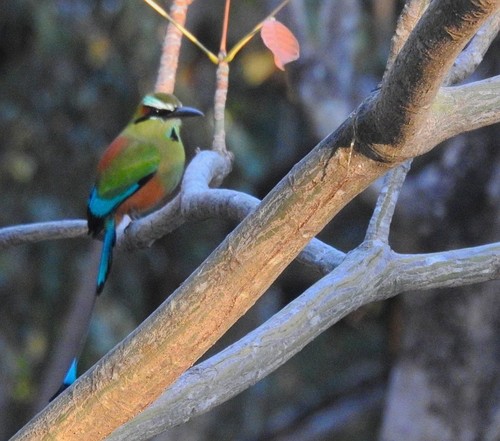
Turquoise-browed Motmot
34 cm (13 in) long including tail
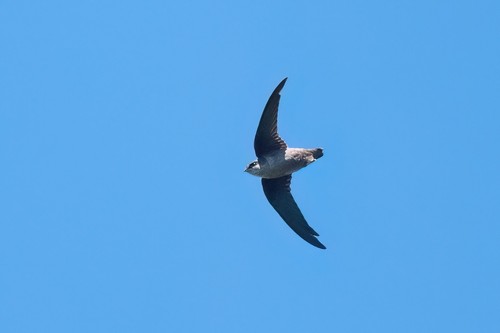
Vaux's Swift
10-12 cm (4-4.5 in) long, 27-30 cm wingspan
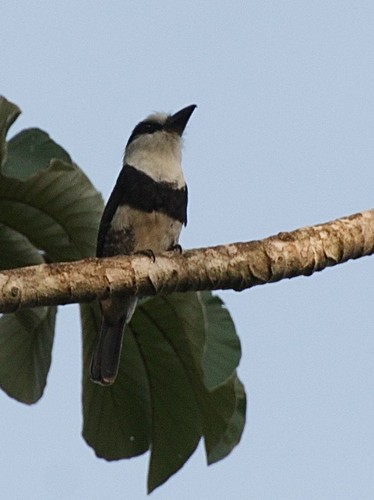
White-necked Puffbird
22-24 cm (8.5-9.5 in) long
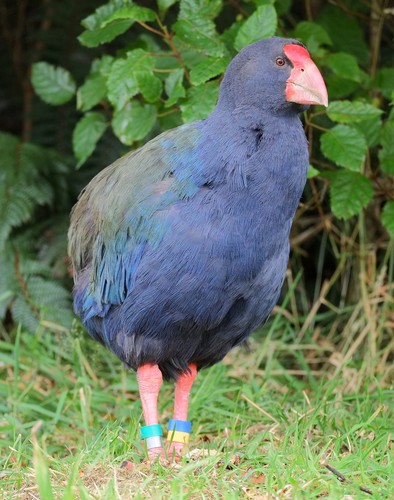
Takahe
50 cm (20 in) long, up to 3.5 kg; flightless
Weka
50-60 cm (20-24 in) long; flightless