
Rufous Motmot Identification Guide
A large, richly colored motmot of Central and South American rainforests, with cinnamon-rufous underparts, greenish-blue wings, a black facial mask, and a long racket-tipped tail it swings like a pendulum.
Read the full Rufous Motmot encyclopedia entry →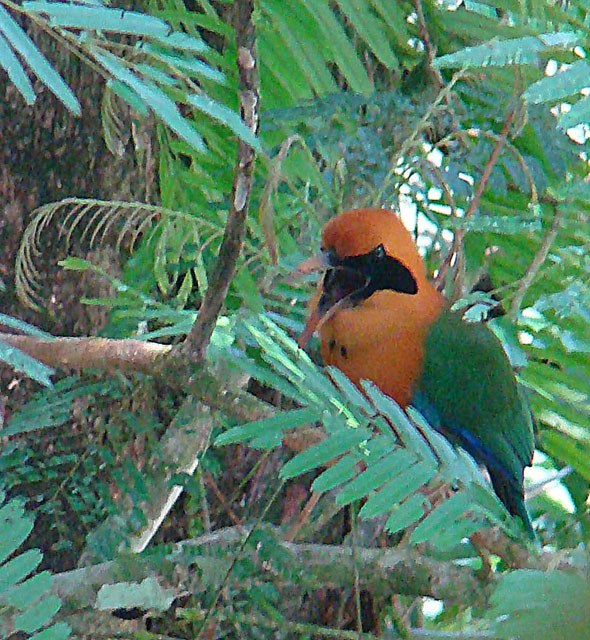
Key Field Marks
- Large motmot, among the biggest in its family, with a heavy build and a long tail ending in distinctive racket-shaped tips.
- Head and underparts are rich cinnamon-rufous, deepest on the belly, contrasting with greenish-blue wings and back.
- Black mask runs through the eye, bordered above by the rufous crown, giving a bandit-like facial pattern.
- Bill is fairly long, slightly downcurved, and serrated along the edge, typical of motmots.
- Tail is long and graduated, blue-black toward the tip, with bare shafts leading to the paddle-like rackets.
Separating It From Similar Species
- Broad-billed Motmot is noticeably smaller, has a blue crown and greenish (not rufous) breast with a black chest spot, and shows much less extensive rufous coloring overall.
- Other rufous-bellied motmots in the region differ in size, the extent of blue on the crown, and the amount of black on the face; Rufous Motmot is distinguished by its large size and extensively rufous head and underparts reaching up onto the crown/nape in many individuals.
- The pendulum-like tail-swinging motion is shared among motmots generally, but combined with the large size and rufous coloring, helps confirm this species within its range.
Where and When to Look
- Resident from Honduras south through Central America and into the Amazon basin and Andean foothills of South America.
- Inhabits the understory and mid-story of humid lowland and foothill primary and mature secondary forest, generally avoiding open or heavily disturbed habitats.
- A non-migratory, year-round resident; most reliably found by listening for its distinctive low calls at dawn in forest interior.
Voice and Behavior
- Voice is a deep, resonant, hooting "hoo-hoo" or a low croaking series, often given from a perch within the forest and carrying well through dense vegetation.
- Perches quietly and often motionless for long periods, periodically swinging its long tail side to side in a slow, pendulum-like motion.
- Feeds on large insects and small vertebrates, sallying from a perch to snatch prey from foliage or the ground; nests in burrows dug into earthen banks.
Frequently asked questions
What is the most distinctive feature of the Rufous Motmot?
Its large size combined with extensively rufous-cinnamon head and underparts, greenish-blue wings, and a long racket-tipped tail make it one of the more recognizable motmots in its range.
Why do motmots swing their tails?
Motmots, including the Rufous Motmot, often swing their long tails side to side in a slow pendulum motion, a behavior thought to signal alertness to potential predators.
How is Rufous Motmot different from Broad-billed Motmot?
Rufous Motmot is considerably larger with more extensive rufous coloring on the head and underparts, while Broad-billed Motmot is smaller with a blue crown and greenish breast marked by a black spot.
What habitat does the Rufous Motmot prefer?
It lives in the understory of humid lowland and foothill forest in Central and South America, generally avoiding open or heavily cleared areas.