
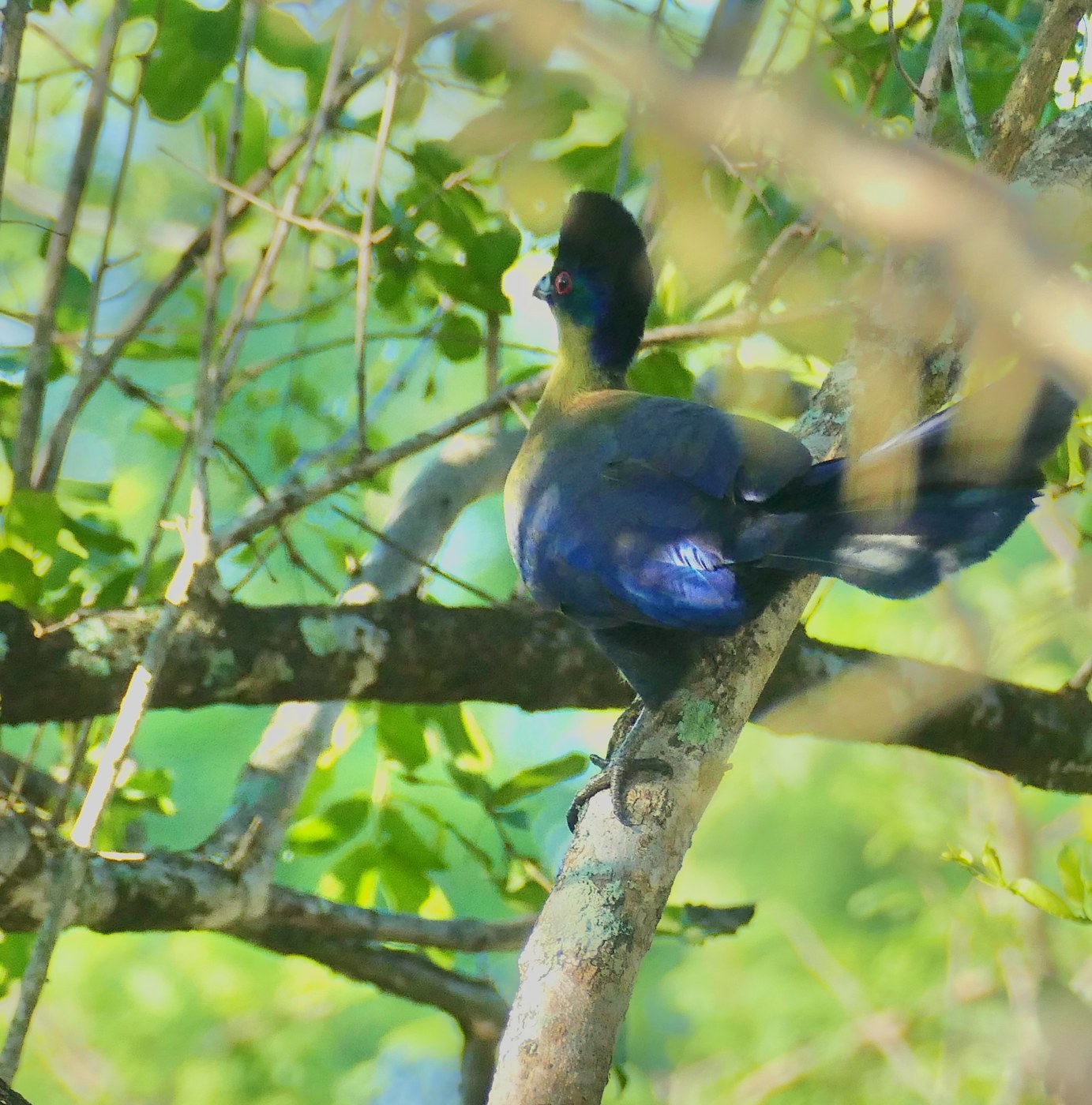
Purple-crested Turaco
Tauraco porphyreolophus
A glossy green forest bird of southeastern Africa with a rounded purple crest and crimson flight feathers that flash brilliantly in flight.
- Size
- 40–46 cm (16–18 in) long; short, rounded wings
- Habitat
- Coastal, riverine, and montane forest and dense woodland
- Type
- other
Spotted a bird like this?
Identify any bird from a photo, free.
Overview
The Purple-crested Turaco is a large, arboreal fruit-eating bird of southeastern Africa's forests. Its body plumage is a rich, iridescent green washed with bronze and blue tones, set off by a rounded crest glossed deep violet-purple. In flight it reveals crimson primary flight feathers, a hallmark shared by most turacos and produced by a unique copper-based pigment called turacin found in no other bird group.
The face shows a bare red eye-ring, and the underparts fade to a soft grey-brown. It is the national bird of Eswatini, where its crest feathers historically held ceremonial significance.
Quick facts
- Iridescent green body with a violet-purple rounded crest
- Crimson primaries flash open in flight
- Bare red skin around the eye
How to identify it
Key field marks
- Rounded crest glossed purple, not green
- Crimson-red flight feathers visible as a flash when the bird flies or opens its wings
- Bare red eye-ring and grey-brown belly contrasting with the green chest and back
Similar species
- Knysna Turaco has a green crest tipped white rather than purple, and occurs further south and west along the coast.
- Livingstone's Turaco has a longer, more pointed crest with a white-tipped forecrest and a different range further north.
- Schalow's Turaco (an inland relative) shows a white line below the eye and a less rounded crest.
Because turacos are quiet, leaf-hopping birds rather than strong fliers, the crimson wing flash seen briefly as one crosses a gap in the canopy is often the best clue to species when the crest color is hard to judge in shade.
Habitat & range
Range
Found in southeastern Africa, including eastern South Africa (KwaZulu-Natal), Eswatini, Mozambique, eastern Zimbabwe, Malawi, Zambia, and parts of Tanzania.
Habitat
Inhabits evergreen coastal and riverine forest, forest edge, and dense woodland with fruiting trees, favoring closed canopy where it can move between branches largely unseen.
Movement
Non-migratory and strongly sedentary, remaining in territorial forest patches year-round.
Behavior & voice
Behavior
A poor flier, the Purple-crested Turaco moves mainly by running and bounding along branches with great agility, using flight only for short glides between trees. Pairs and family groups forage together, often joining mixed fruiting-tree gatherings with other frugivores.
Voice
Gives a loud, far-carrying series of guttural "kok-kok-kok-kok" notes, often in a rolling chorus between neighboring birds, used to advertise territory.
Feeding
Primarily frugivorous, favoring wild figs and other forest fruits; it plays an important role dispersing seeds through the forest.
Nesting
Builds a flimsy, shallow platform of twigs in a tree fork, in which it lays 2 eggs; both parents help incubate and feed the semi-precocial chicks, which can clamber out of the nest before they can fly.
Frequently asked questions
Why does the Purple-crested Turaco have red wings?
The crimson primary feathers contain turacin, a unique copper-based red pigment found only in turacos, which is chemically unlike the pigments used by any other bird family.
Where does the Purple-crested Turaco live?
It lives in coastal, riverine, and montane forest across southeastern Africa, including South Africa, Eswatini, Mozambique, and parts of Zimbabwe, Malawi, and Zambia.
How do I tell it apart from the Knysna Turaco?
Look at the crest color: the Purple-crested Turaco's crest is glossed purple, while the Knysna Turaco's crest is green and tipped with white.
What does the Purple-crested Turaco eat?
It is mostly frugivorous, feeding heavily on wild figs and other forest fruit, with occasional flowers, leaves, and insects.
Can the Purple-crested Turaco fly well?
Not really — turacos are primarily runners and climbers among branches, using only short, labored flights or glides to cross gaps between trees.
Purple-crested Turaco guides
In-depth guides for identifying, finding, and understanding Purple-crested Turaco.
Other birds you may enjoy
Kiwi
35-55 cm (14-22 in) long; roughly chicken-sized
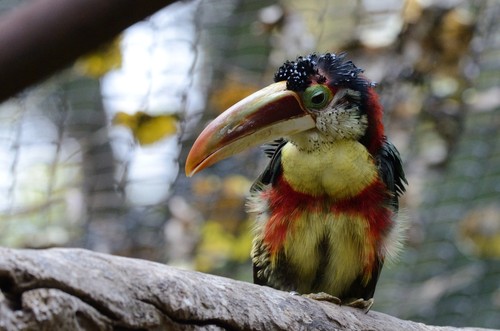
Curl-crested Aracari
41-46 cm (16-18 in) long, including a long bill and tail
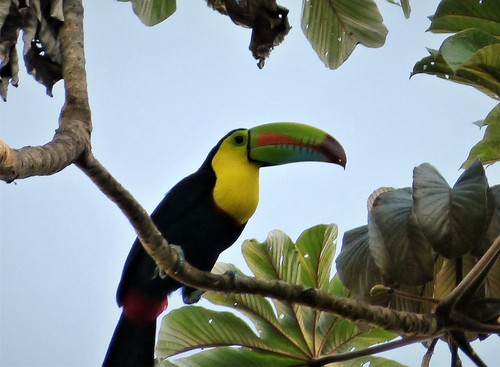
Keel-billed Toucan
42-55 cm (17-22 in) long including bill
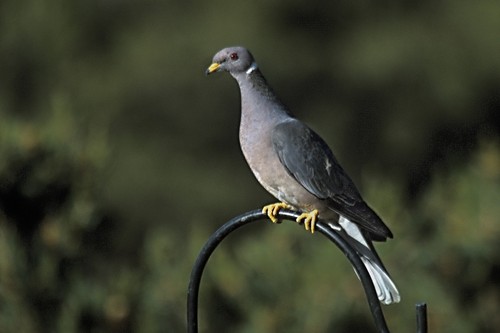
Band-tailed Pigeon
33-38 cm (13-15 in) long, wingspan about 66 cm (26 in)
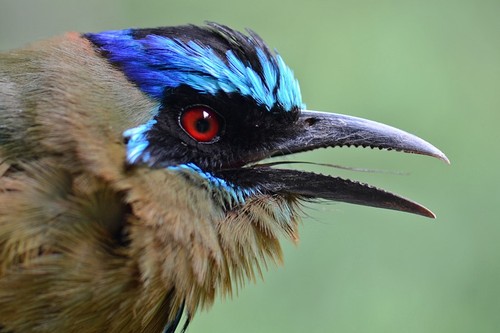
Blue-crowned Motmot
38-43 cm (15-17 in) long including tail
White-tipped Dove
27-30 cm (10.5-12 in) long, 38-43 cm wingspan
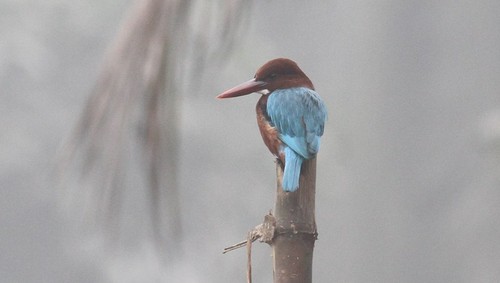
White-throated Kingfisher
27-28 cm (10.5-11 in) long
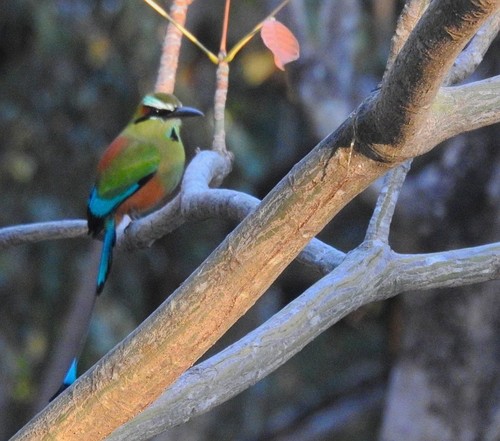
Turquoise-browed Motmot
34 cm (13 in) long including tail
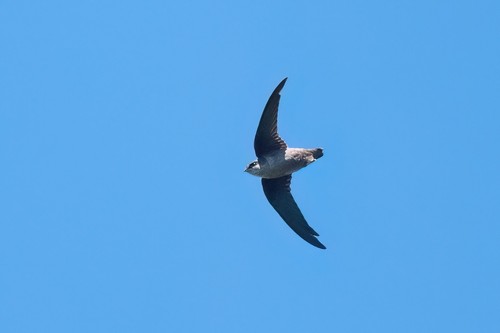
Vaux's Swift
10-12 cm (4-4.5 in) long, 27-30 cm wingspan
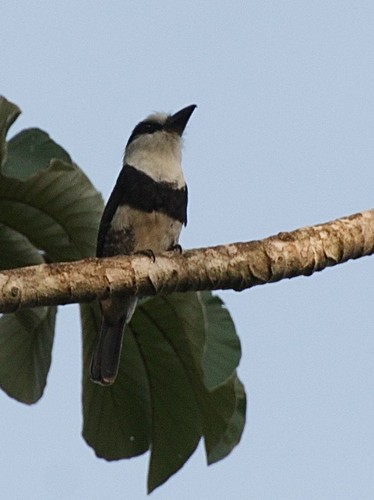
White-necked Puffbird
22-24 cm (8.5-9.5 in) long
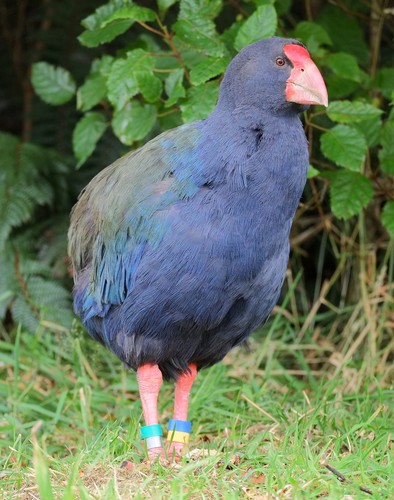
Takahe
50 cm (20 in) long, up to 3.5 kg; flightless
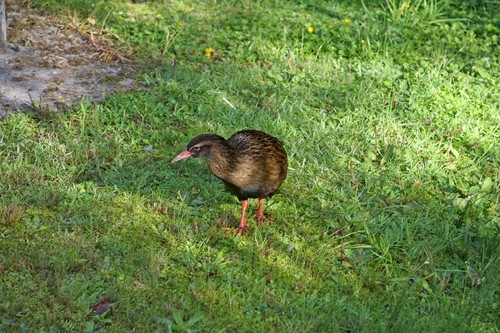
Weka
50-60 cm (20-24 in) long; flightless