
Purple-crested Turaco Identification Guide
A vividly plumaged African forest bird with a glossy purple crest and green body, revealing brilliant crimson flight feathers in a flash of color when it takes wing.
Read the full Purple-crested Turaco encyclopedia entry →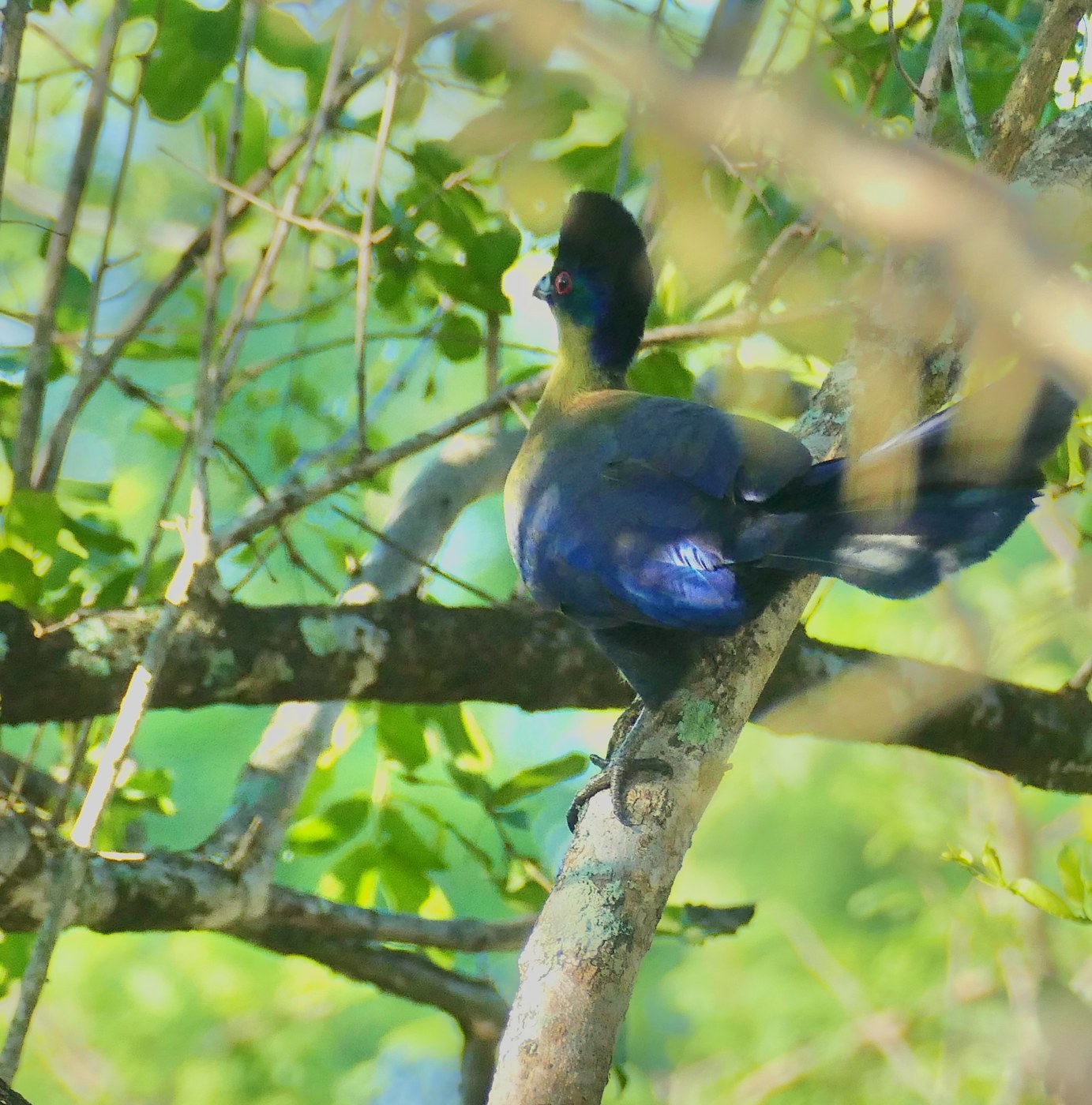
Key Field Marks
- Size & shape: A medium-large, long-tailed arboreal bird around 16–18 inches long, with a short, curved bill and a rounded, crested head.
- Plumage: Rich, glossy green body plumage with a bronzy sheen, a prominent purple crest on the crown, and a maroon-purple nape and back of neck.
- Face: A striking facial pattern with a red eye-ring, and a green face bordered by a whitish or pale streak below the eye in some views.
- In flight — key mark: Flashes a broad panel of brilliant crimson-red primary flight feathers, normally hidden at rest but unmistakable as the bird flies between trees.
- Bill: Short, stout, slightly downcurved, reddish or dark depending on light.
Separating It From Similar Species
- Knysna Turaco / Livingstone's Turaco (other green turacos): Very similar green-and-crimson pattern; Purple-crested is best told by its more purple (rather than green) crest and by range, as these species are largely geographically separated across southern/eastern Africa.
- Grey Go-away-bird (Grey Lourie): Same family but entirely gray, lacking any green or red — easily eliminated.
- No other bird in its southern African range combines a purple crest with a green body and crimson wing flash, making adults straightforward to identify when seen well.
Habitat, Range & Season
A resident, non-migratory species of coastal forest, riverine woodland, and dense bush in eastern and southern Africa, including parts of South Africa (especially KwaZulu-Natal), Eswatini, Mozambique, Zimbabwe, and southern Tanzania. Present year-round in suitable forest and thicket habitat, including well-wooded gardens and reserves.
Behavior
Moves through the canopy with agile, bounding hops along branches rather than extended flight, using its long tail for balance; flies only short distances between trees, when the red wing patches become visible. Feeds mainly on fruit, often in small family groups.
Voice
A loud, far-carrying series of guttural, barking notes, "kok-kok-kok-kok," accelerating and often given as a duet or chorus between group members — frequently heard well before the bird is seen in dense canopy.
Frequently asked questions
What is the best way to see the Purple-crested Turaco's red wing patches?
Watch it in flight — the crimson primary flight feathers are largely hidden at rest but flash brightly as the bird flies between trees.
How do you tell a Purple-crested Turaco from other green turacos?
Look at the crest color (purple rather than green in most similar species) and consider range, since Purple-crested Turaco occupies southern and eastern Africa while similar species like Knysna and Livingstone's Turacos occupy different regions.
What habitat does the Purple-crested Turaco prefer?
Coastal forest, riverine woodland, and dense bush, including well-wooded gardens, across eastern and southern Africa.
What does the Purple-crested Turaco's call sound like?
A loud, accelerating series of guttural barking notes, 'kok-kok-kok-kok,' often given as a chorus among group members.