
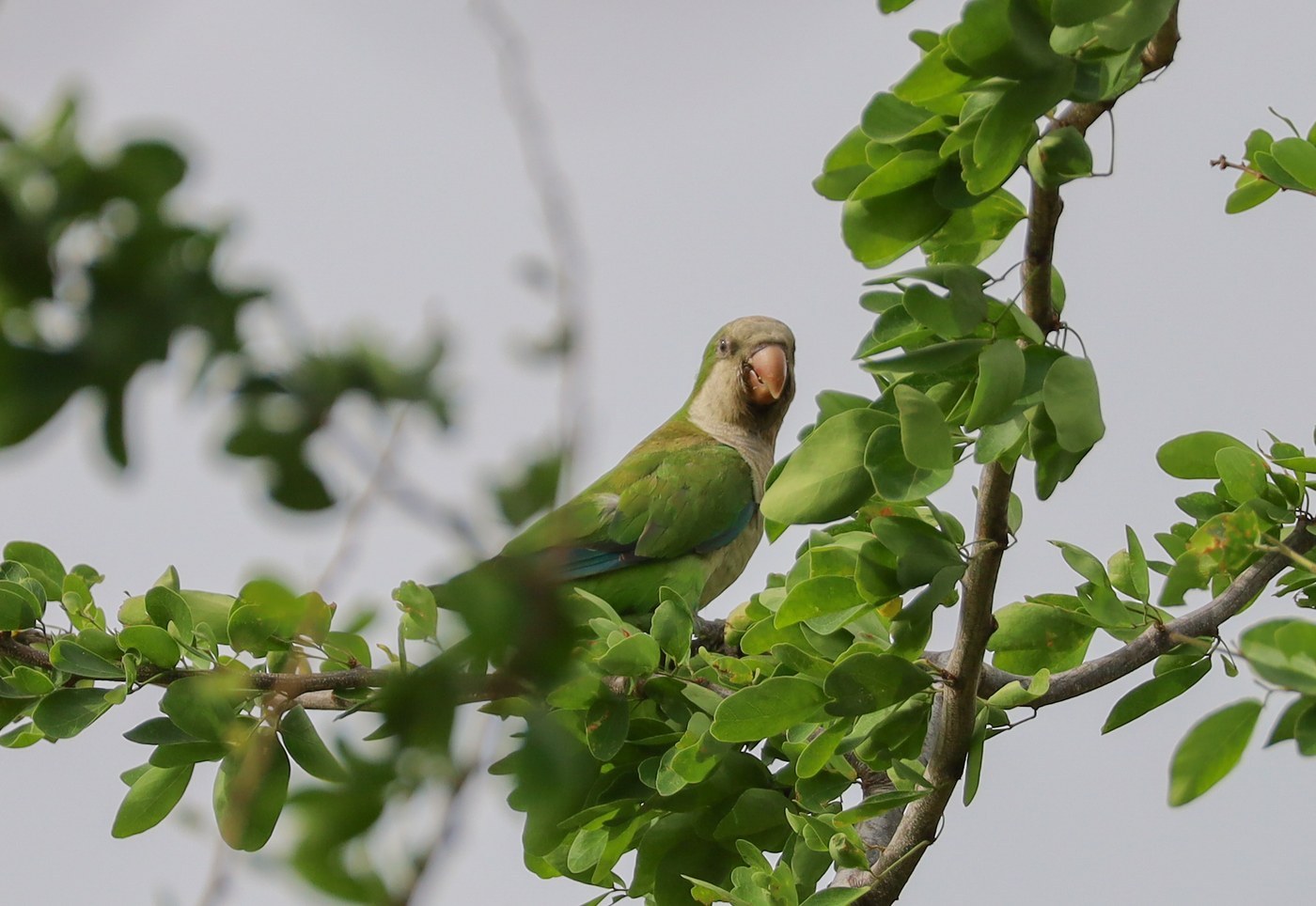
Monk Parakeet
Myiopsitta monachus
A small green Neotropical parakeet uniquely known for building large, elaborate communal stick nests rather than nesting in tree cavities.
- Size
- About 29 cm (11.5 in) long; wingspan approx. 48 cm
- Habitat
- Subtropical woodland and savanna, naturalized in urban and suburban areas
- Type
- parrot
Spotted a bird like this?
Identify any bird from a photo, free.
Overview
The Monk Parakeet is a small, stocky parrot native to temperate and subtropical South America, notable for being one of the few parrot species that builds its own nest from sticks rather than using a cavity. It has also established numerous naturalized populations elsewhere in the world.
Plumage is mostly bright green above, with a pale grey forehead, face, throat, and breast, and pale blue-green flight feathers visible in flight. The belly shows a wash of yellowish green, and the bill is a pale horn color.
How to identify it
Key field marks
- Grey forehead, face, and breast contrasting with green upperparts
- Pale, unmarked horn-colored bill
- Blue-green tinge in the flight feathers
- Bulky stick nests, often visible on utility poles or in large trees
Similar species
The grey face and breast readily distinguish the Monk Parakeet from most other small green parakeets, which typically show green or yellow faces. Its bulky communal stick nests are also a strong identification clue where present, since no other common parakeet builds this type of structure.
Habitat & range
Range
Monk Parakeets are native to a broad area of central and southern South America, including parts of Bolivia, Brazil, Paraguay, Uruguay, and Argentina. Escaped and released birds have established self-sustaining populations in parts of North America, Europe, and elsewhere.
Habitat
In its native range it occupies open and semi-open habitats such as savanna, dry woodland, palm groves, and agricultural land. Introduced populations thrive readily in urban and suburban settings with parks, trees, and utility structures.
Movements
Monk Parakeets are largely non-migratory and resident year-round, remaining near their nest structures throughout the year.
Behavior & voice
Social behavior
Highly social, Monk Parakeets live in colonies and are rarely seen alone, foraging, roosting, and nesting communally throughout the year.
Voice
Calls are loud, harsh, and chattering, including sharp repeated squawks given frequently both in flight and around the nest colony.
Feeding
They feed on a wide variety of seeds, fruits, buds, and blossoms, foraging both in trees and on the ground, and readily exploit agricultural and urban food sources.
Nesting and breeding
Unique among most parrots, Monk Parakeets build large, bulky stacked-stick nests with multiple chambers, often used and expanded communally by several pairs within a single structure, frequently sited on poles, transmission towers, or large trees. Each pair maintains its own nest chamber, laying 5-8 eggs, and nests are reused and enlarged year after year, sometimes growing to substantial size.
Frequently asked questions
What makes the Monk Parakeet's nesting behavior unusual?
Unlike almost all other parrots, which nest in tree cavities, Monk Parakeets build large stick nests themselves, often shared communally by multiple breeding pairs in separate chambers.
Where are Monk Parakeets originally from?
They are native to central and southern South America, including Bolivia, Brazil, Paraguay, Uruguay, and Argentina.
Why are Monk Parakeets found in cities outside South America?
Escaped and released birds have established self-sustaining feral populations in various urban areas around the world, aided by their adaptability and ability to build their own nests.
How can you identify a Monk Parakeet?
Look for a grey face, throat, and breast contrasting with green upperparts, a pale horn-colored bill, and, where present, its distinctive large communal stick nest.
Are Monk Parakeets migratory?
No, they are year-round residents that stay close to their nest colonies throughout the year.
Monk Parakeet guides
In-depth guides for identifying, finding, and understanding Monk Parakeet.
Other birds you may enjoy
Eclectus Parrot
35-42 cm (14-16.5 in) long
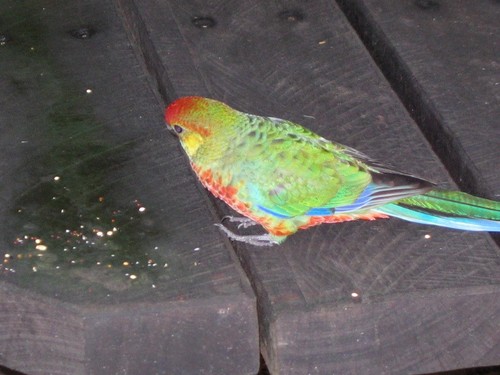
Western Rosella
25-30 cm (10-12 in) long
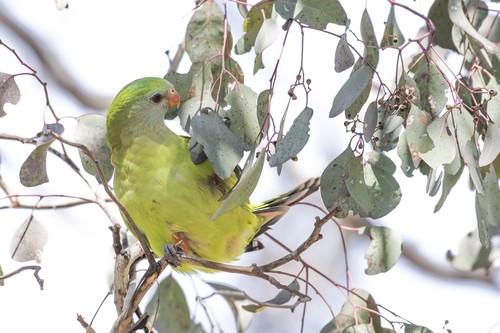
Superb Parrot
About 40 cm (16 in) long including a long tail
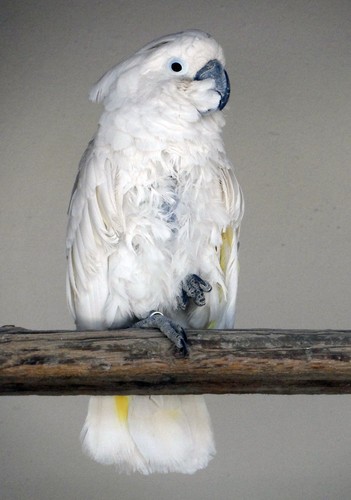
Umbrella Cockatoo
About 46 cm (18 in) long
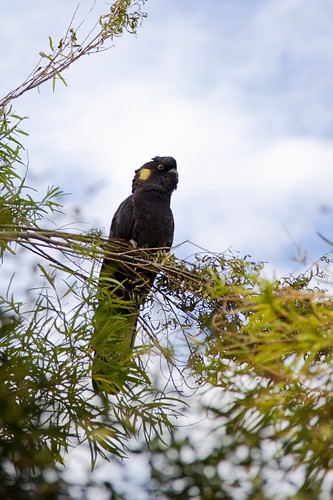
Yellow-tailed Black Cockatoo
55-65 cm long; wingspan up to about 130 cm
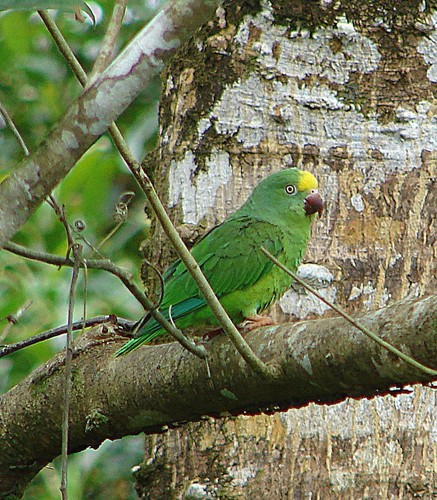
Yellow-crowned Amazon
About 35-38 cm (14-15 in) long
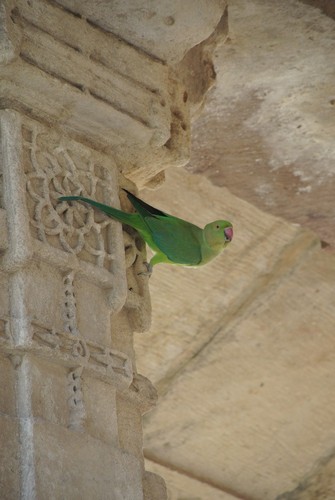
Rose-ringed Parakeet
40 cm (16 in) long including long tail
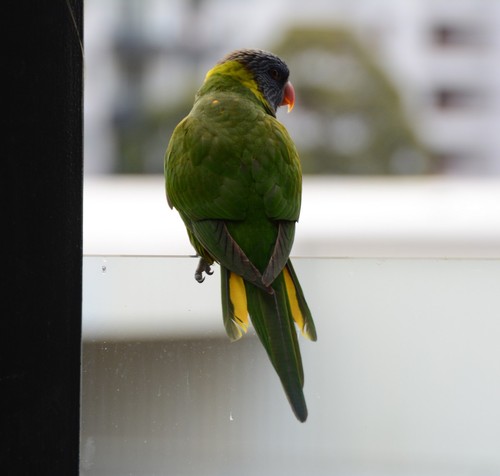
Rainbow Lorikeet
25-30 cm (10-12 in) long
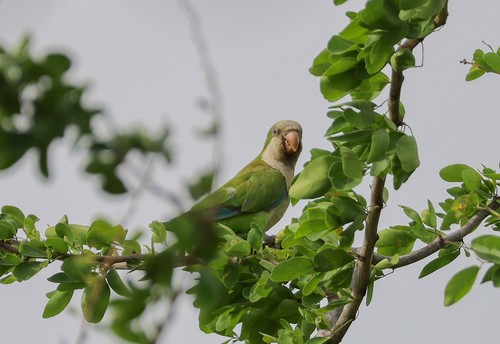
Quaker Parrot
28-31 cm (11-12 in) long
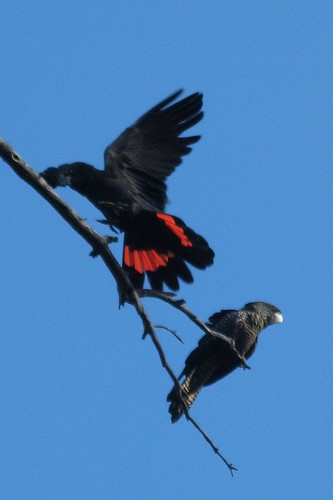
Red-tailed Black Cockatoo
55-65 cm long
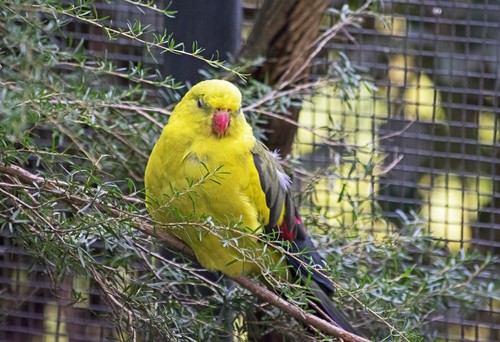
Regent Parrot
37-42 cm (15-17 in) long, including a long tail
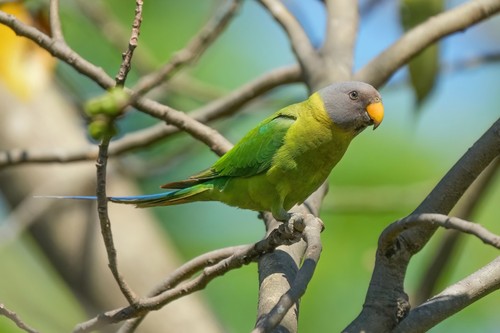
Plum-headed Parakeet
33 cm (13 in) long including tail