
Monk Parakeet Identification Guide
A bright green, gray-faced parakeet native to South America, notable as the only parrot that builds large communal stick nests, and now established as a feral species in many cities worldwide.
Read the full Monk Parakeet encyclopedia entry →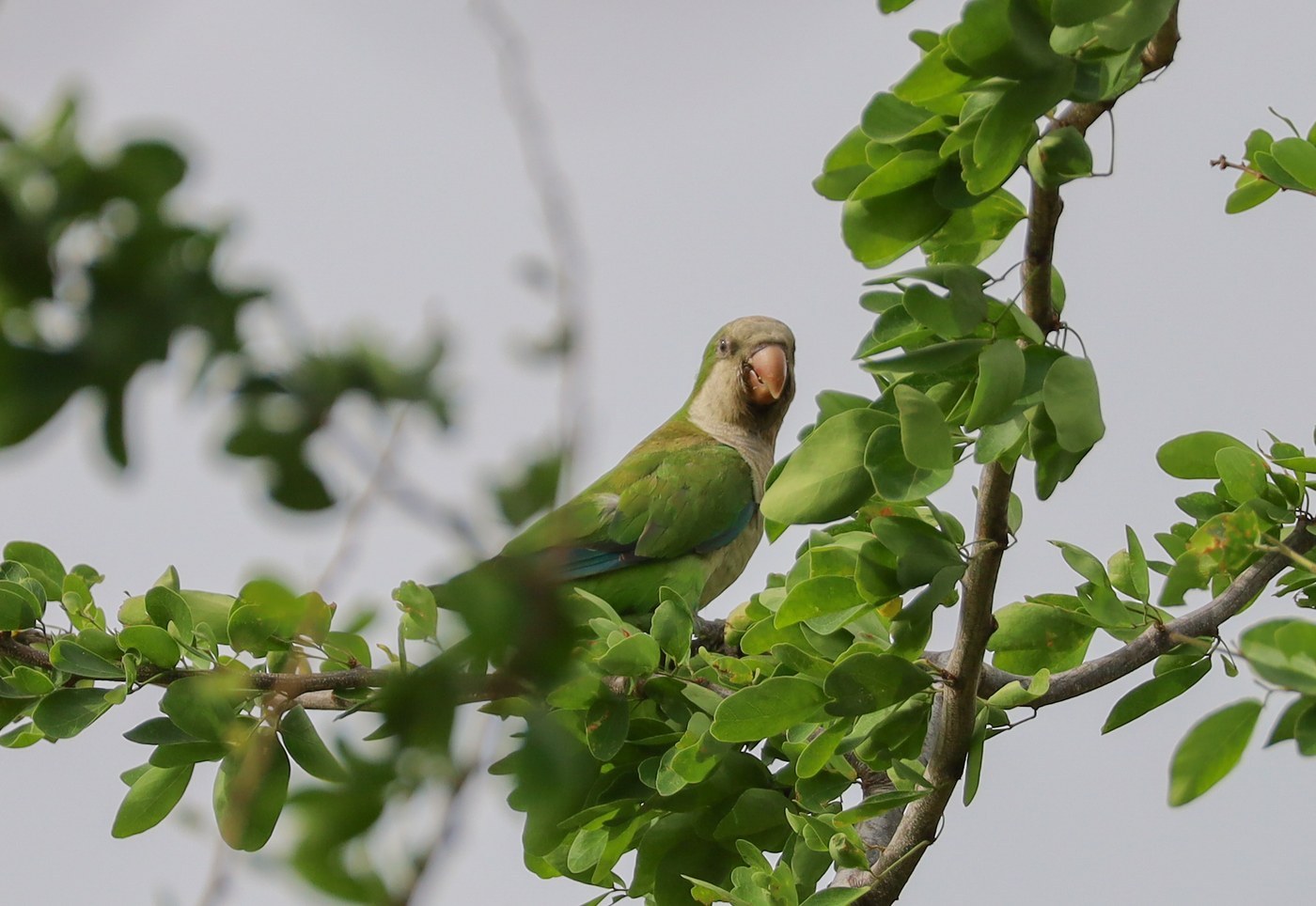
Key Field Marks
- Medium-small parrot, about 29 cm (11.5 in), with bright green upperparts and a long, pointed green tail.
- Gray forehead, face, throat, and breast, with a subtle scalloped or barred pattern on the breast feathers.
- Pale, pinkish-horn colored bill; greenish-yellow wash on the lower belly; blue visible in the flight feathers, especially in flight.
Separating It From Similar Species
Rose-ringed (Ring-necked) Parakeet
- Longer tail, red bill, and a thin pink-and-black neck ring on males; entirely lacks the gray face and breast of Monk Parakeet, and has a different, more piercing flight call.
Other feral green parakeets
- Monk Parakeet is the only commonly naturalized parakeet with a solidly gray face and breast, making this combination a reliable field mark wherever feral parrot populations occur.
Behavior & Voice
- Uniquely among parrots, builds large, bulky stick nests rather than nesting in cavities — colonies construct communal multi-chambered nests in trees or on man-made structures such as utility poles and cell towers, a strong identification clue even at a distance.
- Highly social and noisy, living in colonies and constantly maintaining and adding to nest structures year-round.
- Calls are loud, harsh, chattering screeches, especially around nest colonies.
Habitat, Range & Season
- Native to subtropical and temperate lowlands of Argentina, Bolivia, Brazil, Paraguay, and Uruguay, in open woodland, palm groves, and agricultural areas.
- Widely established as a feral species from escaped or released pet birds in cities across the United States (including Chicago and New York), Spain, and other parts of Europe, where large stick nest colonies are often the easiest way to detect them.
- Non-migratory and resident wherever established, tolerating cold winters thanks to the insulating bulk of its communal nests.
Frequently asked questions
What is the easiest way to identify a Monk Parakeet?
Look for its bright green body combined with a gray face and breast, and especially for its bulky stick nest, which no other common parrot species builds.
Why does the Monk Parakeet build stick nests instead of using tree cavities?
It is the only parrot species known to construct its own large, communal stick nests rather than relying on natural or excavated cavities, likely helping it survive in colder climates.
Where can Monk Parakeets be seen outside South America?
Established feral populations exist in many cities in the United States and parts of Europe, originating from escaped or released pet birds.
How does a Monk Parakeet differ from a Rose-ringed Parakeet?
Monk Parakeet has a gray face and breast and a pale bill, while Rose-ringed Parakeet has an all-green head, a red bill, and (in males) a thin neck ring.