
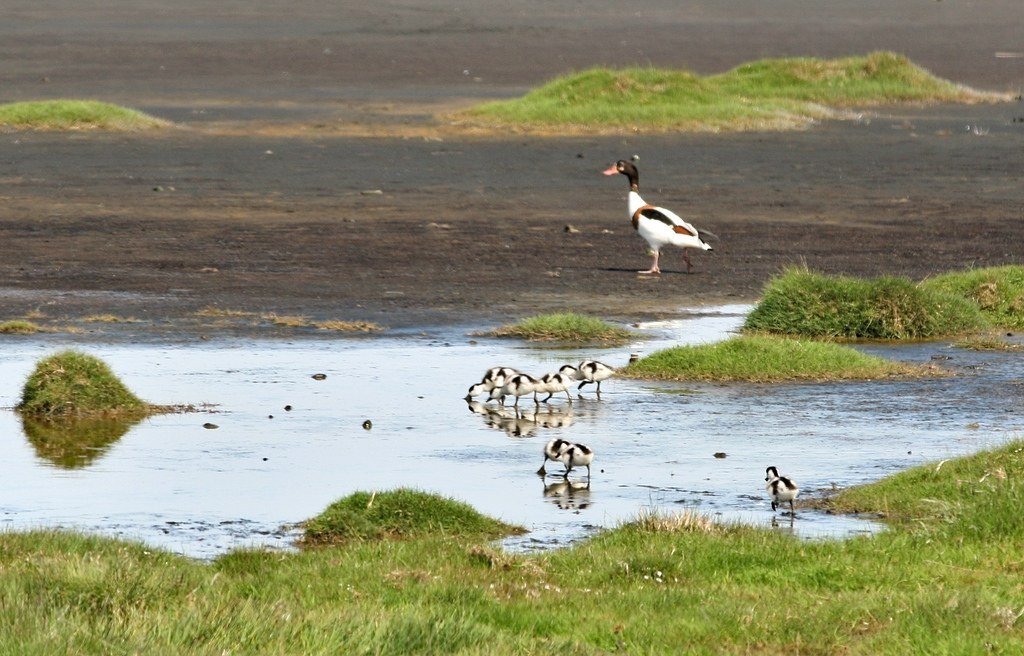
Common Shelduck
Tadorna tadorna
A large, goose-like duck with bold white, black, and chestnut plumage and a bright red bill.
- Size
- 58-67 cm (23-26 in) long, 100-120 cm wingspan
- Habitat
- coastal mudflats, estuaries, salt marshes; also inland lakes
- Type
- waterfowl
Spotted a bird like this?
Identify any bird from a photo, free.
Overview
The Common Shelduck is a large, boldly patterned duck that looks almost goose-like in size and shape. Both sexes share a striking pattern of a white body crossed by a broad chestnut breast band, a glossy dark green head, and a bright red bill; males show a small knob at the base of the bill during the breeding season. In flight, the black flight feathers and green speculum contrast sharply with the white body.
Widespread across temperate Europe and Asia, the Common Shelduck is most closely tied to coastal mudflats and estuaries, though it also uses inland lakes in parts of its range.
How to identify it
Key field marks
- Large size, goose-like proportions, white body with a chestnut breast band
- Glossy dark green head and neck, bright red bill (males have a red knob at the base during breeding season)
- Black scapulars and flight feathers, iridescent green speculum visible in flight
Similar species
The Ruddy Shelduck is entirely orange-brown with a pale head and lacks the white body and chestnut breast band of the Common Shelduck, and its bill is dark rather than red. No other Eurasian duck combines the bold white/chestnut/green pattern of the Common Shelduck.
Habitat & range
Common Shelducks breed across temperate Europe and Central Asia, favoring coastal mudflats, estuaries, salt marshes, and adjacent farmland, as well as some inland lakes and wetlands. Many populations are migratory, with large numbers molting communally at a few key coastal sites before dispersing to winter along milder coastlines within the breeding range or slightly to the south.
Behavior & voice
Behavior
Shelducks feed by walking and sifting through mud and shallow water, often in pairs or small flocks, and gather in large numbers at traditional molting sites after breeding.
Voice
Males give a soft whistling call, while females produce a loud, harsh, repeated barking or laughing quack, especially in flight or during disputes.
Feeding
Small mollusks, crustaceans, and other invertebrates sifted from mud and shallow water, along with some plant material.
Nesting
Nests in burrows, rabbit holes, tree cavities, or dense vegetation, sometimes well away from water; clutches typically hold 8-12 eggs, and broods are sometimes combined into large creches tended by a few adults.
Frequently asked questions
How do you identify a Common Shelduck?
Look for a white body crossed by a chestnut breast band, a glossy dark green head, and a bright red bill, giving it a bold, goose-like appearance.
Where do Common Shelducks nest?
In burrows, rabbit holes, tree cavities, or dense vegetation, often surprisingly far from open water.
What do Common Shelducks eat?
Small mollusks, crustaceans, and other invertebrates sifted from coastal mud and shallow water.
Is the Common Shelduck related to geese?
It is a shelduck, a group of ducks that are intermediate in size and behavior between true ducks and geese, though it is not a true goose.
Common Shelduck guides
In-depth guides for identifying, finding, and understanding Common Shelduck.

Other birds you may enjoy
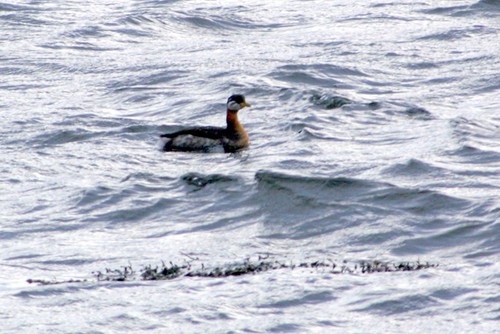
Red-necked Grebe
40-55 cm (16-22 in) long, 77-85 cm wingspan
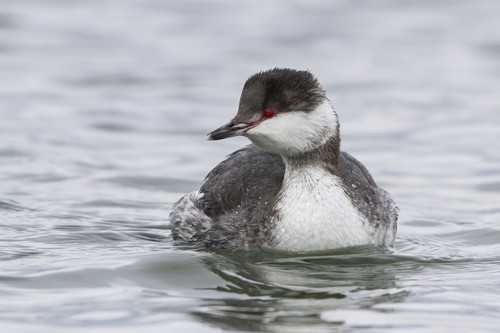
Horned Grebe
31-38 cm (12-15 in) long, 46-55 cm wingspan
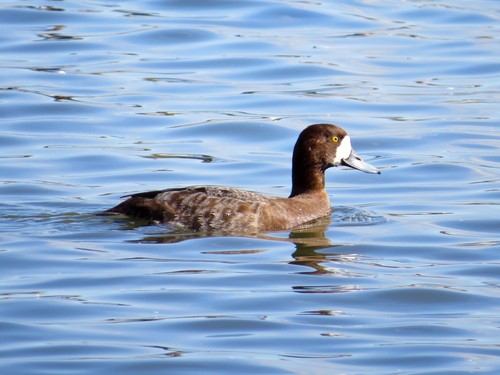
Greater Scaup
42-51 cm (16.5-20 in) long, 71-84 cm wingspan
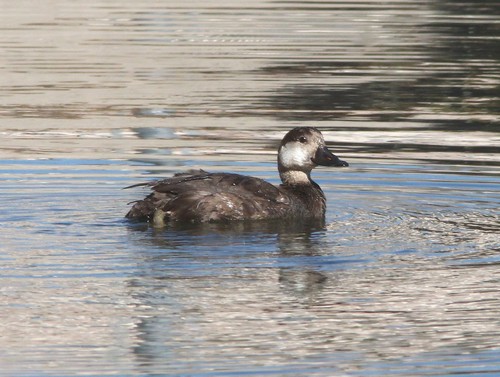
Black Scoter
43-54 cm (17-21 in) long, 79-90 cm wingspan
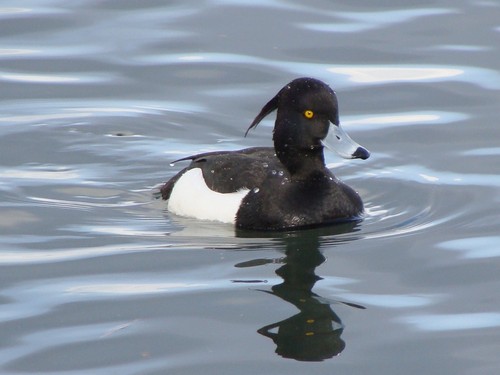
Tufted Duck
40-47 cm (16-18.5 in) long, 67-73 cm wingspan
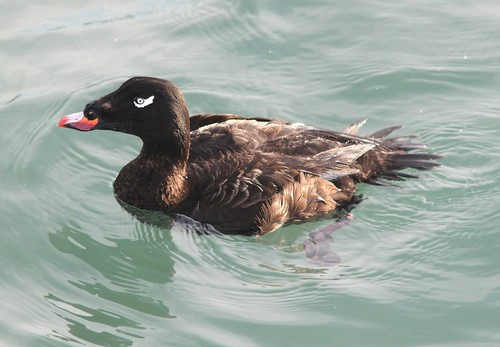
White-winged Scoter
48-58 cm (19-23 in) long, 86-99 cm wingspan
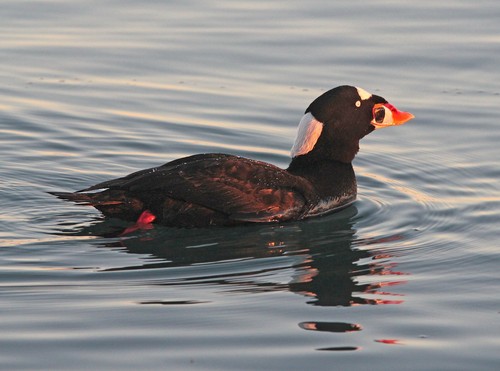
Surf Scoter
45-56 cm (18-22 in) long, 78-92 cm wingspan
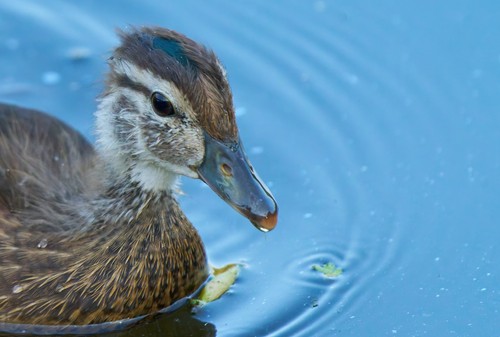
Wood Duck
47-54 cm (18.5-21 in) long, 66-73 cm wingspan
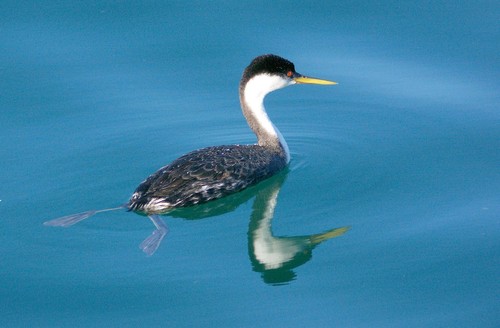
Western Grebe
56-74 cm (22-29 in) long, 79-102 cm wingspan
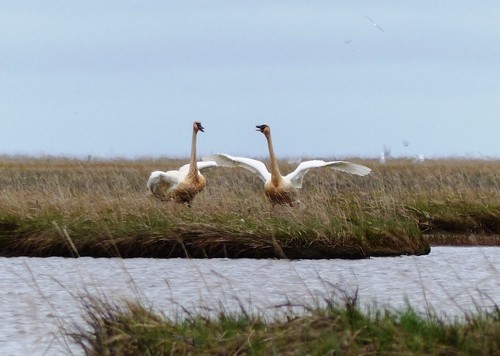
Tundra Swan
115-150 cm (45-59 in) long, about 180 cm wingspan
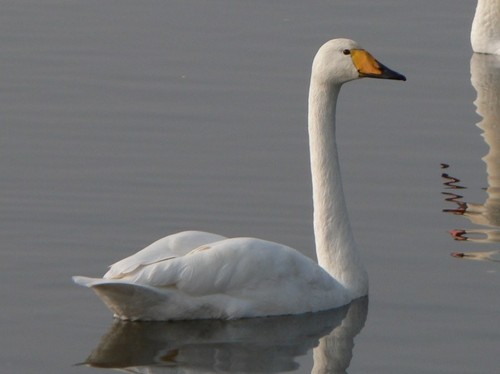
Whooper Swan
140-165 cm (55-65 in) long, 205-235 cm wingspan
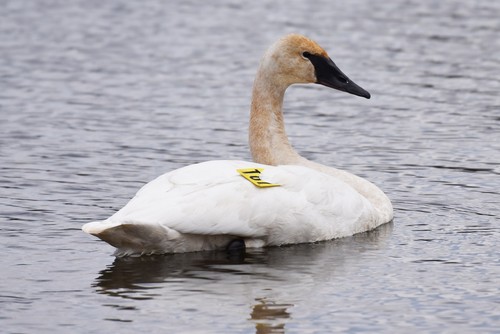
Trumpeter Swan
150-180 cm (59-71 in) long, up to 300 cm wingspan