
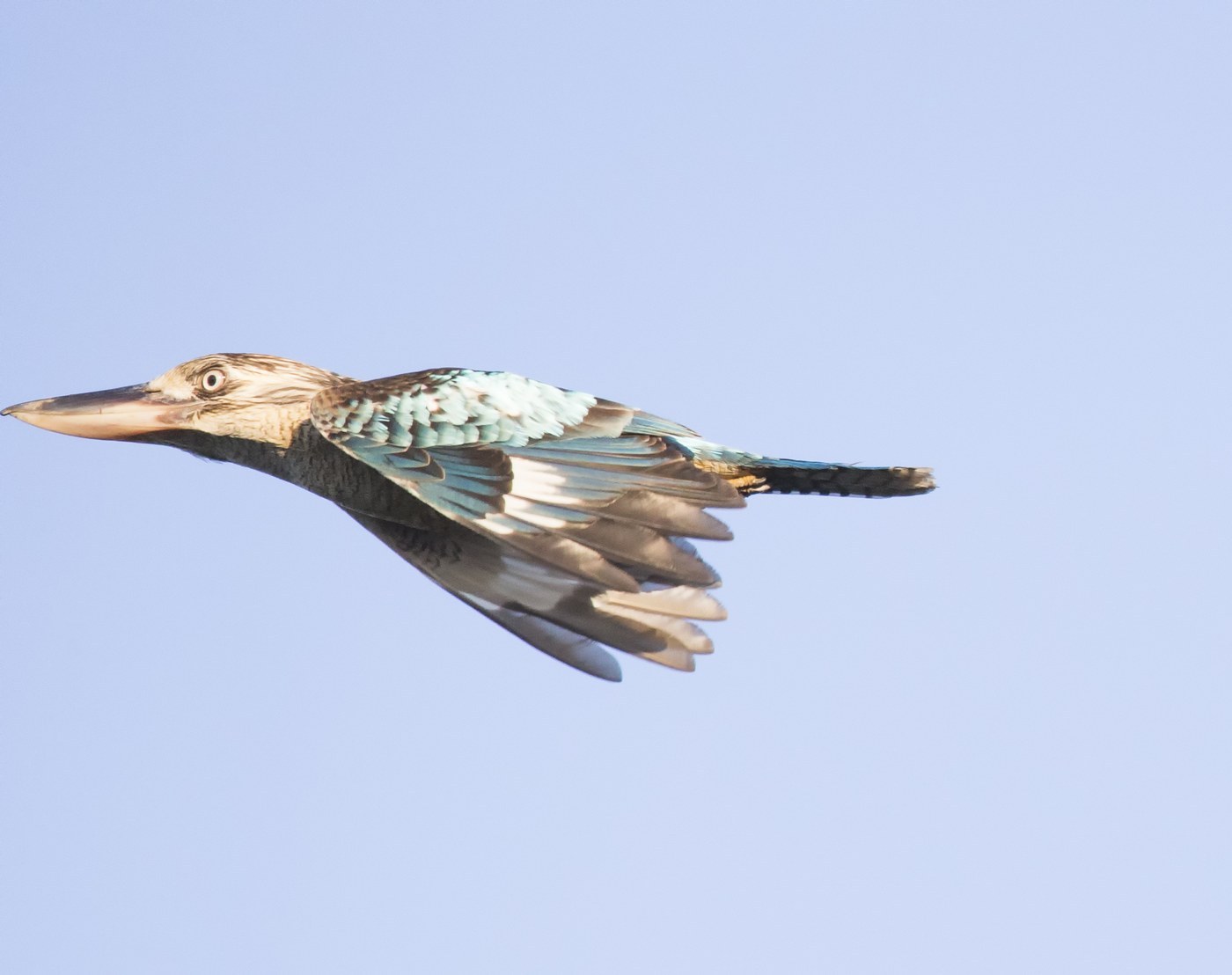
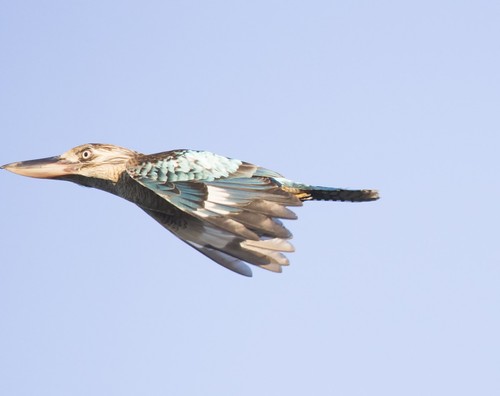
Blue-winged Kookaburra
Dacelo leachii
A large, pale-eyed kingfisher of northern Australia known for its harsh, cackling calls given by family groups at dawn and dusk.
- Size
- 35-38 cm long; stocky, large-headed build
- Habitat
- Open woodland, savanna, mangroves and farmland with scattered trees
- Type
- other
Spotted a bird like this?
Identify any bird from a photo, free.
Overview
The Blue-winged Kookaburra is a large terrestrial kingfisher of northern Australia and southern New Guinea. It is a heavy-bodied bird with an oversized bill, a whitish-streaked brown head, pale underparts, and a brown back.
Its common name comes from the bright blue patches on the wing coverts, which flash noticeably in flight. The tail is blue above, barred with black. Males and females differ subtly: males show more blue in the rump and tail, while females tend to have more rufous-brown tail coloring.
How to identify it
Key field marks
- Large, thickset kingfisher with an oversized bill
- Pale, whitish iris (eye) — the single best mark separating it from the Laughing Kookaburra
- Blue patches on the wing coverts, visible at rest and in flight
- Blue tail barred with black
- Streaky brown-and-white head, no strong dark eye-stripe
Similar species
The Laughing Kookaburra (Dacelo novaeguineae) overlaps in parts of Queensland but has a dark brown eye, a bold dark eye-stripe, and much less blue in the wing. Laughing Kookaburra's famous "laughing" song is more melodious than the harsher, more manic cackle of the Blue-winged Kookaburra.
Habitat & range
Range
Found across northern Australia, from the Kimberley in Western Australia across the Top End of the Northern Territory to Cape York and central coastal Queensland, and in southern New Guinea.
Habitat
Prefers open eucalypt woodland, savanna, paperbark swamps, mangrove edges, and farmland with scattered trees for perching and hunting. It avoids dense rainforest.
Movement
Generally sedentary, holding permanent territories year-round as family groups.
Behavior & voice
Voice
Gives a harsh, cackling, almost maniacal call, often described as more raucous and less musical than the Laughing Kookaburra's laugh. Family groups frequently call together in a chorus, especially around dawn and dusk, to advertise territory.
Feeding
A sit-and-wait predator, perching quietly before dropping onto prey on the ground — insects, lizards, snakes, frogs and small mammals — which it kills by beating against a branch.
Breeding
A cooperative breeder: young from previous broods often stay to help parents feed and defend later chicks. Nests are unlined cavities in tree hollows or excavated into arboreal termite mounds.
Frequently asked questions
How do you tell a Blue-winged Kookaburra from a Laughing Kookaburra?
Look at the eye: Blue-winged Kookaburras have a pale, whitish iris, while Laughing Kookaburras have a dark brown eye and a bolder dark eye-stripe. Blue-winged Kookaburras also show more blue in the wing.
Where do Blue-winged Kookaburras live?
Across northern Australia (Kimberley to Cape York and central Queensland) and southern New Guinea, in open woodland, savanna and mangrove-edge habitat.
What does a Blue-winged Kookaburra eat?
Insects, lizards, snakes, frogs and small mammals, caught by pouncing from a perch.
Do Blue-winged Kookaburras live in family groups?
Yes, they are cooperative breeders — offspring from earlier broods often help their parents raise later chicks.
Blue-winged Kookaburra guides
In-depth guides for identifying, finding, and understanding Blue-winged Kookaburra.
Other birds you may enjoy
Kiwi
35-55 cm (14-22 in) long; roughly chicken-sized
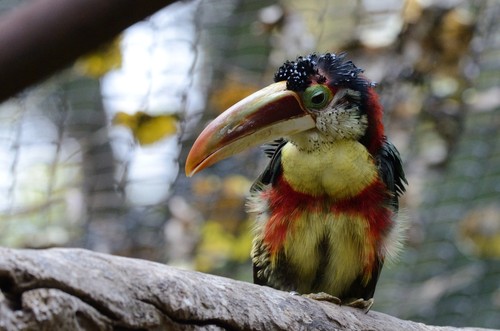
Curl-crested Aracari
41-46 cm (16-18 in) long, including a long bill and tail
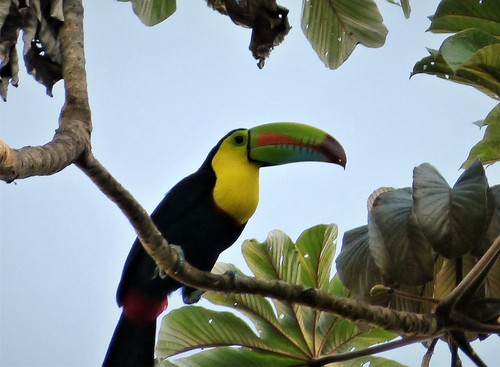
Keel-billed Toucan
42-55 cm (17-22 in) long including bill
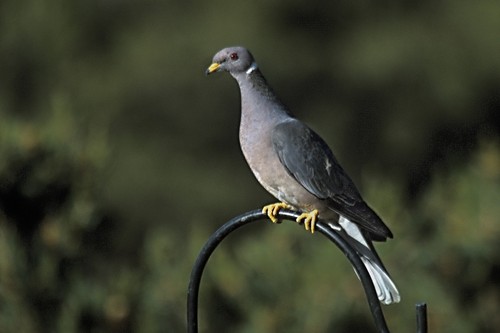
Band-tailed Pigeon
33-38 cm (13-15 in) long, wingspan about 66 cm (26 in)
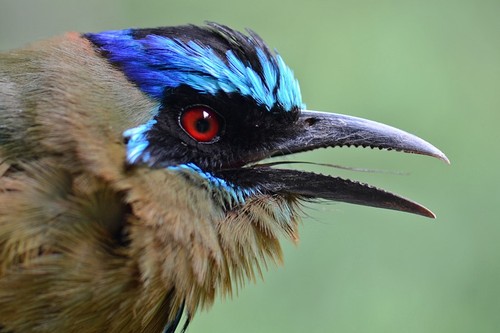
Blue-crowned Motmot
38-43 cm (15-17 in) long including tail
White-tipped Dove
27-30 cm (10.5-12 in) long, 38-43 cm wingspan
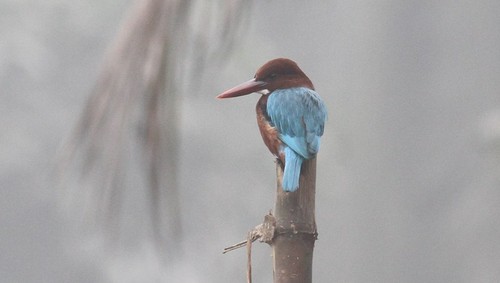
White-throated Kingfisher
27-28 cm (10.5-11 in) long
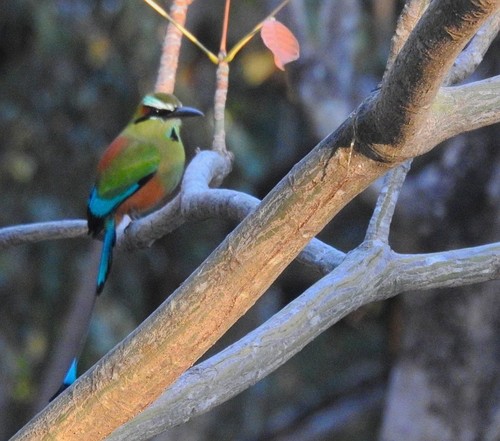
Turquoise-browed Motmot
34 cm (13 in) long including tail
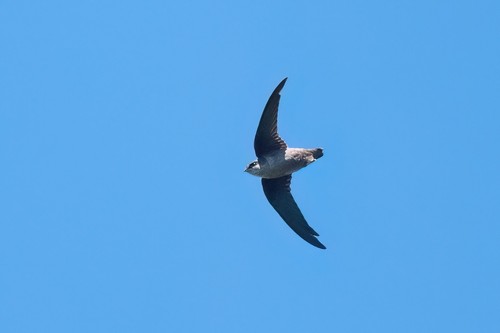
Vaux's Swift
10-12 cm (4-4.5 in) long, 27-30 cm wingspan
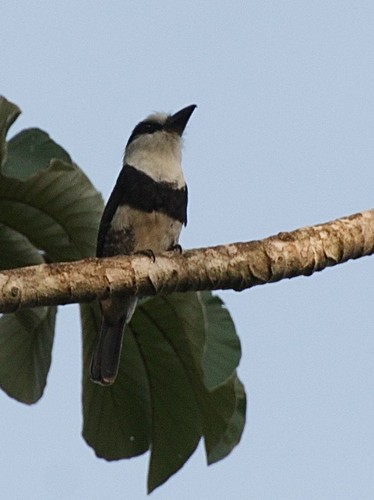
White-necked Puffbird
22-24 cm (8.5-9.5 in) long
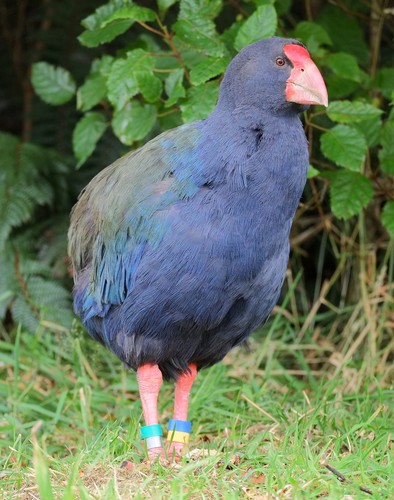
Takahe
50 cm (20 in) long, up to 3.5 kg; flightless
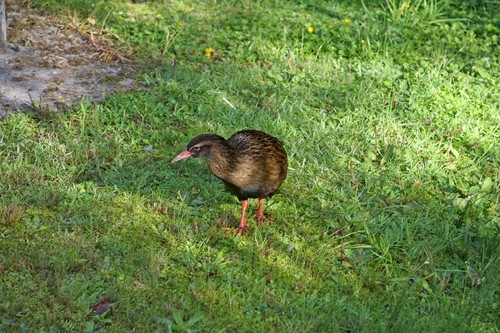
Weka
50-60 cm (20-24 in) long; flightless