
Blue-winged Kookaburra Identification Guide
A large, raucous Australasian kingfisher with a whitish head, dark eye-stripe, and vivid blue wing patch, known for its loud cackling calls.
Read the full Blue-winged Kookaburra encyclopedia entry →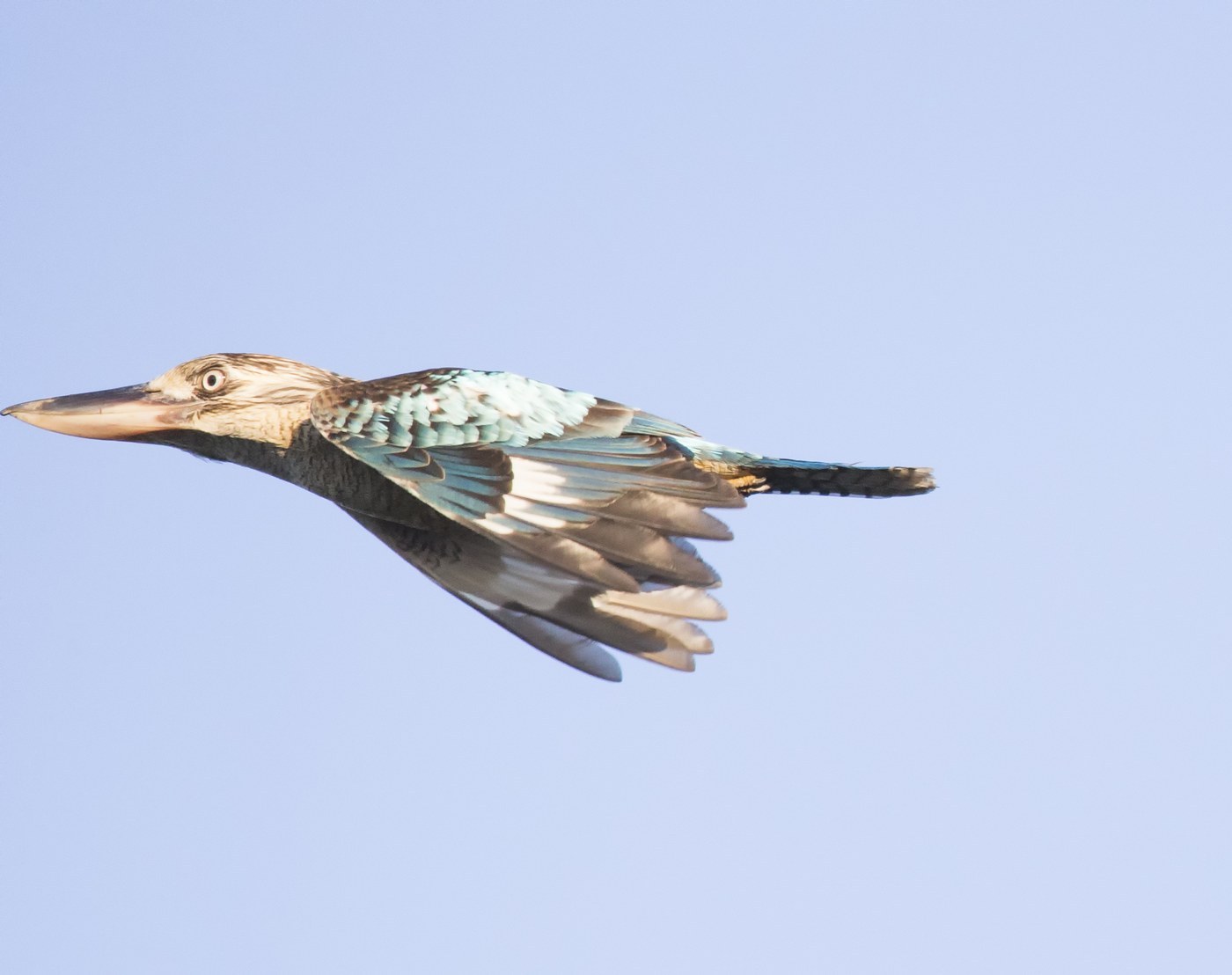
Key Field Marks
- Size & shape: A large kingfisher, about 38-42 cm (15-16.5 in), with a heavy, dagger-like bill, a big head, and a relatively short tail — similar in build to its better-known relative, the Laughing Kookaburra.
- Plumage: Pale, whitish to buffy head and underparts with a dark brown-black stripe through the eye; brown back; and a bright, vivid blue patch on the wing coverts that is much more extensive and saturated than in the Laughing Kookaburra.
- Tail: Blue tail with dark barring, more blue overall than the rufous-and-black tail of Laughing Kookaburra.
- Sexes: Females often show a duller, browner rump/lower back compared to the more blue-toned males, a useful distinguishing feature within the species.
- Behavior: Perches prominently on bare branches, wires, or posts scanning for prey; drops to the ground to catch reptiles, large insects, and small vertebrates; often seen in family groups.
Similar Species
- Laughing Kookaburra: Larger overall, with a duller, more restricted patch of dull blue on the wing (vs. the bright, extensive blue of Blue-winged), a rufous tail with black barring, and a more famous, deeper "laughing" call.
- Other Australasian kingfishers (e.g., Forest Kingfisher): Much smaller and more slender with proportionally smaller bills, lacking the bulky kookaburra build.
- The much brighter and more extensive blue wing patch, plus the blue-toned (rather than rufous) tail, are the key marks separating this species from Laughing Kookaburra where ranges overlap in northern Australia.
Where & When to See It
- Range: Found across northern Australia (from the Kimberley region east through the Top End and Cape York to Queensland) and in New Guinea and nearby islands.
- Habitat: Open woodland, savanna, mangroves, and clearings with scattered trees, generally in more tropical/monsoonal habitat than the drier woodland favored by Laughing Kookaburra.
- Season: Resident year-round; most active and vocal around dawn and dusk, especially at the start of the breeding season.
Voice & Song Cues
- A loud, raucous, cackling call similar in structure to Laughing Kookaburra but generally described as harsher, more manic, and less deeply "laughing," often likened to maniacal cackling or shrieking.
- Family groups often call in noisy chorus, especially at dawn, a behavior shared with Laughing Kookaburra and used to declare territory.
- The higher-pitched, harsher quality of the call (compared to the rich, rolling laugh of the Laughing Kookaburra) is a useful clue even before the bird is seen.
Frequently asked questions
How do I tell a Blue-winged Kookaburra from a Laughing Kookaburra?
Blue-winged Kookaburra shows a much brighter, more extensive blue wing patch and a blue-toned tail, versus the duller wing patch and rufous, black-barred tail of Laughing Kookaburra; the call is also harsher and less deeply 'laughing.'
Where does the Blue-winged Kookaburra live?
Across tropical northern Australia and New Guinea, favoring open woodland, savanna, and mangrove edges.
Can males and females be told apart?
Females typically show a duller, browner lower back/rump compared to the bluer tones of males, offering a subtle but useful distinction.
What does the Blue-winged Kookaburra eat?
It hunts from an exposed perch, dropping to the ground to catch reptiles, large insects, and small vertebrates.