
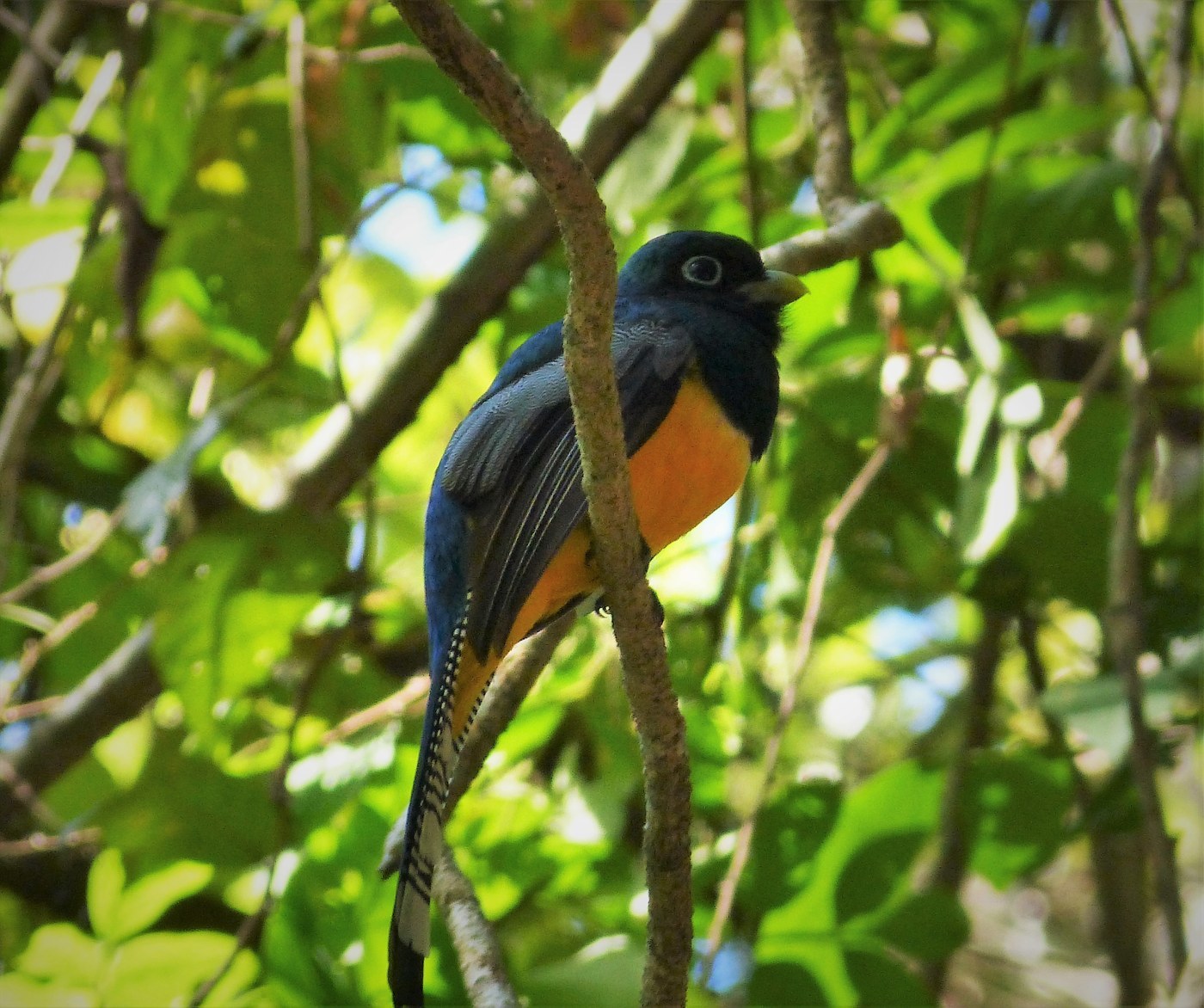
Black-throated Trogon
Trogon rufus
A quiet lowland-forest trogon with a black face and throat, green upperparts, and a bright yellow belly.
- Size
- 23-25 cm (9-10 in) long
- Habitat
- understory and mid-story of humid lowland and foothill forest
- Type
- other
Spotted a bird like this?
Identify any bird from a photo, free.
Overview
The Black-throated Trogon is a relatively small, understated trogon of humid lowland and foothill forest, more often heard than seen as it perches motionless in shaded mid-story vegetation. Males have a glossy green crown, back, and chest bordered by a black face and throat, with a bright yellow belly and a finely barred blackish-and-white undertail; a blue ring of bare skin encircles the eye. Females are duller olive-brown above with a buffy eye-ring, retaining the yellow belly.
How to identify it
Key field marks
- Male: green crown/back, black face and throat, yellow belly, blue eye-ring, finely barred undertail.
- Female: brown/olive above (replacing male's green and black), yellow belly, buffy eye-ring.
- Quiet, still perching posture in shaded mid-story.
Similar species
Blue-crowned/Gartered Trogon complex also shows a yellow belly but has a green (not black) throat and a blue crown patch; Black-throated Trogon's solid black face/throat is the key distinguishing feature. Collared and Slaty-tailed Trogons both have red, not yellow, bellies.
Habitat & range
This species occupies the shaded understory and mid-story of humid lowland and foothill evergreen forest, generally below about 1,200-1,500 m, from Honduras south through Central America and across much of the Amazon basin to Bolivia and Brazil. It is a non-migratory forest-interior resident that rarely ventures into open habitat.
Behavior & voice
Voice
A soft, mellow, slightly descending series of notes, often paired or in short phrases, given from a still perch within the forest shade.
Feeding
Black-throated Trogons sit motionless for extended periods before sallying to pluck fruit or snatch large insects from nearby foliage, a foraging style shared across the trogon family.
Nesting and breeding
Pairs excavate a nest cavity in soft, rotten wood — sometimes in an active arboreal termite nest — and both parents share incubation and feeding of the chicks.
Frequently asked questions
What is the key field mark for Black-throated Trogon?
A solid black face and throat contrasting with a green crown/back and bright yellow belly in males.
How does it differ from Blue-crowned/Gartered Trogon?
Black-throated Trogon has a black throat, while Blue-crowned and Gartered Trogons have a green throat and a blue crown patch.
Where does Black-throated Trogon live?
In the shaded understory of humid lowland and foothill forest from Honduras through Central America and across much of the Amazon basin.
What does it eat?
Fruit and large insects, taken by sallying from a still perch.
Black-throated Trogon guides
In-depth guides for identifying, finding, and understanding Black-throated Trogon.
Other birds you may enjoy
Kiwi
35-55 cm (14-22 in) long; roughly chicken-sized
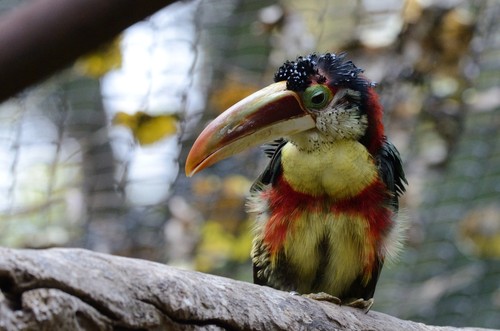
Curl-crested Aracari
41-46 cm (16-18 in) long, including a long bill and tail
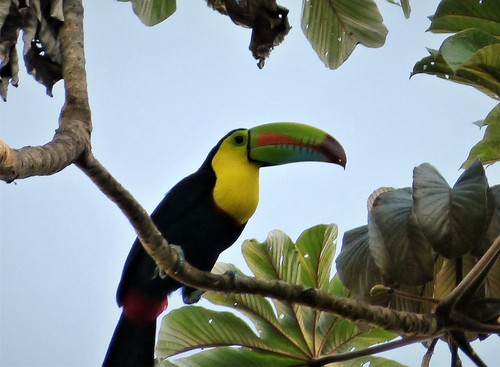
Keel-billed Toucan
42-55 cm (17-22 in) long including bill
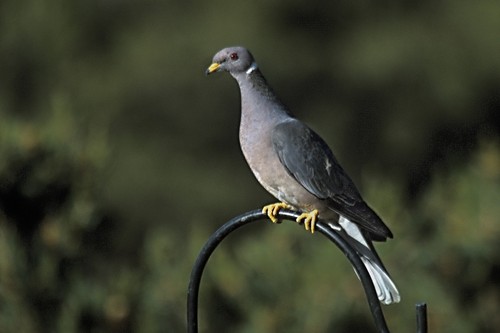
Band-tailed Pigeon
33-38 cm (13-15 in) long, wingspan about 66 cm (26 in)
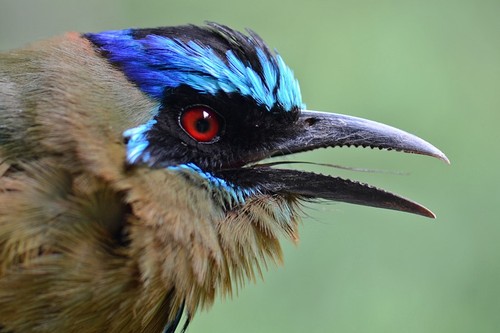
Blue-crowned Motmot
38-43 cm (15-17 in) long including tail
White-tipped Dove
27-30 cm (10.5-12 in) long, 38-43 cm wingspan
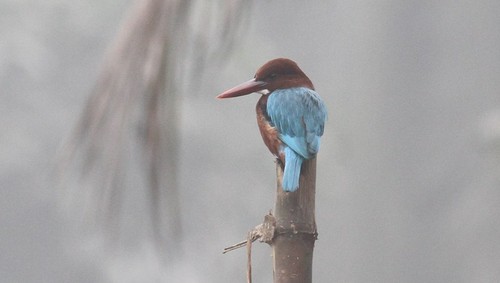
White-throated Kingfisher
27-28 cm (10.5-11 in) long
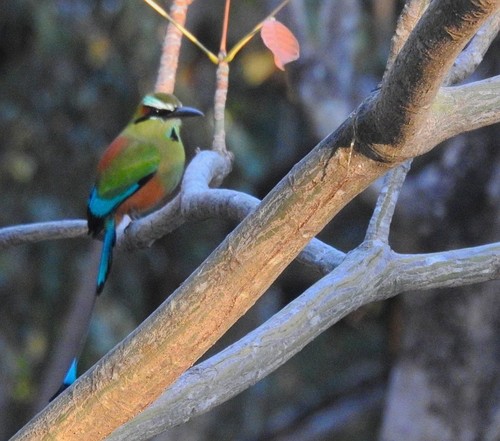
Turquoise-browed Motmot
34 cm (13 in) long including tail
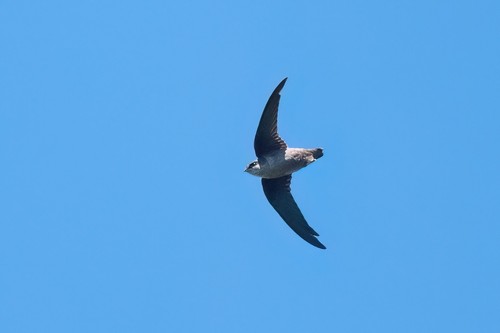
Vaux's Swift
10-12 cm (4-4.5 in) long, 27-30 cm wingspan
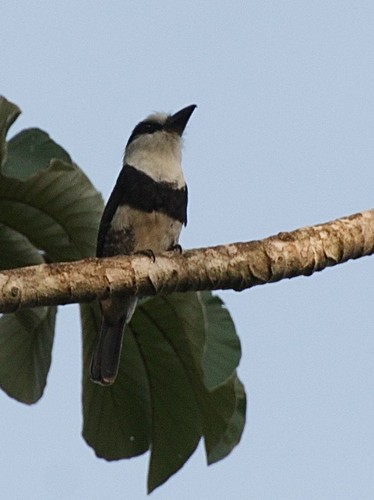
White-necked Puffbird
22-24 cm (8.5-9.5 in) long
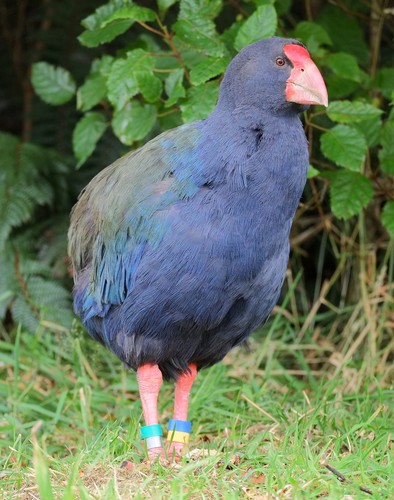
Takahe
50 cm (20 in) long, up to 3.5 kg; flightless
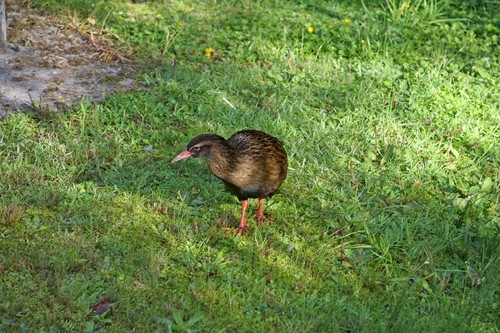
Weka
50-60 cm (20-24 in) long; flightless