
Black-throated Trogon Identification Guide
A quiet, jewel-toned forest trogon of Central and South American lowlands, with a green-and-black male, brown-headed female, and a bright blue eye-ring.
Read the full Black-throated Trogon encyclopedia entry →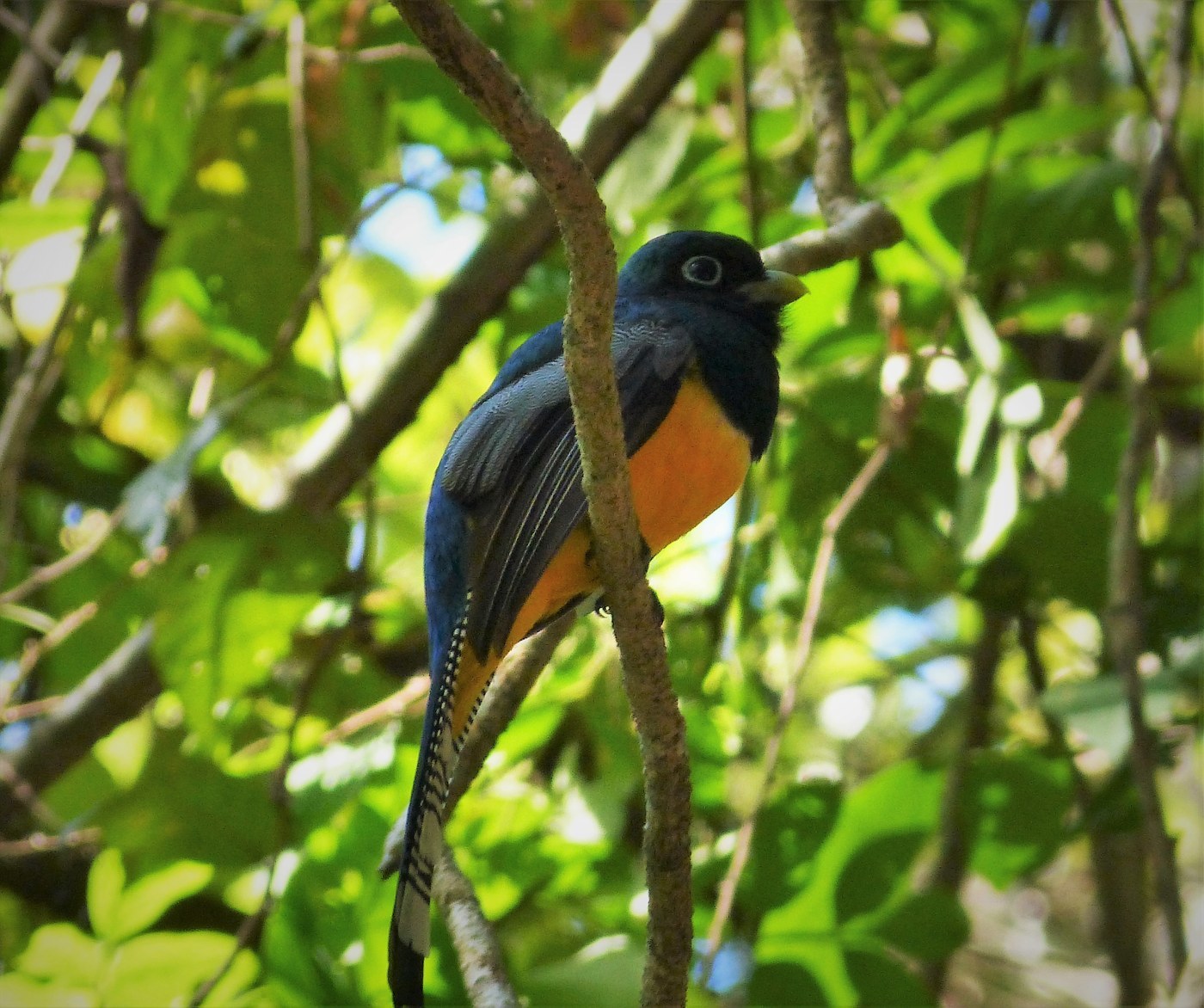
Key Field Marks
- Medium-sized trogon, about 23-26 cm, with the compact body, short neck, and long squared-off tail typical of the family
- Male: iridescent green head, back, and breast, with a black face and throat, sharply divided from a yellow belly; distinct blue, bare skin eye-ring
- Female: plain olive-brown head, back, and breast (no green iridescence), yellow belly, and a buffy or pale gray eye-ring
- Undertail pattern shows fine black-and-white barring in both sexes, visible when perched or in flight
- Perches upright and still for long periods, often sallying out briefly to catch insects or fruit before returning to the same perch
Similar Species
- Gartered Trogon (formerly part of Violaceous Trogon): very similar green-and-yellow pattern but typically has a pale yellow (not blue) eye-ring and a different undertail barring pattern; ranges overlap in parts of Central America
- Slaty-tailed Trogon: larger, with a red (not yellow) belly and an all-dark, unbarred tail
- Baird's Trogon: also has a red belly, differing sharply from the yellow-bellied Black-throated Trogon
- Voice and precise eye-ring color are often the most reliable ways to separate similar trogon species in areas of range overlap
Habitat & Range
- Inhabits the shaded interior and understory of humid lowland and foothill forest, generally avoiding forest edge and open areas
- Ranges from Honduras south through Central America (Costa Rica, Panama) and into northern and western South America, including the Amazon basin
- Generally a non-migratory, resident species throughout its range
Seasonality
- Present year-round; breeding activity concentrated in the local dry-to-wet season transition, varying by region
Voice
- Song is a soft, mellow series of low whistled or cooing notes, often described as a gentle "cow, cow, cow" or a slow descending series
- Generally quiet and easily overlooked despite its bright plumage; often located by voice before being seen
Frequently asked questions
How do you tell male and female Black-throated Trogon apart?
Males show iridescent green upperparts and a black throat with a blue eye-ring, while females have plain brown (non-iridescent) upperparts and a buffy eye-ring; both sexes share a yellow belly.
What color is the eye-ring, and why does it matter for identification?
Male Black-throated Trogons have a distinctive blue eye-ring, which helps separate them from similar yellow-eye-ringed trogons like the Gartered Trogon in areas where ranges overlap.
Where in the forest is this species most likely to be found?
In the shaded midstory and understory of humid lowland and foothill forest interior, rarely at forest edges or in open habitats.
Is Black-throated Trogon hard to spot despite its bright colors?
Yes — it perches quietly and motionless for long stretches in shaded foliage, and is often detected first by its soft, low whistled call rather than by sight.