Order: Anseriformes, Family: Anatidae
White-faced Whistling Duck
Dendrocygna viduata
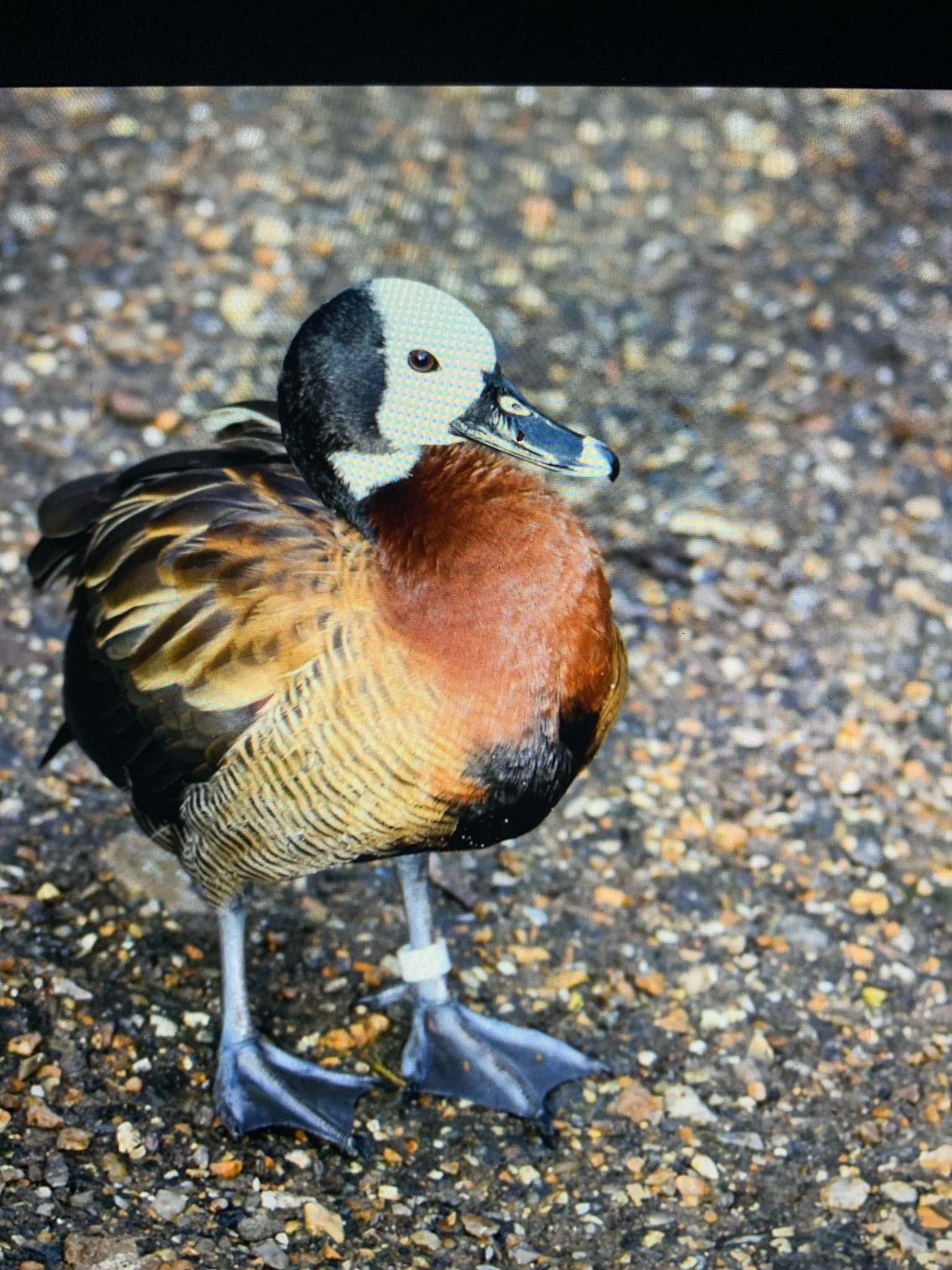
A medium-sized, long-legged duck with an upright posture, unmistakable white facial mask, chestnut breast, and finely barred flanks. Highly gregarious and vocal.
Explore White-faced Whistling Duck in the encyclopedia →Identify your own birds.
Get a report just like this from any photo or call, free.
Plumage & appearance
Distinctive pure white face and throat contrasting with a black crown and nape. The lower neck and breast are rich chestnut-red, grading into a black belly. The flanks are finely barred with black and yellowish-white. The back and wings are dark brown with tawny fringes. Sexes are similar in plumage, though females may be slightly duller; juveniles have a duller, more brownish head pattern.
Key field marks
Striking white face and throat, black rear crown and back of neck, rich chestnut breast, barred flanks, and noticeably long legs and neck in flight.
Size & weight
Length: 38-48 cm, Wingspan: 86-91 cm, Weight: 450-800 g
Voice — call & song
A very distinct, loud, clear, three-note whistling call ('see-ui-ou') often given in flight or when disturbed.
Diet & foraging
Primarily vegetarian, feeding on seeds of aquatic plants, grasses, grains, and occasionally small aquatic insects and mollusks by dabbling or grazing on land.
Habitat
Shallow freshwater lakes, marshes, flooded grasslands, swamps, and agricultural fields with abundant emergent vegetation.
Migration & movement
Mainly resident or nomadic, undertaking localized seasonal movements in response to rainfall and water availability.
Nesting & breeding
Nests on the ground hidden in tall grass near water, sometimes in tree cavities or old nests of other birds. Clutch size ranges from 6 to 12 eggs. Both parents share incubation and care for the precocial young.
Similar species
Fulvous Whistling Duck (Dendrocygna bicolor) and Wandering Whistling Duck (Dendrocygna arcuata), neither of which shares the striking pure white face and black head pattern of the White-faced Whistling Duck.
Ecological significance
Acts as a seed disperser and plays a role in nutrient cycling in wetland ecosystems through its foraging and feeding habits.
Conservation status
Least Concern, with a stable and widespread global population
Observation tips
Easily observed at freshwater wetlands, lakes, and marshes. They are often approachable at managed wildlife parks or reserves and frequently roost in large, noisy flocks near the water's edge.
Interesting facts
Unlike typical ducks, whistling ducks spend a considerable amount of time perched in trees and possess a more goose-like posture and social structure.
More like this