Order: Anseriformes, Family: Anatidae
Nene (Hawaiian Goose)
Branta sandvicensis
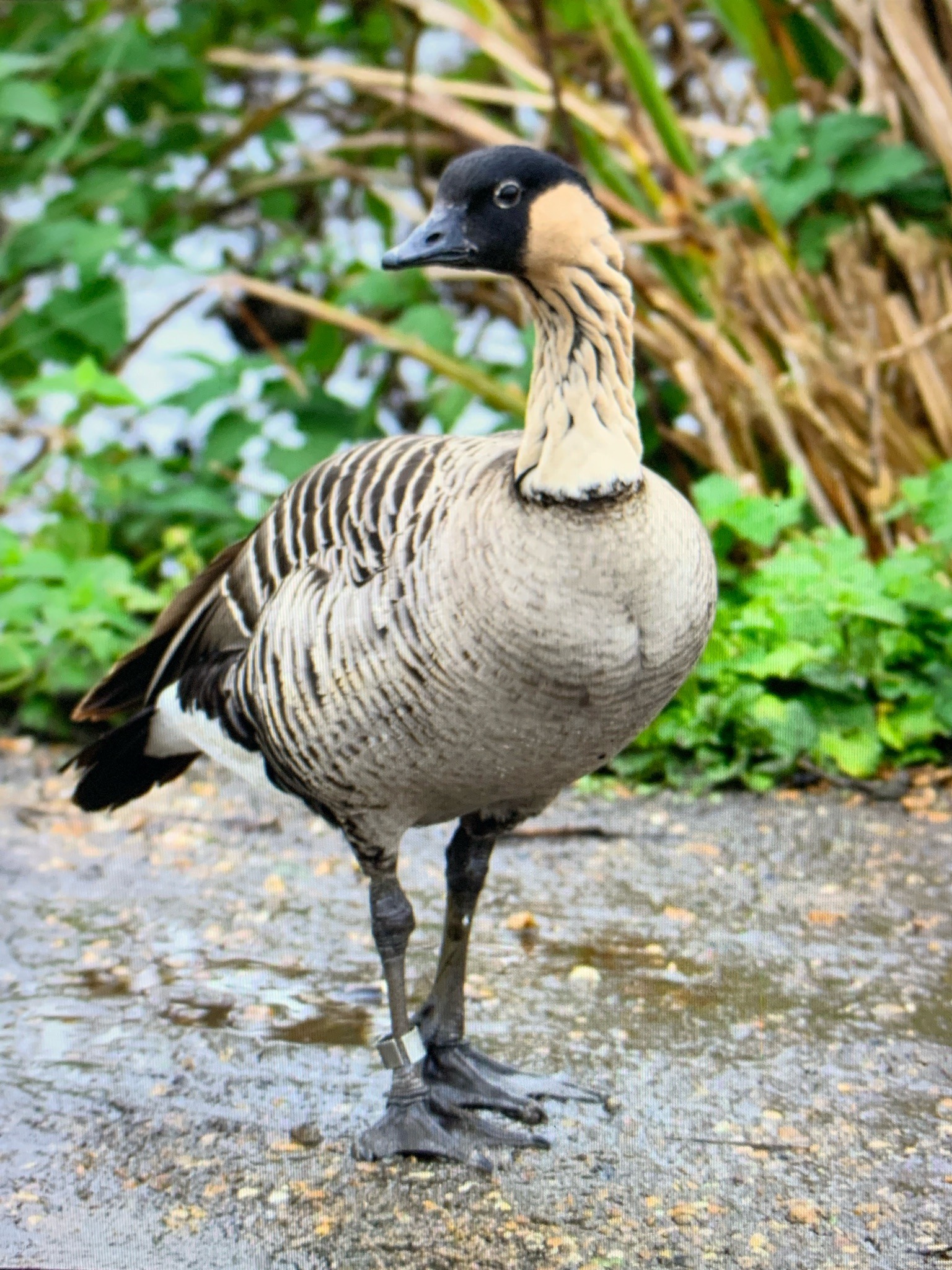
A medium-sized goose adapted for a terrestrial lifestyle with reduced webbed feet. It has a black face and crown, buff cheeks, and a heavily furrowed neck pattern.
Explore Nene (Hawaiian Goose) in the encyclopedia →Identify your own birds.
Get a report just like this from any photo or call, free.
Plumage & appearance
Black head and hindneck, a buff-colored cheek patch, and a distinct black-and-white diagonal striped pattern on the neck. The body features brownish-gray feathers with pale buff margins creating a barred appearance. Sexes look alike in plumage, though females are slightly smaller.
Key field marks
Black head and crown, buff cheeks, diagonally furrowed black and white neck skin/feathers, grayish-brown barred body, and dark legs with reduced toe webbing.
Size & weight
Length: 53-66 cm (21-26 in); Wingspan: approx. 110-130 cm; Weight: 1.5-3.0 kg (3.3-6.6 lbs).
Voice — call & song
A soft, high-pitched call resembling 'nay-nay' or a soft honking, particularly during flight or when communicating with mates.
Diet & foraging
Herbivorous. Feeds on leaves, seeds, fruits, and flowers of native and introduced grasses, shrubs, and berries.
Habitat
Shrublands, grasslands, coastal dunes, lava flows, and sometimes agricultural or developed areas like golf courses, ranging from sea level up to alpine zones.
Migration & movement
Non-migratory resident, though some populations show altitudinal movements between breeding and non-breeding seasons.
Nesting & breeding
Nests on the ground in a scrape hidden by vegetation. Lays 2 to 5 creamy-white eggs. Incubation is done entirely by the female over 29-30 days, while the male guards the territory.
Similar species
Canada Goose (Branta canadensis), from which it evolved, but the Nene is smaller, has distinctive neck striping, a buff cheek patch, and significantly reduced webbing on its toes.
Ecological significance
Acts as an important seed disperser for native Hawaiian plants across upland and lava field habitats.
Conservation status
Vulnerable (IUCN), though historically it was on the brink of extinction and recovered largely due to captive breeding programs.
Observation tips
Look for them in open areas, golf courses, national parks (like Haleakala and Hawaii Volcanoes National Park), and upland shrublands. Often seen walking rather than swimming.
Interesting facts
The Nene is the rare state bird of Hawaii and represents one of the world's most famous success stories of bird conservation, having rebounded from a low of around 30 individuals in the 1950s.
More like this