Order: Accipitriformes, Family: Accipitridae
Cooper's Hawk
Accipiter cooperii
A medium-sized hawk with a distinctive relative long tail and rounded wings, built for agile flight through dense forests and suburban areas.
Explore Cooper's Hawk in the encyclopedia →Identify your own birds.
Get a report just like this from any photo or call, free.
Plumage & appearance
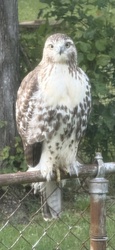
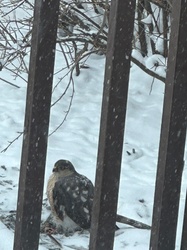
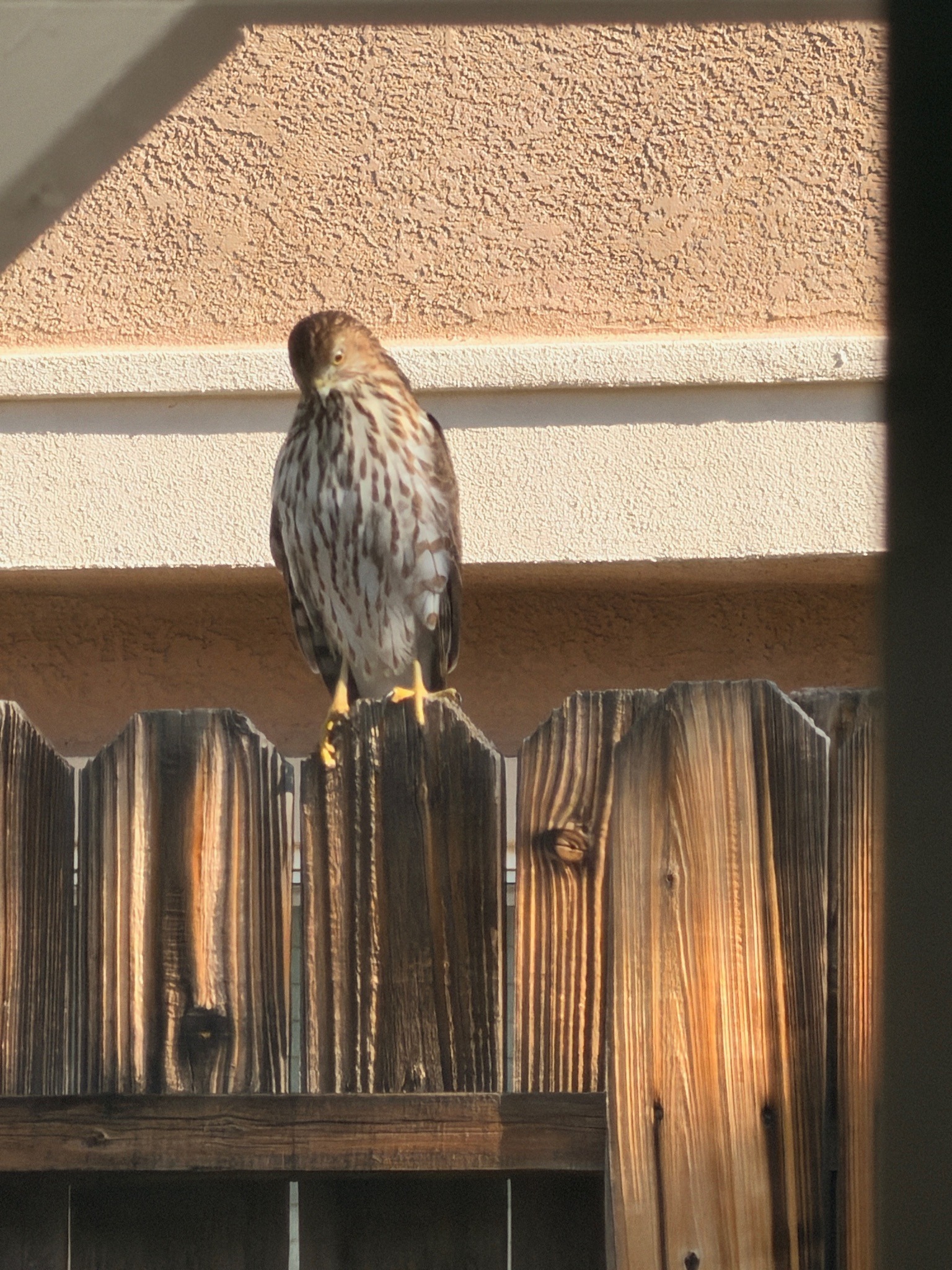
Adults have blue-gray upperparts, reddish-brown barring on the underparts, and dark bands on the tail. Immature birds (like the one pictured) are brown above with heavy, brown, tear-shaped streaks on a white breast, and yellowish eyes.
Key field marks
Medium size, long rounded tail with dark bands, relatively large flat-topped head, and reddish-brown barring on adult underparts (or streaked chest in juveniles).
Size & weight
Length: 35-50 cm (14-20 in), Wingspan: 75-90 cm (30-35 in), Weight: 220-680 g (7.8-24 oz). Females are noticeably larger than males.
Voice — call & song
A rapid, repeated series of low-pitched cackling or alarm notes, often written as 'kak-kak-kak'.
Diet & foraging
Primarily preys on medium-sized birds (such as doves, pigeons, starlings, and robins) as well as small mammals, captured by surprise attacks.
Habitat
Deciduous and mixed forests, wooded areas, river groves, and increasingly in suburban neighborhoods and urban parks.
Migration & movement
Partial migrant. Northernmost breeders migrate to the southern US and Mexico for winter, while others are year-round residents.
Nesting & breeding
Builds a bulky platform of sticks in a large tree, usually 25 to 50 feet off the ground. Lays 3 to 5 bluish-white eggs per clutch.
Similar species
Sharp-shinned Hawk, which is smaller with a squared or slightly notched tail, and Northern Goshawk, which is larger and bulkier with a prominent white supercilium.
Ecological significance
Acts as an apex avian predator, helping to regulate populations of medium-sized birds and small mammals, maintaining ecosystem balance.
Conservation status
Least Concern, with stable or increasing populations due to successful recovery from past pesticide declines.
Observation tips
Often spotted perched near backyard bird feeders where they hunt prey. Look for quick, powerful bursts of flight interspersed with glides.
Interesting facts
Cooper's Hawks are famous for their high-speed, acrobatic aerial pursuits through dense tree canopies, sometimes sustaining high-impact collisions with prey without injury due to thickened skull bones.
More like this