Order: Pelecaniformes, Family: Ardeidae
Western Cattle Egret
Bubulcus ibis
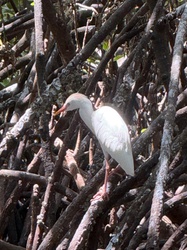
A stocky, compact white heron with a relatively short, thick neck and a straight yellow bill. Often seen actively following livestock or large herbivores to catch flushed insects.
Explore Western Cattle Egret in the encyclopedia →Identify your own birds.
Get a report just like this from any photo or call, free.
Plumage & appearance
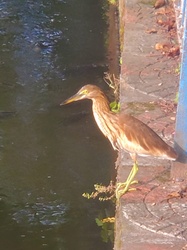
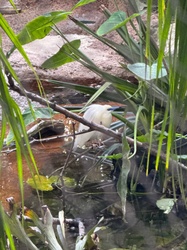
Non-breeding adults and juveniles are entirely white with a yellow bill and yellowish-grey legs. During the breeding season, adults develop striking golden-buff or orange plumes on the head, breast, and back, and their bills, legs, and irises can temporarily brighten to a reddish-orange hue.
Key field marks
Short yellow bill, stocky white body, shorter neck than most other egrets, and dark legs (which can appear greenish-yellow). Breeding adults show buff-orange patches on the head, chest, and back.
Size & weight
Length: 45-56 cm (18-22 in), Wingspan: 88-96 cm (35-38 in), Weight: 270-512 g (9.5-18 oz)
Voice — call & song
Generally quiet away from the breeding colony. At colonies, they produce a variety of hoarse, croaking, or raspy calls, including a low-pitched 'rick-rack' sound.
Diet & foraging
Primarily feeds on insects (especially grasshoppers, crickets, flies, and beetles), spiders, frogs, and lizards. Unlike most other herons, its diet is less dependent on aquatic prey and heavily tied to terrestrial invertebrates.
Habitat
Prefers open country, pastures, agricultural fields, wetlands, and grasslands, frequently foraging in close proximity to large grazing mammals.
Migration & movement
Partial migrant. Populations in northern ranges migrate south for the winter, while tropical and subtropical populations are largely resident. They are also known for strong dispersive tendencies, often flying hundreds of miles off course.
Nesting & breeding
Colonial nesters, often breeding alongside other waterbirds like ibises, cormorants, and other herons in trees, bushes, or reed beds. Builds a flimsy platform of sticks. Clutch size typically ranges from 2 to 5 pale blue-white eggs.
Similar species
Little Egret and Snowy Egret, both of which are slighter, have entirely black legs and feet (and yellow feet in Snowy), longer slender necks, and black bills, and typically forage in water rather than dry fields.
Ecological significance
Acts as a biological control agent by consuming large quantities of agricultural pests, ticks, and flies associated with livestock, helping to reduce parasite loads on domestic and wild animals.
Conservation status
Least Concern, with a stable or increasing global population due to its adaptability and association with agricultural development.
Observation tips
Look in pastures, agricultural fields, and grasslands, particularly near grazing cattle, horses, or tractors turning up soil. They are generally tolerant of human presence.
Interesting facts
The cattle egret is a phenomenal natural colonizer; it crossed the Atlantic Ocean unassisted from Africa to South America in the late 19th century and has since colonized almost the entire Western Hemisphere.
More like this