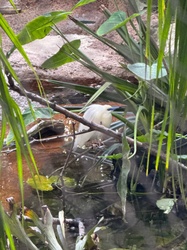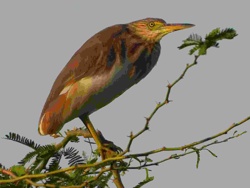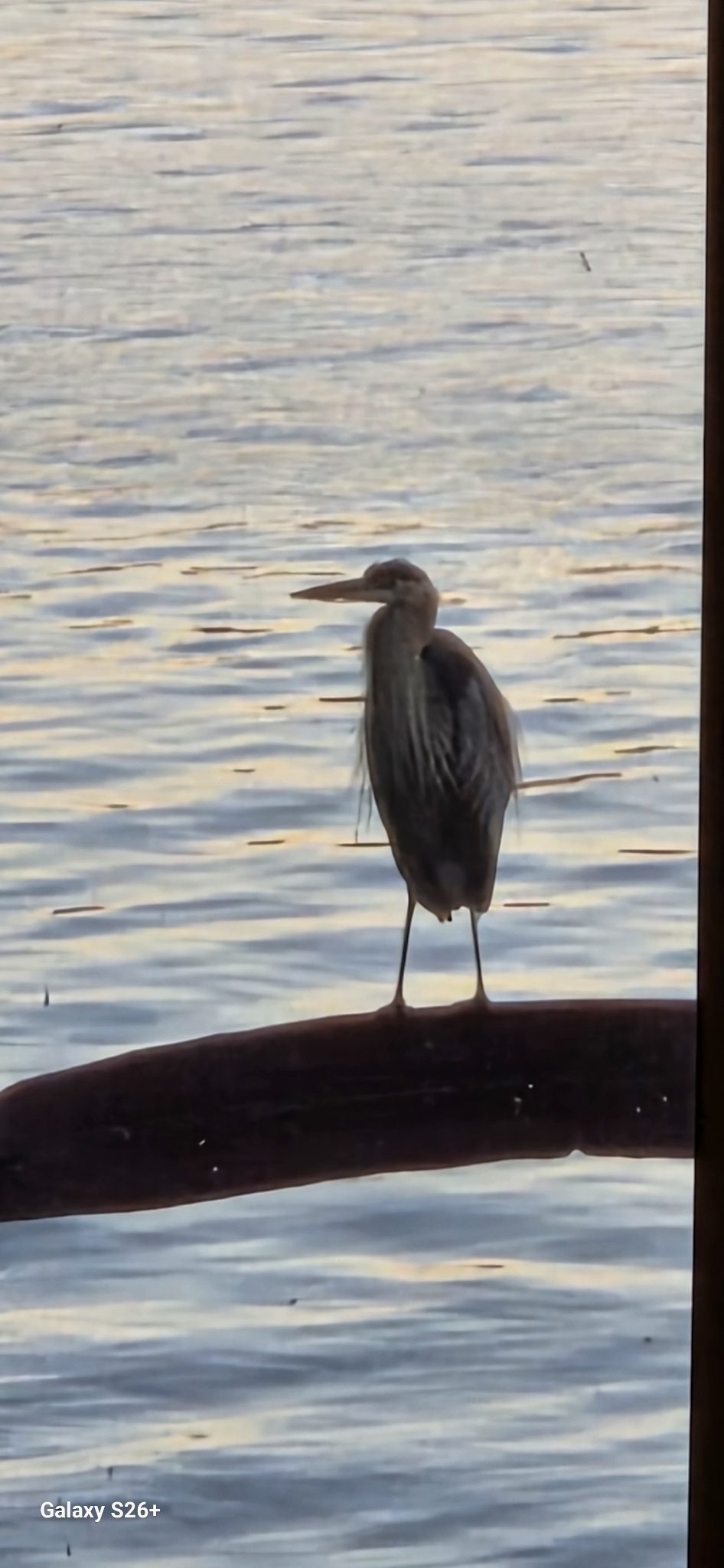
Order: Pelecaniformes, Family: Ardeidae
Great Blue Heron
Ardea herodias
A very large, long-legged, long-necked wading bird with a dagger-like yellowish bill and slow, majestic flight with its neck folded in an S-shape.
Explore Great Blue Heron in the encyclopedia →Identify your own birds.
Get a report just like this from any photo or call, free.
Plumage & appearance
Overall bluish-gray plumage with a slate-blue back, chestnut-brown thighs, and a white face with a black stripe extending from the eye to the back of the head. Adults feature long, delicate plumes on the lower neck and back during breeding season. Juveniles are duller and lack the distinct head plumes.
Key field marks
Large overall size, bluish-gray body, black plumes on the head, yellowish bill, and the characteristic S-curved neck in flight.
Size & weight
Length: 91–137 cm (36–54 in), Wingspan: 167–201 cm (66–79 in), Weight: 2.1–3.6 kg (4.6–7.9 lbs)
Voice — call & song
A harsh, deep, throaty croak or squawk, often described as a loud 'fraoh' given when startled or in flight.
Diet & foraging
Primarily fish, but also eats frogs, salamanders, snakes, rodents, insects, and small birds, hunting by patiently waiting or slowly stalking prey before striking with its sharp bill.
Habitat
Freshwater and saltwater wetlands, marshes, mangrove swamps, riverbanks, and lake edges.
Migration & movement
Partial migrant. Populations in northern and inland areas typically migrate south for winter, while coastal and southern populations are year-round residents.
Nesting & breeding
Builds bulky stick nests high up in trees in colonies called heronries. Females lay 3 to 5 pale blue-green eggs, and both parents share incubation and feeding duties.
Similar species
Sandhill Crane and Great Egret. Cranes fly with their necks outstretched rather than folded, and Egrets are entirely white.
Ecological significance
Acts as an apex predator in aquatic food webs, helping to control fish, amphibian, and small mammal populations while indicating the health of wetland ecosystems.
Conservation status
Least Concern, with stable to increasing populations across most of its range.
Observation tips
Look near the edges of lakes, rivers, marshes, and coastal marine areas during early morning or late afternoon. Approach slowly and use binoculars to avoid flushing them.
Interesting facts
Great Blue Herons can swallow surprisingly large fish whole, occasionally choking if the prey is too big. They fly at speeds of up to 30 to 35 miles per hour.
More like this