Order: Anseriformes, Family: Anatidae
Brant
Branta bernicla
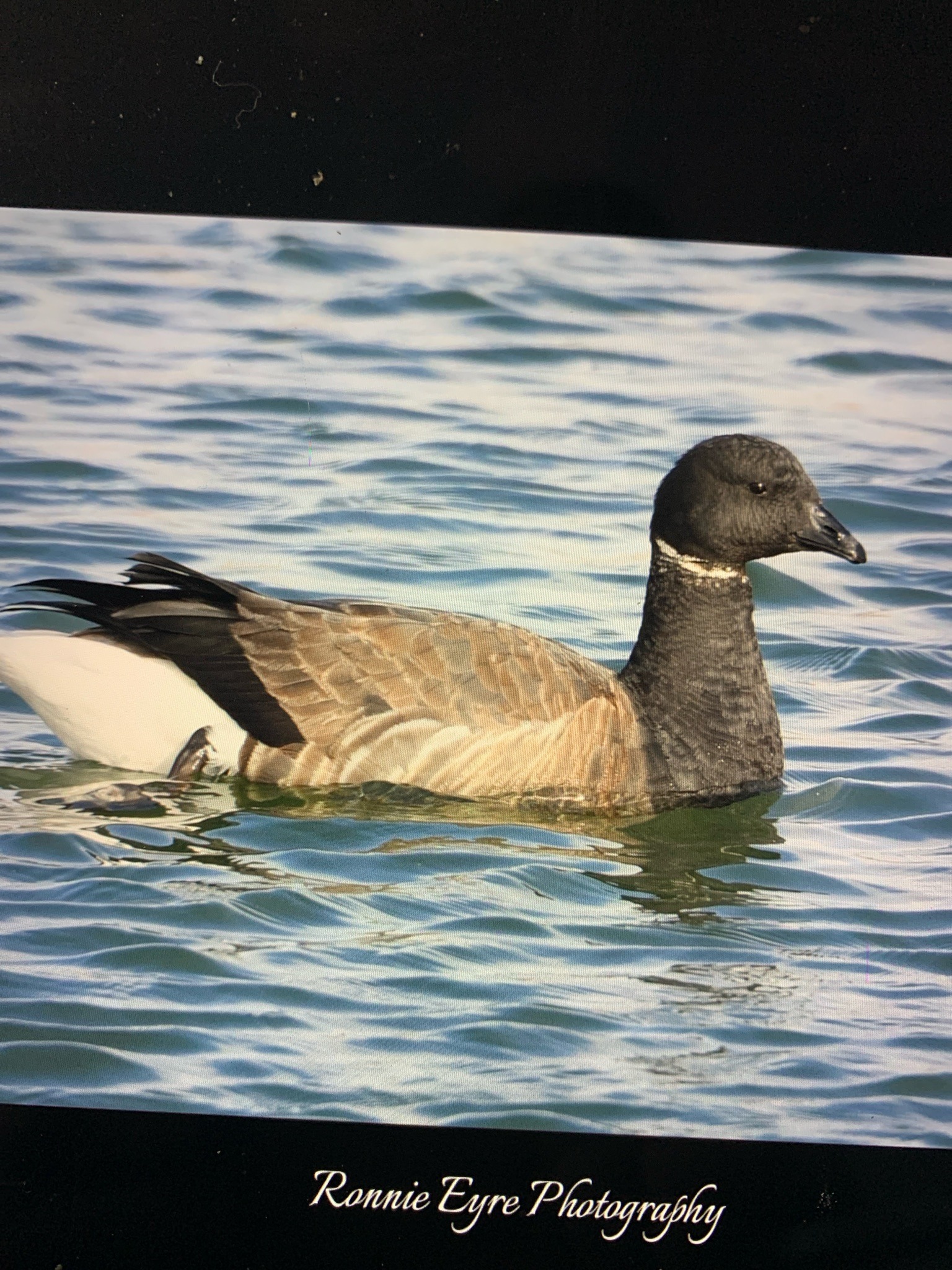
A small, dark goose with a short neck and stubby black bill, highly social and mostly found near salt water.
Explore Brant in the encyclopedia →Identify your own birds.
Get a report just like this from any photo or call, free.
Plumage & appearance
Dark brownish-black head, neck, and chest with a distinctive small white neck patch (collars vary by subspecies). Upperparts are brownish-grey, underparts vary from pale grey to dark slate-grey depending on the subspecies, contrasting sharply with a bright white undertail and rump.
Key field marks
Small size, completely dark head and neck, contrasting white neck collar (incomplete in some races), dark brownish body, and bright white undertail coverts.
Size & weight
Length: 55-66 cm (22-26 inches), Wingspan: 106-121 cm (42-48 inches), Weight: 1.1-2.2 kg (2.4-4.8 lbs).
Voice — call & song
A low, throaty, grunting or barking 'cronk' or 'rraah', often given in flight or when disturbed.
Diet & foraging
Primarily vegetarian, feeding on eelgrass, sea lettuce, algae, and sometimes grazing on salt marsh grasses and agricultural fields.
Habitat
Coastal bays, estuaries, salt marshes, mudflats, and tundra during the breeding season.
Migration & movement
Strongly migratory, traveling in large flocks along coastal flyways from Arctic breeding grounds to temperate wintering areas.
Nesting & breeding
Nests on the Arctic tundra near water, making a shallow depression lined with plant material and down. Lays 3 to 5 creamy-white eggs.
Similar species
Cackling Goose and Canada Goose, but Brant are significantly smaller, much darker overall, and lack the prominent white cheek patches.
Ecological significance
Brant heavily utilize eelgrass beds in marine environments, playing a key role in coastal ecosystems and nutrient cycling, though intense grazing can impact local aquatic vegetation.
Conservation status
Least Concern, with stable or increasing population trends globally.
Observation tips
Look for them in large flocks along sheltered marine bays, estuaries, and mudflats during low tide when they feed on exposed eelgrass and marine algae.
Interesting facts
Brant have an incredible reliance on eelgrass; historical declines in eelgrass populations due to disease caused massive crashes in Brant populations in the 1930s.
More like this