Order: Passeriformes, Family: Passerellidae
Seaside Sparrow
Ammospiza maritima
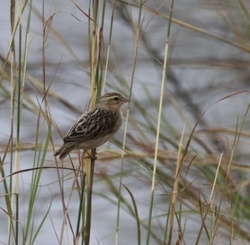
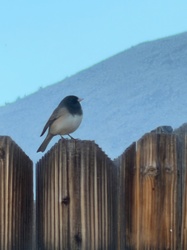
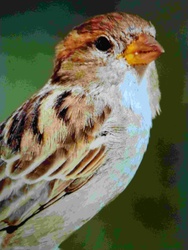
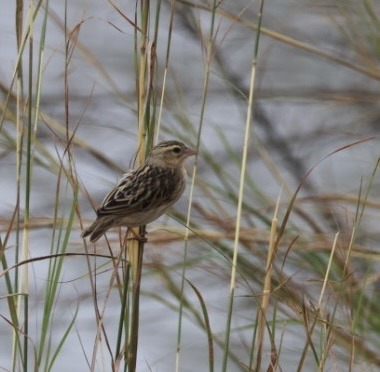
A medium-sized, dark, secretive sparrow of saltmarshes with a relatively long bill, short tail, and distinct facial markings. It spends most of its time hidden deep within dense grasses.
Explore Seaside Sparrow in the encyclopedia →Identify your own birds.
Get a report just like this from any photo or call, free.
Plumage & appearance
Dark grayish-brown upperparts with subtle streaking, gray underparts with faint breast streaks, a yellowish-buff supraloral spot in front of the eye, and a whitish throat bordered by dark malar stripes. Sexes are similar in appearance.
Key field marks
Dark overall appearance, gray underparts, yellowish spot in front of the eye, white throat, and a stout, pointed bill suited for marsh life.
Size & weight
Length: 12-15 cm (4.7-5.9 in), Wingspan: 18-21 cm (7.1-8.3 in), Weight: 18-30 g (0.6-1.1 oz)
Voice — call & song
A harsh, buzzed, introductory note followed by a rapid, wheezing trill that resembles the sound of a mechanical insect or a red-winged blackbird.
Diet & foraging
Insects, spiders, marine invertebrates, and seeds of saltmarsh plants. Forages on the mud or among vegetation.
Habitat
Saltmarshes, brackish tidal marshes, and occasionally grassy coastal flats.
Migration & movement
Mainly resident; northern populations make short-distance migrations south along the coast.
Nesting & breeding
Builds an open cup nest woven from grasses, attached to vertical stems of cordgrass just above the high tide line. Clutch size is typically 3 to 4 eggs, with breeding occurring in spring and summer.
Similar species
Saltmarsh Sparrow, which has a brighter orange face and sharper crown stripes. Nelson's Sparrow is also similar but features a brighter buffy-orange breast band.
Ecological significance
Acts as an important indicator species for the health of saltmarsh ecosystems and helps control insect and small invertebrate populations.
Conservation status
Near Threatened (IUCN) due to habitat loss, sea-level rise, and coastal development. The dusky seaside sparrow subspecies is famously extinct.
Observation tips
Look for them perched on tall marsh grass stems during high tides when they are forced out of the lower vegetation. Listening for their distinctive buzzing song is often the easiest way to locate them.
Interesting facts
The Seaside Sparrow is uniquely adapted to tidal marshes and can tolerate drinking brackish water when fresh water is scarce.
More like this