Order: Passeriformes, Family: Passerellidae
Spotted Towhee
Pipilo maculatus
A large, sparrow-like bird with high-contrast plumage, often found scratching noisily in leaf litter on the ground.
Explore Spotted Towhee in the encyclopedia →Identify your own birds.
Get a report just like this from any photo or call, free.
Plumage & appearance
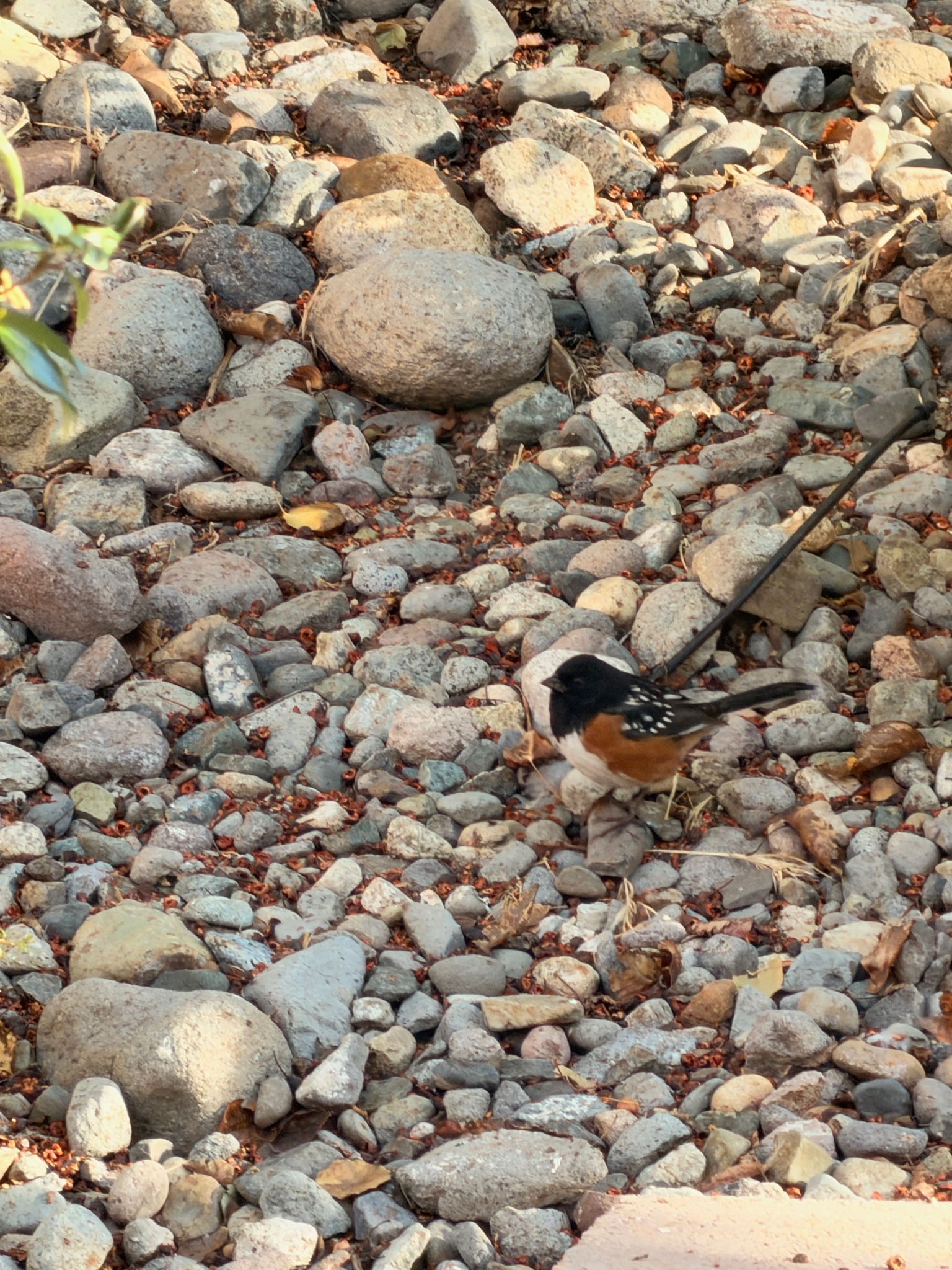
Adults have a striking black head, throat, and upperparts (dark brown in females), with bold white spots on the back and wings. The flanks are a rich rufous-chestnut, the belly is white, and the eyes are bright red.
Key field marks
Black head and upperparts with distinct white spots on the back and wings, bright rufous flanks, white belly, and glaring red eyes.
Size & weight
Length: 17-21 cm (6.7-8.3 in), Wingspan: 28-31 cm (11-12 in), Weight: 33-53 g (1.2-1.9 oz)
Voice — call & song
Call is a distinct, nasal "chwee" or "towhee" sound. Song is a rhythmic introduction followed by a trill, sounding like "drink-a-teee-ee-ee".
Diet & foraging
Omnivorous; feeds on seeds, fallen fruit, spiders, and various insects by scratching backwards in leaf litter with both feet simultaneously.
Habitat
Dense brush, chaparral, shrublands, forest edges, overgrown gardens, and wooded canyons.
Migration & movement
Permanent resident in most regions, but some northern and high-altitude populations are short-distance migrants.
Nesting & breeding
Builds a cup nest hidden on the ground or low in shrubs. Lays 2 to 6 creamy-white eggs speckled with reddish-brown. Incubation is done primarily by the female.
Similar species
Eastern Towhee, which lacks the white spots on the back and wings found on the Spotted Towhee. Where their ranges overlap in the Great Plains, they occasionally hybridize.
Ecological significance
Acts as an important seed disperser and helps control insect populations in shrubby understories.
Conservation status
Least Concern, with a stable population trend.
Observation tips
Listen for their characteristic scratching sounds in dense brush. Use binoculars to look under low-hanging bushes where they forage on the ground.
Interesting facts
Spotted Towhees hop backward simultaneously with both feet when scratching through leaf litter, a unique double-scratching technique to uncover hidden food.
More like this