Order: Passeriformes; Family: Passerellidae
Eastern Towhee
Pipilo erythrophthalmus
A large, bulky sparrow often found scratching through leaf litter. They are known for their secretive nature and distinctive 'drink-your-tea' song.
Explore Eastern Towhee in the encyclopedia →Identify your own birds.
Get a report just like this from any photo or call, free.
Plumage & appearance
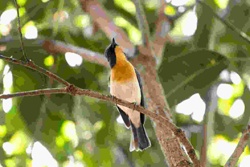
Males are striking with jet-black upperparts and hoods, rufous (reddish-brown) flanks, and a white belly. Females are similar but have warm brown where the male is black. Both have white patches on the wing corners and outer tail feathers.
Key field marks
Adults have bright red eyes (though some coastal populations have white eyes), dark upperparts, rufous sides, and white bellies.
Size & weight
Length: 6.7-9.1 in (17-23 cm); Wingspan: 7.9-11.8 in (20-30 cm); Weight: 1.1-1.8 oz (32-52 g).
Voice — call & song
The song is a musical 'drink-your-tea'. The call is a sharp, rising 'chewink' or 'towhee'.
Diet & foraging
Omnivorous; they eat seeds, fruits, insects, spiders, and occasionally small lizards or snakes. They forage by hopping and scratching the ground with both feet simultaneously.
Habitat
Shrug-lands, overgrown fields, forest edges, and thickets. They prefer dense undergrowth.
Migration & movement
Partial migrant. Northern populations move to the southern US for winter, while southern populations are permanent residents.
Nesting & breeding
Nests are usually built on or near the ground in dense vegetation. They lay 2-6 eggs that are creamy white with reddish spots. Females do most of the incubation.
Similar species
Spotted Towhee (identified by white spots on back/wings), Spotted and Eastern were once considered the same species ($Rufous-sided Towhee$).
Ecological significance
They act as seed dispersers and help control insect populations. They are also common hosts for the parasitic Brown-headed Cowbird.
Conservation status
Least Concern (IUCN), though populations have seen a gradual decline due to habitat loss.
Observation tips
Look for them on the ground in brushy areas or at the edges of forests. Listen for their scratching in dead leaves which often sounds louder than expected for a bird of their size.
Interesting facts
The name 'Towhee' is an onomatopoeic representation of its common call note. They are famous for their 'double-scratch' foraging move, jumping backward and forward to uncover seeds.
More like this