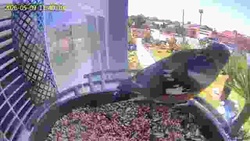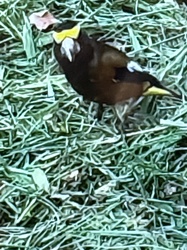
Order: Passeriformes, Family: Passerellidae
Dark-eyed Junco
Junco hyemalis
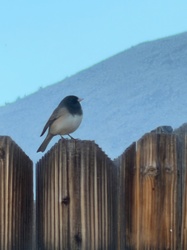
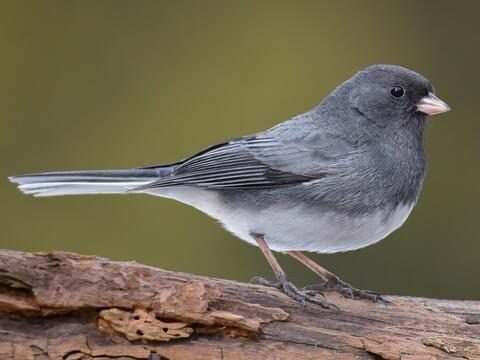
A small, neat sparrow with a rounded head, pink bill, dark hood contrasting with a white belly, and distinct white outer tail feathers that flash during flight.
Explore Dark-eyed Junco in the encyclopedia →Identify your own birds.
Get a report just like this from any photo or call, free.
Plumage & appearance
Varies by subspecies group. The 'Slate-colored' form shown features a dark gray hood, back, and upper breast contrasting sharply with a white belly. Females tend to be slightly paler with brownish tinges. Juveniles are streaked.
Key field marks
Dark gray hood, starkly contrasting white belly, pinkish bill, and conspicuous white outer tail feathers.
Size & weight
Length: 13-17 cm (5.1-6.7 in), Wingspan: 18-25 cm (7.1-9.8 in), Weight: 18-30 g (0.6-1.1 oz)
Voice — call & song
A high-pitched, musical trill or chatter that sounds similar to a canary or chipping sparrow; calls include sharp metallic ticks.
Diet & foraging
Primarily seeds of grasses, weeds, and fallen grain during fall and winter; heavily shifts to insects and spiders during the summer breeding season.
Habitat
Coniferous and mixed forests during breeding season; open woodlands, brushy areas, fields, parks, and suburban gardens in winter.
Migration & movement
Partial migrant. Northern and high-elevation populations migrate south or to lower elevations for the winter.
Nesting & breeding
Builds a cup nest on the ground hidden under logs, rocks, or tufts of grass. Lays 3 to 6 pale bluish-white eggs speckled with brown. Incubated by the female for about 12-13 days.
Similar species
Townsend's Solitaire (lacks pink bill and white outer tail feathers) and various other sparrows, but the dark hood and white belly combination is unique.
Ecological significance
Acts as an important seed disperser and helps control insect populations during the breeding season.
Conservation status
Least Concern, with a stable and very large population trend.
Observation tips
Often found hopping on the ground underneath backyard bird feeders. Look for their characteristic two-footed scratch in the leaf litter.
Interesting facts
Dark-eyed Juncos are sometimes called 'snowbirds' because they frequently appear in populated areas just as winter snows begin to fall.
User notes
ground feeding
More like this